A Developed Country Is One in Which Rich People Use Public Transport
Source: DARIO HIDALGO and MADHAV PAI for The New York Times
 Photo: Prakash Singh/Agence France-Presse — Getty Images
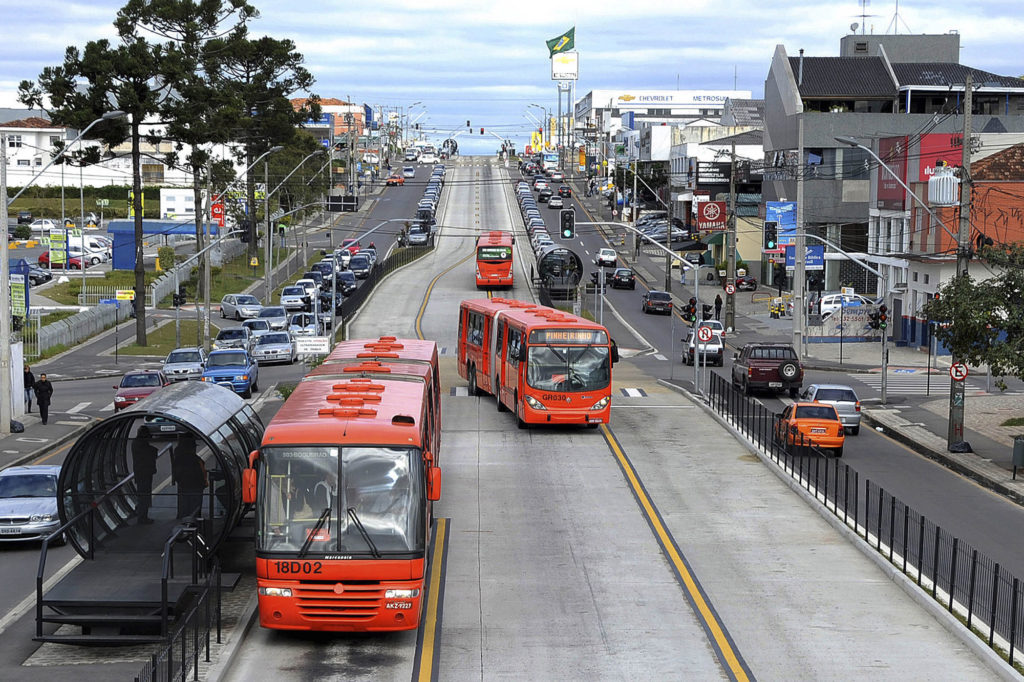
In a landmark ruling that overturns conventional traffic engineering approaches, the Delhi High Court on October 2012 advanced the idea that transportation facilities are for moving people, not cars, and should favor all users, not just the minority fortunate enough to use private cars. In addition, it advocated introducing measures that move people out of cars and into public transportation.
The ruling dismissed a petition demanding that the bus corridor from the Moolchand intersection to Ambedkar Nagar in New Delhi be scrapped to create more traffic lanes for private vehicles. The petition, filed earlier this year by Nyaya Bhoomi, claimed that the bus corridor was aimed at harassing commuters and was a waste of public money. It said it resulted in increased travel time for car users and longer idling time due to traffic jams, resulting in wastage of fuel.
The case received extensive media coverage and was widely debated, with several arguments for and against the bus corridor presented. Interestingly, the issue also sparked commentary on the inherent class divisions in Indian society, where the rich minority seems to possess a sense of entitlement over a majority of the public resources.
In 2009, an assessment of the corridor by Embarq, which was used by the defense counsel in the court hearings, revealed that commuters using the corridor as part of their journey benefited from it, and that the delays in general traffic were offset by the reduced travel time for bus commuters.
However, transportation experts agreed that the corridor left a lot to be desired. The assessment also indicated that the 5.6-kilometer corridor was not a full Bus Rapid Transit (B.R.T.) system, as it lacked most of the critical features of such systems. It also recommended improvements in many areas, particularly the introduction of performance indicators and monitoring systems. The report suggested measures to enhance operations, communications and branding, and also recommended that the corridor be extended to Delhi Gate, as originally planned. However, these recommendations were not implemented.
Another assessment, as a result of a court order, compared the bus corridor with other corridors, and found that the corridors without central bus priority lanes fared better in terms of traffic movement. The court, however, dismissed that report, stating that the comparison was faulty, as the traffic volumes and passengers on the corridors chosen for the study were unequal. It was a traditional traffic engineering study about vehicle movement, rather than people transported.
Without disregarding the flaws of the bus corridor and the changes that could be made to improve the flow of traffic at critical intersections, the judges, Pradeep Nandrajog and Manmohan Singh, dismissed the petition to let all traffic use the exclusive bus lanes.
They reasoned that since a bus could transport up to 200 persons in the course of one journey, as opposed to a car, which would transport 3 or 4 persons, it was not irrational to assign dedicated road space for buses. In fact, what does appear irrational is that when more than 50 percent of road users travel by bus, 98 percent of Jawaharlal Nehru National Urban Renewal Mission grants from the Ministry of Urban Development have been spent on the expansion of roads, construction of flyovers and parking projects, in which the primary targeted beneficiaries are cars. A mere 2 percent has been spent on other transportation projects.
The Delhi High Court also recognized that the larger problem of traffic congestion was because of the growing number of vehicles in the city – currently over seven million. It would be unfeasible to further augment the city’s already extensive road network, which accounts for 21 percent of its geographical area and includes 46 flyovers, to accommodate this alarming increase in the number of private vehicles, the judgment said. The only sustainable solution would be to improve Delhi’s integrated public transportation system to include high-capacity mass transit options, like B.R.T. These improvements would urge a shift in the “mode shares” or the percentage of people traveling by public and private transportation.
This ruling comes at a critical point in the evolution of B.R.T.’s in India, when several cities are exploring the viability of B.R.T.’s to enhance their public transportation systems. As a result of this ruling, and with support from the newly formed Asia B.R.T.’s Association, which is an international network of Asian cities, transit authorities, operators, policy- and decision-makers, technical institutes and representatives of the public manufacturing and service industry, the path has been paved for additional B.R.T. projects around the country to be planned and implemented. While bus priority is good, a B.R.T. is much more than buses and bus lanes. A systematic approach has made the B.R.T. successful in many cities around the world.
Dario Hidalgo and Madhav Pai are directors at Embarq, the urban transportation program of the World Resources Institute. Embarq is headquartered in Washington and works in India, China, Brazil, the Andes, Mexico and Turkey. Dario Hidalgo is also member of our BRT Centre of Excellence
¿Comments? ¿Opinions? ¿Similar News? Send them to us!
Tweet
Aggregate price-demand elasticities estimation for a fare-integrated public transport system
An integrated real time transit signal priority control for high frecuency transit services
How much can holding and/or limiting boarding improve transit performance?
Bus bunching affects transit operations by increasing passenger waiting times and its variability. This work proposes a new mathematical programming model to control vehicles operating on a transit corridor minimizing total delays. The model can handle a heterogeneous fleet of vehicles with different capacities without using binary variables, which make solution times compatible with real-time […]
Bus Rapid Transit Is Coming to Philly
Source: Next American City
 Photo: Sean Marshall on Flickr
Bus rapid transit (BRT) routes are cropping up across the U.S., and it looks like Philly-area commuters will get a taste of one such streamlined system in the near future, reports the Philadelphia Inquirer.
The Obama administration announced on July that New Jersey Transit is set to receive $2.6 million to go toward a planned BRT route that will connect South Jersey and Philadelphia along the traffic-heavy Routes 55, 42 and Interstate 676.
As is typical of BRT systems, the new line would allow rush-hour buses to travel in bus-only lanes — specifically, highway shoulder lanes and medians — for part of the trip to Philadelphia, with the aim of reducing traffic and easing commutes. The project, expected to cost $46 million total, would also create 1,800 new commuter parking spaces in Winslow and Deptford Townships, N.J.
The plans sound promising, but there’s a lot of work ahead. The system’s budget calls for new buses, modified traffic signals and the construction of shelters along the 23-mile route, outfitted with ticket machines and GPS-supported information about bus arrival times. NJ Transit officials estimate that the bus service won’t be in full operation until 2020, with construction beginning in about two years. However, expectations for the BRT route remain high as officials project that 6,400 riders will use the service by 2035.
Though activists in Pittsburgh have launched a campaign to improve the not quite up to industry-standard BRT system in their city, rapid-bus systems have largely remained absent from Pennsylvania. New Jersey saw its first BRT system when Newark’s Go Bus was unveiled in 2009, serving the 4.8-mile corridor between Irvington Bus Terminal and Newark Penn Station.
The money for NJ Transit’s newest BRT project came from a larger $787 million budget that will fund 255 transit projects in 48 states, the District of Columbia and Puerto Rico. SEPTA, Philadelphia’s transit authority, also received $5 million in funding to upgrade the century-old 69th St. Terminal in Upper Darby, a township adjacent to West Philly, with improved lighting, waiting areas and pedestrian access.
With construction on a new, $1.5 billion light rail line as little as two years away, NJ Transit has a lot on its plate in the near future. If and when the work gets completed, however, commuters on both sides of the Delaware will have a host of transit options never before available to them.
¿Comments? ¿Opinions? ¿Similar News? Send them to us!
Tweet
Information processing in choice-based conjoint experiments: a process-tracing study
Purpose – This paper investigates how respondents to conjoint experiments process information and choose among product profiles, and how this varies with their knowledge about the product. Models for estimating conjoint attribute weights are almost exclusively based on principles of compensatory decision making. The paper aims to explore to what extent and in what way […]
Traffic Safety on Bus Corridors: Pilot Version – Road Test
The purpose of this guidebook is to provide bus agencies, local jurisdictions, as well as regional and international organizations with a set of suggested design, planning, and operational criteria that should be considered in the planning and design of new bus systems.
The information contained in these guidelines should by no means be used as standard details on which to base a final design, but rather as recommended criteria and general guidance which, in conjunction with engineering judgment and a thorough analysis of existing conditions on the corridors, should help develop final designs. Moreover, these are global guidelines representing general concepts and are not site or country specific, and they may not always be adapted to local design and signalization standards. The applicable local standards for signalization and markings should always be checked before applying the recommendations set forth in these guidelines.
Download full report.
Traffic safety in surface public transport systems
Understanding Road Safety Impact of High-Performance Bus Rapid Transit and Busway Design Features
The design choices made in the planning of a new bus rapid transit (BRT) or busway corridor (e.g., use of a center-lane or curbside configuration, counterflow lanes, and open or closed stations) affect not only the operational performance of the system but also the risks of crashes, injuries, and fatalities on the facility over its lifetime. With data from nine BRT systems and busways around the world (including Bogotá, Colombia; Curitiba, Brazil; Mexico City, Mexico; and Delhi, India), some of the road safety impacts of major BRT-busway corridor design characteristics are illustrated. The approach included a combination of crash frequency modeling, road safety inspections, and interviews with transit agency staff and safety experts. Center-lane systems tended generally to be safer than were curbside systems, and counterflow lanes were the most dangerous possible configuration. Some of the features that provide higher passenger capacity (such as multiple bus lanes and multiple docking bays at stations) may introduce new types of conflicts and crashes. In the planning of any bus system, trade-offs often need to be made between capacity, safety, and pedestrian accessibility along the corridor. This study provides the necessary elements for successfully integrating road safety considerations into the design and operation of future BRT systems and busways.
Opinion Pieces: Contract and Markets – mature or otherwise
[caption id="attachment_1448" align="alignleft" width="295"] Professor David Hensher.[/caption]
Opinion Pieces: since 2007, Prof. David Hensher has written an opinion column in the Australasian Bus and Coach magazine, where he monthly discusses a lot of different transport-related hot topics. In this section we are revisiting these columns.
October 2011
The 12th International Conference on Competition and Ownership of Land Passenger Transport (known as the Thredbo Series) has just concluded in Durban, South Africa. As Co-founder of the series, I am delighted with the success of the series and the impact that it has globally on the reform process in many countries, including Australia. Learning about the ongoing challenges facing reforms in South Africa helps to put in perspective the Australian challenges, which almost pale into significance. Put simply, countries with mature markets (like Australia) wrestle with the abundance of rich talent in the sector; in contrast South Africa typifies a situation best described as immature and evolving. Despite this circumstance, South Africa has a very large informal min-bus (or para transit) sector that offers a very high level of service in terms of frequency and connectivity, but it is accompanied by high levels of risk of exposure to accidents and corruption. Although the recapitalisation program is well advanced in replacing old mini-buses (which South Africa calls taxis) with new 16 seater Toyota vans, greatly improving the quality and safety of the vehicles, there still remains the ‘cowboy’ mentality of many drivers who lack the commitment to obeying the rules of the road (including illegal overcrowding the their 16 seater vehicles which commonly carry 23 plus persons). The challenge in reforming this very large sector with high service levels is to remove the illegal practices and safety concerns while preserving such high levels of service. Many would argue that it will be a sad day if this is resolved by removing the sector entirely and replacing it with a very Western conventional timetabled bus service. For sure this will deliver a lower level of service even if it is fully compliant.
In both mature and evolving market settings there remains great interest in the design of bus contracts. With over 26 countries present at Thredbo 12, an intense high level debate identified the key risks to the success of a contract, given global experiences. The risks in order of relative importance are:
- Unclear description of government objectives and outcomes
- Poor quality in tender/negotiation assessment
- Allocation of risks and responsibilities
- Ensuring financial viability
- Dispute management and resolution arrangements
- Specifying the services to be provided
- Understanding of the best technical content
- Changes over time in government/government policy
- Specifying (key) performance indicators
- Distortions introduced during contract negotiations
- Collecting and acting on performance indicators
- Complexity in the scope of services
- Building and maintaining a positive partnership
- Tendering /Negotiation process
What is particularly gratifying is the overall view from the conference that we must continue to ensure that the process of contract negotiation is open, clear and achieves buy-in from all sides; that it recognise contracts are at the tactical level, but need to be constructed within a clear strategic framework; that it ensures a clear alignment between Strategic, Tactical and Operational (STO) aspects; and that we continue to learn from the past and others’ experience, and undertake self evaluation. Linked to achieving these outcomes is a performance management regime defined on a set of key performance indicators (KPIs) that must be in the contract but with benchmarked levels included in an accompanying schedule; and these KPIs must be part of an appropriate structure to manage performance regime by the regulator and not just for compliance, but also to assist operators. It was made clear that “Performance is not the same as compliance”. The 8 KPIs developed by Hensher-Arbuckle for NSW received complete support as a sensible and appropriate way ahead in order to track cost efficiency, network effectiveness and customer satisfaction in particular. It was also reinforced that social exclusion has to be explicit within public transport service contracts with operators.
Food for thought
¿Comments? ¿Opinions? ¿Similar News? Send them to us!
Postdoctoral Research Position
The Department of Transport Engineering and Logistics at the Pontificia Universidad Católica de Chile, host of the BRT Centre of Excellence, is currently looking for one postdoctorate or experienced researchers to work in our Research group. We have a number of ongoing projects in different Public Transportation issues in which the successful applicant could participate leading some projects and collaborating with other researchers at the BRT Centre in others. Individuals with research interests in any domain regarding public transportation, ranging from the most strategic to the most operational aspects are especially encouraged to apply (i.e. planning, urban studies, design, financing, economics, demand modeling, operations and control).
Job Description: We are seeking applicants with a PhD or industry experience in an area related to Public Transport. Candidates need not be fluent in Spanish at the moment of applying; we welcome applications from within and outside Chile. They must exhibit excellent oral and written communication skills and an aptitude for teamwork. It is advantageous to have earned a Ph.D. in a Public Transport related field, with a demonstrated research potential. While industrial experience is desirable, a strong commitment to rigorous and relevant research is essential. We offer the attractive opportunity of a job working in the field of Public Transport while collaborating with a University.
Requirements: Applicants must hold a Ph.D. in related discipline or be about to complete it. It is important that the applicant be able to work collaboratively, and international experience is desirable. Review of applications starts immediately and the positions will remain open until a successful candidate has been found.
Information and application: To apply, interested applicants should forward their CV including a publication list, contact details of three reference writers and a one page description of their experience and research interests related to this position. Please send application information and/or request more information by sending an e-mail to Prof. Juan Carlos Muñoz (jcm@ing.puc.cl).
Tweet
New tool visualizes American BRT
Source: The City Fix
Duke University’s Center on Globalization, Governance & Competitiveness (CGGC) released a new report, “U.S. Bus Rapid Transit: 10 high-quality features and the value chain of firms that provide them”, a collection of best practices and metrics for bus rapid transit (BRT) in the United States.
Three web tools are attached to the CGGC report, including a detailed BRT station mock-up with the 10 essential features of high-value BRT. In addition to the mock-up, the report has created two – web databases, detailing the transit providers currently running American BRT systems, as well as the complete value chain, from bus manufacturers to transportation planners, for American BRT.
Marcy Lowe, lead contributor of the CGGC report, said, “We hope our interactive online tool–highlighting the 10 high-quality BRT features–will help agencies consider the best package of BRT features for their community. The more of these features they can incorporate, the better their BRT system will be.”
The report stresses these guidelines:
- Safe, Comfortable Platform Level Boarding
- Consistent Branding
- Real Time Information
- Clearly Recognizable, Efficient Vehicles
- Intelligent Transportation Systems with Vehicle Tracking
- Integration Into The Existing Transport Network
- Standardized Fare Collection Off Vehicle
- Shared BRT System Infrastructure on a Dedicated Right of Way
- Innovative Financing Mechanisms for service sustainability
As BRT systems continue to form across the globe, with more than 20 systems commencing operations in the past two years alone, the rate of BRT growth in the U.S. is slower than global trends. One reason for this slow adoption stateside, according to Lowe, is the funding challenges for public transit, generally.
“Funding and financing is one of the biggest challenges for communities looking to expand public transit,” she said. “That’s why more communities are seriously considering BRT as an alternative to light rail and other major transit projects.”
Indeed, a U.S. Department of Transportation report found that there is a $77.7 billion backlog in transit funding to simply get the current nationwide transit system into a state of good repair, and this number does not reflect costs for new transit projects. The CGGC report recommends one such alternative finance tool: the formation of public-private partnerships (PPP) in both hiring bus operators through private contract and by creating innovative ways to fund BRT systems.
There are already many examples of PPPs in American road construction projects. PPP financing for transit is not without precedent in the U.S. For example, heavy rail systems in Chicago and New York have earned funding through selling station naming rights as part of advertising revenue. Though these novel PPP fundraising sources lack comprehensive funding opportunities for a sustainable financial support system, Lowe notes that they can help “spread costs” and pay for operating expenses.
However complex American BRT financing may appear, BRT as a transportation alternative has a firm backing in research and past precedent. EMBARQ’s Carrigan notes, “By identifying 10 features of high-quality bus rapid transit systems, Duke’s visualization tool emphasizes that BRT is more than just dedicated bus lanes; it’s an integrated transport system.” That is something that all American transit agencies can find useful.
¿Comments? ¿Opinions? ¿Similar News? Send them to us!
Tweet
Ellenbrook BRT concept design under way
Source: Government of Western Australia
Design work has started on the Bus Rapid Transit (BRT) system between Ellenbrook and Bassendean train station.
Transport Minister Troy Buswell said AECOM had been awarded the $630,000 tender to develop the 15 per cent concept designs for the BRT system.
“The BRT system will provide improved journey times, enhanced bus stops/stations and strategically-located park and ride facilities. By 2031, it will serve an estimated 6,500 daily users,” Mr Buswell said.
“The BRT design will include planning for stations, integration with existing and planned land use and transport networks, park and ride facilities and bus priority treatment.
“This work will help to identify any key construction issues and any impacts the BRT may have on the broader transport network.”
The Minister said that development of the concept designs would include consultation with key stakeholders, including the Public Transport Authority, Main Roads, Department of Planning and local government.
The concept design work is expected to be completed by March 2013.
¿Comments? ¿Opinions? ¿Similar News? Send them to us!
Tweet
Bus Rapid Transit Gaining Traction Despite Concerns
Source: Governing
Photos: Ken Blaze
Localities from San Francisco to Jacksonville, Fla., are embracing bus rapid transit — even if not everyone in the transportation community is sold on the idea.
 Nashville officials are pursuing a transit line they say will be integral to the future of the region as the population grows. The 8-mile route, dubbed the East-West Connector, would link hospitals, the city’s football stadium, its state Capitol and Vanderbilt University, among other destinations. Regional officials say that, if executed properly, the connector could be online as soon as 2015 and will serve more than 1.3 million riders annually. “Something like this has never been attempted in Nashville,” says Mayor Karl Dean.
That something isn’t a subway, light rail or even a streetcar. It’s a bus. And its impact on Nashville could be huge. “People who work downtown will be able to get downtown faster and cheaper,” Dean says. “That’s the appeal.” The East-West Connector isn’t a traditional bus line either. Rather, it’s bus rapid transit, or BRT. It focuses on taking bus service — historically unattractive and slow — and making it something riders want to use, as opposed to its current status as a mode of last resort.
Until now, just a handful of U.S. transit agencies have embraced BRT. That’s changing. Longtime transit leaders like Chicago, New York City and San Francisco are planning new BRT services, while less transit-focused places like Hartford, Conn.; Jacksonville, Fla.; and Montgomery County, Md., are pursuing it as well. Dean — who’s visited several of the country’s leading BRT systems — says it’s no surprise that the mode is becoming increasingly prevalent. At a time when localities are struggling financially, it’s a cost-effective option. In Nashville, officials say they can build the East-West Connector for $136 million — half the cost of a similar streetcar system — and serve almost as many riders. “This is a popular form of transit for cities that do not have sophisticated transit systems right now,” says Dean. “Nashville has a good bus system, but it needs to expand. BRT is an attractive way of doing it.”
The idea for BRT is rooted in making two fundamental shifts in the way buses run. The first goal is to do everything possible to speed up rides, which is crucial to attracting new customers. As part of that effort, BRT buses generally run more frequently during peak travel times. Stops are spaced farther apart to ensure that buses don’t pause too often for pickups and drop-offs. High-tech devices on traffic lights can detect buses and give them a little extra time to make a green light. Tickets are purchased at bus stops instead of on the bus to avoid delays as passengers fumble for change. Dedicated lanes are created to make sure buses don’t get trapped in congestion. And some systems even have bus stops on elevated platforms so that time isn’t wasted waiting for passengers to climb up and down the bus steps.
The other goal is to make buses feel safe and inviting. The exteriors of BRT buses often feature cosmetic enhancements to make them appear more modern. Stops are designed to be aesthetically pleasing and convenient, complete with landscaping and bicycle racks. And electronic displays let riders know how soon the next vehicle is coming.
 Ground zero for BRT is Curitiba, Brazil, which first launched its BRT service in 1974 and has served as a model for practitioners worldwide. Subsequent systems have developed in China, India, Mexico and elsewhere. And while Los Angeles and Pittsburgh built the first precursors of American BRT in the ’70s, it wasn’t until recently that the systems caught on. Historically, the U.S. hasn’t embraced BRT because of residents’ attitudes toward transit. In South American cities that have strong BRT systems, “you have the majority of the population moving in buses,” says Dario Hidalgo, director for research and practice at EMBARQ, which studies and promotes sustainable transportation. That makes it easier for transportation officials to get buy-in from the public when it’s time to repurpose a lane.
Generally, the thinking among U.S. transit officials is that “choice riders” — those who don’t have to take transit but opt to because of its convenience — are willing to ride subways, light rail and streetcars, but not buses. Advocates of BRT argue that bus service itself isn’t the problem; it’s the way the service is implemented. Offer riders buses that are fast, clean and safe, they say, and passengers will embrace them. “If you build it right, people will come,” says Janette Sadik-Khan, New York City’s transportation commissioner. “People aren’t going to get on dirty buses that are slow.”
In the 1990s, the Federal Transit Administration began organizing international trips for American transit officials to see BRT systems abroad. At the same time, BRT started to make sense for American cities, as growing congestion coupled with fiscal realities meant not everyone could hope to build light rail, which can cost as much as three times the price of a comparable BRT system. In the early 2000s, L.A. and Pittsburgh redoubled their BRT efforts, while later in the decade, places like Eugene, Ore., and Cleveland launched their own highly touted BRT services that today are considered the top American systems. The successes of those projects helped inspire local officials across the country, who could finally point to examples of successful BRT in American cities instead of looking abroad as they tried to make the case for BRT. Today, virtually every major metro area is considering or actively planning some degree of rapid bus service. “There’s definitely an effort to equalize the playing field between bus and rail,” says Gabe Klein, transportation commissioner in Chicago, which will launch the first of three BRT lines this fall. “The bus doesn’t have to be second-class transportation.”
The recent explosion of BRT has prompted a debate within the transit community, which is asking what exactly BRT service is, and more important, does a definition even matter? Last year, the Institute for Transportation and Development Policy (ITDP), a nonprofit that provides technical assistance and advocates for BRT, released a scorecard rating BRT services. Systems got points for things like high-frequency buses, limited local stops, fare collection that occurred off-board and having physically separated lanes. While several international systems received high marks, not a single U.S. city was rated above “bronze,” and the group deemed that New York City’s highly publicized BRT service wasn’t really BRT at all. “We ruffled a lot of feathers,” says Annie Weinstock, ITDP’s U.S. BRT program director.
Transit officials generally take a big-tent approach to the BRT definition. They say every city is unique and that the same set of standards shouldn’t be applied universally. But many respected voices in the BRT community believe that some agencies are trying to take advantage of the cachet that comes with BRT and inaccurately apply the label to their own fleets in an effort to get buy-in from passengers and grants from the federal government. (BRT service is eligible for more types of funding than traditional bus service.) Protecting the BRT brand, Weinstock says, is key. If the public feels like it’s been misled, it may not support BRT in the future.
 It’s an important discussion to have right now, since so many cities are examining the service. While it’s clear that a train becomes a subway when it goes underground, what’s less clear is when a bus becomes BRT. Benjamin de la Peña, associate director for urban development at the Rockefeller Foundation, says that ambiguity could make it easy for some agencies to take ambitious BRT projects and morph them into traditional bus routes as a way to save money. “It’s really easy to water down,” de la Peña says. In a case of the debate coming full circle, officials in the Washington, D.C., suburb of Montgomery County have started to deliberately refer to their project as RTV, or rapid transit vehicle, because they believe BRT doesn’t describe the significance of their service.
Officials in local transit agencies almost universally say they don’t want to get bogged down in the debate about the BRT definition. What’s more important, they argue, are the ultimate payoffs: faster rides and greater ridership. If that happens, they say, the way the buses and service is configured isn’t so important. The Federal Transit Administration has chosen not to weigh in on the debate, offering guidance on BRT best practices but not mandates on which elements must be included.
In New York City, officials developed a system that has embraced some BRT tenets, like off-board fare collection, signal priority for buses at some intersections and greater distances between stops. But it doesn’t have bus lanes that are physically separated from normal traffic, which caused it to lose marks on ITDP’s scorecard.
Sadik-Khan, the transportation commissioner, isn’t too worried about that. The city has three BRT lines right now — the department describes them by its own term, Select Bus Service — and another three are in the works. Eventually the hope is to have 16 lines. While buses don’t travel in separated lanes, they drive in specially painted ones that cars are prohibited from using during peak hours. If they do, the buses snap a photo, and the drivers are ticketed. “It’s the system that works for New York,” Sadik-Khan says. “For New York, every single time we’ve put in a Select Bus Service route, we’ve seen an increase in ridership — amid a citywide decline in bus ridership.”
Still, there are BRT skeptics. In Berkeley, Calif., downtown businesses opposed a proposal that would have linked the city to Oakland because they feared the loss of parking spaces and left-turn lanes, making it more difficult for customers to access their stores. Those old battles between drivers and transit riders often play out as communities develop BRT, because to be truly effective, BRT sometimes requires taking a lane from cars for at least part of the route.
Some in the light-rail community view BRT as a threat that actually undermines transit.
 While streetcars and subways are permanent, BRT is more susceptible to changes. Dan Malouff, a transportation planner for the Arlington County, Va., transportation department, recently posted a piece on his influential blog that eviscerated BRT, saying cities generally pursue it in order to “cut a corner” by avoiding rail, making the service susceptible to failure. “[A]s long as U.S. planners think of BRT as a cheap replacement for rail, then the U.S. will be very unlikely to ever produce BRT that is actually rail-like … because that mindset inherently undervalues many of the specific features that are needed to produce a high-quality transit line, regardless of mode,” he wrote.
And BRT’s early stalwarts are showing signs of trouble. Earlier this year, the newspaper of Curitiba reported that from 2008 to 2011, the number of paid rides on its system fell by about 14 million, or 4.3 percent, and there were recent riots in Bogota, Colombia, by protesters frustrated with that city’s slipping BRT service.
Regardless, BRT is a path that transit agencies are likely to continue to pursue as they try to stretch dollars. Nearly 85 percent of transit agencies had flat or decreased capital funding in the wake of the recession, according to a survey released by the American Public Transportation Association last year. Transit agencies save money with BRT because of lower infrastructure costs — they don’t have to lay down track or dig underground — and there are lower personnel costs, since they can use the same types of drivers and mechanics that they use for existing buses.
Cleveland, for example, opened its 7-mile BRT in 2008 at a cost of $200 million. Light rail would have cost nearly $1 billion, says Joseph Calabrese, general manager of the Greater Cleveland Regional Transit Authority. “A few people said it should be light rail or nothing,” he says. “In that case, it would have been nothing.”
In greater Eugene, Ore., the BRT system got its 10 millionth rider just five years after its launch. Today, daily ridership on the system known as EmX is triple what it was for comparable local service lines, says Ron Kilcoyne, general manager of the system. “We never projected when we’d hit our 10 millionth rider, but certainly we weren’t expecting it to happen that quickly,” says Kilcoyne. EmX has two corridors now, but officials hope to eventually expand to five.
Kilcoyne says it’s crucial to understand that the goal isn’t to create more BRT systems; it’s to find a better way of moving people. “I think you really have to take a look at what the outcomes you’re trying to achieve are,” says Kilcoyne. “Because everything else — whether or not you build rail, or rely on buses, or a full-scale BRT — those are all means to the end. The end is speed, reliability and the ability to attract more customers.”
¿Comments? ¿Opinions? ¿Similar News? Send them to us!
Tweet
International Visit to Rio's First BRT Line
Source: EMBARQ
Photos: Mariana Gil / EMBARQ Brazil.
 With growing international interest in Rio de Janeiro’s bus rapid transit (BRT) system, journalists from around the world are seeking to understand how the system is being implemented. On June 18, reporters Valerie Valcovici (Reuters), Diana Kinch (The Wall Street Journal), and Cynthia Castro (Revista CNT Transporte Atual) visited Rio’s first BRT corridor, the Transoeste.
The journalists were accompanied by the municipal secretary and deputy secretaries of transportation, Alexander Samson and Carlos Maiolino. Representatives from EMBARQ included Director Holger Dalkmann, EMBARQ Chief Operating Officer Clayton Lane, EMBARQ Brazil Director and member of our CoE Luis Antonio Lindau, EMBARQ Brazil Strategic Relations and Development Director Rejane D. Fernandes, and World Resources Institute Media Relations Director Michael Oko. The visit was organized by WRI and EMBARQ Brazil, along with FETRANSPOR (Federated Passenger Transport Company of the State of Rio de Janeiro) and the Secretary of Transportation of Rio de Janeiro.
“The biggest benefit of BRT systems, or any mass transportation system, is increasing accessibility for the population and improving overall quality of life for the city,” Dalkmann said.
The Transoeste line was created.with the goal of integrating the West Zone neighborhoods with the rest of the city. While still in the early stages of implementation, the system extends more than 56 kilometers, connecting Barra de Tijuca to Santa Cruz.
 According to Alexandre Castro, manager of operations for Transoeste, it is estimated that the corridor will serve 250,000 people each day and cut current travel time in half. Secretary of Transportation Alexander Samson said BRT is a paradigm shift for the city. «The BRT is a new concept of transport in Rio. It can carry twice as many people as the current system, besides being more sustainable, emitting less greenhouse gases,» he said.
The modern fleet of articulated buses are monitored by staff at the Operational Control Center at Terminal Alvorada, the future connection point between the Transoeste and Transcarioca lines.
The control center monitors the performance of the lines, which rely on an adaptive system for traffic signal priority, i.e. giving preference to BRT vehicles at intersections.
«A bus lane carries 10 times more people than a car lane. Why, then, not prioritize public transportation?” Lindau said.
«The new system will attract more people to public transport by offering more comfort and speed. The city of Rio de Janeiro is made for public transportation. Rio will soon take ownership of BRT,» Samson said. The secretary also noted that the priority of the city government is to integrate the bus systems, and discourage the use of private vehicles through measures such as tolls for cars.
«Along the Transolímpica corridor there will be a toll for those who choose to use the car while the BRT will operate freely,» he said.
All four corridors – Transoeste, Transcarioca, Transolímpica and Transbrasil – are expected to be completed by 2016. The complete system will extend more than 150 kilometers, one of the largest public transit systems in the world, with a total investment of RS 5 billion from public and private partnerships.
¿Comments? ¿Opinions? ¿Similar News? Send them to us!
Tweet
Delhi row over bus lane reveals class divide
Source: BBC News
 A government initiative to reduce traffic chaos in the Indian capital, Delhi, by creating a special fast lane for bus users has run into a major controversy.
The city’s first experimental Bus Rapid Transit (BRT) corridor system allows bus users a smooth ride through traffic congestion, but it is facing legal challenge from a group which represents car users.
The petition has also exposed the class divide in the Indian society.
The Delhi High Court is to soon rule on the petition seeking to scrap the BRT corridor.
The petitioners say that private car owners are suffering because of the preferential treatment given to public transport.
Class divide?
«Car owners are the creators of wealth. Do you realise that they get exhausted sitting in their cars due to traffic jams and they reach office completely tired? It affects their efficiency. Do you want them to perform less?» asks the main petitioner BB Sharan.
His NGO, Nyayabhoomi, has argued in the court that the system has slowed down the traffic and created problems for the people, «without any evident advantage to bus users».
But Geetam Tiwari, a road safety expert and professor at Delhi’s Indian Institute of Technology (IIT), disagrees. She says the definition of «people» should include those who walk to work or use bicycles and buses.
«The problem of car users, who are in a minority, is being portrayed in the press as the people’s problem. The fact is that less than 10% people in Delhi use private cars. More than 33% travel by buses and 30% walk to work,» she says.
Prof Tiwari believes that the BRT is the only answer to Delhi’s growing traffic problems, where 1,500 to 1,600 vehicles are registered daily. Government figures show that the number of private vehicles in Delhi has grown from 3.3 million in 2000-01 to nearly seven million in 2010-11.
Huge challenges
As the capital of one of the world’s fastest growing economies, Delhi faces huge infrastructure challenges.
Experts say one of the main reasons for the exponential rise in private vehicles in the city is a lack of adequate public transport network and acute shortage of comfortable buses for its over 16 million people.
The Metro rail network, introduced in December 2002, has indeed taken some of the burden off the roads, but it is still a work in progress and does not cover large parts of the city.
Prof Tiwari was part of the expert group which came up with the idea of the BRT in 1995. She told the BBC that the inspiration came from the Brazilian city of Curitiba which has had the bus rapid transit corridor since 1975.
However, it took the Indian government more than a decade to finalise its urban transport policy which promised to allocate more road space to people rather than vehicles, which meant public transport would get priority over private cars.
The initial plan to construct 14 such fast-track bus corridors in Delhi was put on hold after the 2008 decision to dedicate the first 5.8km (3.6-mile)-long stretch for buses created controversy.
In the summer this year, the Delhi high court temporarily allowed private vehicles to use the bus corridor and ordered the government to assess the feasibility of the project.
The Central Road Research Institute (CRRI), which conducted trial runs to record the difference in traffic flow, in its 203-page report concluded that the corridor was «impractical» and its «faulty design» was causing traffic problems.
It said the BRT lane caused chaos because it was in the middle of the road and people wanting to board the bus had to cross the busy road to get to the bus stops.
The CRRI said that 71% bus users wanted bus stops by the side of the road.
However, in a hearing last month, the court supported the concept of an exclusive corridor for public transport and asked the government to «find a mechanism to remove the problem to save BRT».
But critics said the CRRI study ignored the version of bus users and relied only on what the car owners had to say.
Social bias?
The head of the Centre for Science and Environment (CSE), Sunita Narayan says the study glosses over its own figures.
«Cars use more space; crowd the road and move far fewer people. The problem is that people do not matter in our cities; cars do. In this situation, BRT becomes the hate symbol while people waste time in traffic jams,» Ms Narayan wrote in the latest issue of Down to Earth magazine.
Commentators say the whole debate over private versus public transport reflects the mindset that believes in the great social divide that has existed in Delhi since the Moghul period.
Prof Pushpesh Pant says the debate manifests the class divide in a status-conscious city where a car is considered more of a status symbol than a convenient mode of transport.
Rich versus poor
Mr Sharan, the man spearheading the campaign against the BRT, dismisses the argument. He says those who travel in their own cars are the decision-makers, therefore, they should get a priority over buses. He believes that bus users can wait because they are engaged in less important jobs.
«You cannot keep a commander-in-chief waiting in traffic while his army is waiting for his orders. How does it matter if a peon reaches office five minute before time?» Mr Sharan asks.
But what about those who travel by buses?
Salman, a young technician from Bihar, is part of the huge workforce that depends on the public transport to get from one place to another.
He says it is not fair to give preference to car users.
«It is more important that we reach the office on time rather than the employers because we are the ones who do the work, not them,» says Salman.
Another bus commuter, Avinash Chaudhary, is bitter about the whole debate.
«Car users are generally big officials or influential people. Nobody is going to mark them absent even if they reach office four hours’ late. But a daily wage earner, who gets 150 rupees ($2.70, £1.70) a day, is marked absent if he doesn’t report for work on time. India belongs to rich people only,» he says.
Meanwhile, the petitioners say they will continue to contest the case till the very end because they think the car owners in Delhi are being treated unfairly.
¿Comments? ¿Opinions? ¿Similar News? Send them to us!
Tweet
Plans begin for Bus Rapid Transit system in Perth's north (Australia)
Source: WA Today
Design work has started on a bus rapid transit system between Ellenbrook and Bassendean train station.
Transport Minister Troy Buswell today announced AECOM had been awarded a $630,000 tender to develop concept designs for the new system.
The BRT was announced last year as part of the state government’s 20-year, $4 billion public transport plan, which also includes a light-rail network between Mirrabooka and the city, trains to Yanchep and heavy rail connecting Perth Airport to the CBD.
Mr Buswell said the BRT would have dedicated priority within existing streets and would move more people in one road lane than cars.
By 2031 it would accommodate 6500 users daily.
«The BRT system will provide improved journey times, enhanced bus stops/stations and strategically-located park and ride facilities,» Mr Buswell said.
«The BRT design will include planning for stations, integration with existing and planned land use and transport networks, park and ride facilities and bus priority treatment.
«This work will help to identify any key construction issues and any impacts the BRT may have on the broader transport network.»
The Minister said that development of the concept designs would include consultation with key stakeholders, including the Public Transport Authority, Main Roads, Department of Planning and local government.
The concept design work is expected to be completed by March 2013.
¿Comments? ¿Opinions? ¿Similar News? Send them to us!
Tweet
Mayor Bloomberg Praises "Evolution" of Rio de Janeiro
Source: EMBARQ
Urban leaders gather to celebrate opening of new bus rapid transit corridor.
After coordinating the meeting of the C40 Climate Leadership Group and visiting the Morro da Babilônia favela, New York Mayor Michael Bloomberg met officials at the Rio Operations Center on June. The city officials were led by Mayor Eduardo Paes and accompanied by EMBARQ Director Holger Dalkmann, EMBARQ Chief Operating Officer Clayton Lane, EMBARQ Brazil Director and member of our Centre of Excellence Luis Antonio Lindau, and World Resources Institute Media Director Michael Oko. Also present was Carlos Osorio, secretary general of the Organizing Committee for the 2016 Olympic Games.


The partnership between EMBARQ and the city of Rio de Janeiro has grown closer during the design phase of the new bus rapid transit system. With funding from Bloomberg Philanthropies, EMBARQ Brazil provided technical assistance to the city through conducting road safety audits of the project.
«Bloomberg Philanthropies has invested heavily in the BRT project in Rio de Janeiro, helping to improve road safety, reduce crashes and save lives. This was only possible through a partnership with EMBARQ,» said Paes in front of journalists at the Operations Center.
«I was in Rio 20 years ago and I can see the differences, primarily in the actions of people. The city has evolved. I saw many smiles around here. I think the locals are following the right path toward sustainability,» Bloomberg said.
¿Comments? ¿Opinions? ¿Similar News? Send them to us!
Tweet
The costs of inclusion: Incorporating existing bus and paratransit operators into Mexico City’s BRT
The costs of inclusion: Incorporating existing bus operators into Mexico City’s emerging bus rapid transit system
Implementing bus rapid transit (BRT) in systems characterized by a strong presence of weakly regulated private bus operators can be categorized along a “force-foster” continuum, representing the range in effort to replace incumbents. We examine the fostering end of the spectrum in terms of the consequences of incorporating, rather than replacing, existing operators. While the immediate effect enhances the political feasibility of implementation, what are the longer-term consequences on project sustainability? We hypothesize that the short-term political gain from involving existing bus operators may a) negatively affect performance, b) reduce leverage to regulate the emerging system, c) increase operating costs, and/or d) constrain the ability to expand or integrate the system in the future. We test our hypothesis by examining four BRT corridors implemented in Mexico City between 2005 and 2012. Our findings confirm BRT’s potential to transition away from weakly regulated, privatized and atomized systems and empower the state as planner and regulator. We also find longer-term challenges, particularly in the form of non-explicit subsidies to the system and related expectations for subsequent negotiations. The cases suggest that, when managed without a healthy dose of conflict, compromises can be costly. Cities pursuing a “fostering” approach to public transport industry transition should take note.
BRT is the way forward
Source: Opinion on O Globo by Luis Antonio Lindau, president of EMBARQ Brazil and member of our Centre. Published on September, 7th, 2012.
 One of Brazil’s biggest challenges is to implement extensive and high quality public transportation networks in large cities.
We gave away the urban road space to cars. Today we seek for solutions to one of the worst impacts of this wrong decision: traffic jams. Many of us believe that only metro systems can save mobility, as metros already proved to be effective in cities that developed extensive networks formed by several lines.
London and New York metro networks are longer than 350 km, and were consolidated half a century ago. Beijing and Shanghai are getting there: in the last 12 years, jumped from scarce 50 to over 350 km, as result of huge state investments. In Brazil, in spite of 30 years of metro construction, Rio de Janeiro and Sao Paulo still lack a comprehensive network, having not yet achieved 50 and 100 km, respectively.
Metros are very costly and require long periods for implementation. Isolated lines will not solve the transportation problem of our several large cities. If we continue to believe that the only solution to traffic congestion relies on a system that in Brazil expands at an average rate of 3 km per year, we are doomed to a future even more chaotic.
In the current world scenario, dictated by public-private partnerships, it is hard to imagine the construction of large metro networks in any Brazilian city. The private sector is interested in projects with positive financial returns. Its metro participation is thus narrowed to lines with heavy demand potential.
We know that investing only in public transportation is not enough to solve traffic congestion. To discourage car use, we must count on an integrated transit network of high quality. That is why more than a hundred cities around the world reordered the use of the road surface, dedicating a 3.5 m wide lane to public transport, which carries up to ten times more people than cars. Several of them also added to that connectivity, speed and reliability, some of the transit users´ most desired attributes.
A proper public transportation network needs to connect multiple sectors of a city over long periods of time. Its vehicles must circulate free of traffic congestion, operate under short intervals and guarantee arrivals on time. The “metronization” of the buses, a concept originally applied by former mayor Jaime Lerner in Curitiba, today matches stopping, accelerated and express services, making BRT (Bus Rapid Transit) the most efficient user of the urban road surface.
Rio de Janeiro is consolidating its integrated transportation network with BRT corridors that will exceed 150 km by 2016. The recently inaugurated Transoeste corridor has been approved by 90% of its users. This very positive rating follows the trend of other BRT, like Metrobus in Mexico City. In a city wide poll promoted by Reforma newspaper in 2011, BRT beat even the metro as the best transit system: 7.8 to 6.9.
The attack to urban road congestion must begin with setting up a fully integrated and high quality transit network that appeals most citizens. That is the premise to contain the unrestricted use of cars. But when will we get there? To implement high quality public transportation networks, consistent with our financial reality, how about forgetting the sterile discussion on metro versus BRT and start acting?
¿Comments? ¿Opinions? ¿Similar News? Send them to us!
Tweet
Do Bus Rapid Transit right, and it won’t get killed
Source: Next American City
 In Delhi, India, a poorly planned system causes congestion and delays for bus, car and pedestrian traffic. The problem: It’s not true BRT. Credit: ITDP
The growth in popularity of bus rapid transit (BRT) in the U.S. is providing American cities with an important public transit option that has already been shown to reduce congestion and improve quality of life for urban residents around the world. As new BRT systems are planned, however, it is increasingly important that they meet the emerging industry-standard definition of what constitutes true BRT.
Such a standard will guard against the missteps described in this post by Dan Malouff, which detailed two failed attempts at quasi-BRT systems in the U.S. and India.
Earlier this year, the Institute for Transportation and Development Policy, together with many of the world’s leading BRT experts, introduced The BRT Standard: Version 1.0, currently in its pilot year and set for wide distribution in 2013. As the metrics of this scoring system demonstrate, the two examples Malouff cites are very clearly not best practices — nor are they even BRT.
The bus system in Delhi, India, for example, scores a 22 (out of 100) and falls well below what is required for a system to be considered BRT. Stations, placed at intersections, leave insufficient space for free left turns (the equivalent of free right turns in the U.S.), and left-turning vehicles yielding to pedestrians back up traffic. In addition, failing to eliminate turns across the busway significantly slows both bus and car traffic, and fares are collected onboard the bus, which slows boarding times. There is no off-board fare collection, a key aspect of BRT. The system also allows non-BRT buses into the bus lane, so there is no consistency in at-level boarding — which doesn’t require passengers to step up to board and is a critical element to a smooth BRT experience.
All of these issues reduce overall bus speeds on the corridor, thereby reducing passenger comfort. Finally, stations are not of a particularly high quality and are generally poorly maintained. No wonder the city’s high court is considering opening these bus lanes up to car traffic.
Virginia’s Shirley Highway Busway, while once a well-functioning bus lane on a highway, lacked many of the quality-of-service features necessary to make it a world-class BRT system. There were no permanent stations and no off-board fare collection. As its conduit was a highway lane, it was never integrated with bicycling and walking infrastructure. In addition, the frequency of buses was too low, leading to the none-too-rare sight of an empty lane flanking a congested highway. The state has since reduced restrictions on cars allowed in the bus lane, and will soon even permit single-occupant vehicles to use it.
The reality is that dismantling a BRT system only happens when the quality of the system is already too low for it to be viewed as a permanent part of the city’s infrastructure. Cleveland’s HealthLine BRT corridor, which features high-quality stations, off-board fare collection, median-aligned dedicated bus lanes and at-level boarding, is a leading example in the U.S. of a world-class BRT project. The HealthLine joins the ranks of other internationally recognized leaders such as Ahmedabad’s Janmarg in India, Johannesburg’s Rea Vaya in South Africa and the Guangzhou BRT in China.
Such systems have never been, nor are they likely to be, dismantled with the stroke of a pen. They continue to be trusted to maintain their exclusive lanes, and to remain a permanent part of the urban form in their respective home cities.
¿Comments? ¿Opinions? ¿Similar News? Send them to us!
Tweet
Course: Innovation in the design and operation of urban public transport systems
 The Transport Innovation Centre (CENIT) of the Universidad Politécnica de Cataluña (Barcelona, Spain) invited our Director, Juan Carlos Muñoz, to give this 10 teaching hours course on September 3-4, 2012. The group of 45 participants included authorities, operators, professors, researchers and students involved in the public transport area.
The focus of the course, which was given in Spanish, was to explain some of the main research findings of our Centre of Excellence. The state of practice of BRT implementations around the world was described, and a critic analysis of their planning was presented, with special focus on the case of Transantiago (Santiago, Chile).
More information in the following documents (in Spanish):
Course brochure
Introduction to the BRT Centre of Excellence
BRT Corridors Around the World
Operation and Fare Integration
Key Attributes for Route and Mode Election
Design of Express Services
Real Time Control in Buses
¿Comments? ¿Opinions? ¿Similar News? Send them to us!
Tweet
Evaluate, Enable, Engage: Principles to Support Effective Decision Making in Mass Transit Investment Programs
Source: EMBARQ
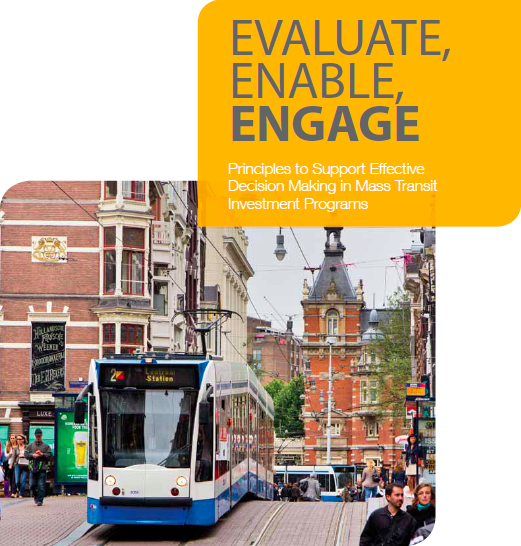 Between 2000 and 2030, developing countries are expected to build more urban area than has been built throughout human history. Urban populations in China and India will grow by at least 600 million residents by 2030, roughly twice the current population of the entire United States. Without major mobility investments, many rapidly growing cities will face traffic and economic gridlock.
Against a backdrop of increasing urban mobility demands and growing concerns about the impacts of climate change, more national governments are investing in the development of urban and metropolitan mass transit systems. Within the last 10 years, national governments in several populous countries with quickly growing economies, including India, Mexico, and Brazil, have introduced programs to fund at least a portion of the construction costs of new mass transit systems. They join countries with more mature transport infrastructure, including France, the United Kingdom and the United States, that have continued and, in some cases, increased their investments in mass transit.
This report from EMBARQ examines 13 existing national mass transit investment programs from the perspective of informed decision making. Based on the reviewed national programs, the report identifies three principles to foster effective decision making in national mass transit investment:
- Rationale
- Deliverability
- Local buy-in
The insights will be of use to administrators of national mass transit investment programs that are identifying areas for improvement, national governments that are introducing new programs, and representatives of multilateral institutions that are helping to structure such programs.
Download full report here English (PDF, 70 pages, 4.32 MB)
¿Comments? ¿Opinions? ¿Similar News? Send them to us!
Tweet
Next Stop, Supreme Court, for Delhi’s Bitter Bus Corridor Battle
Source: The New York Times
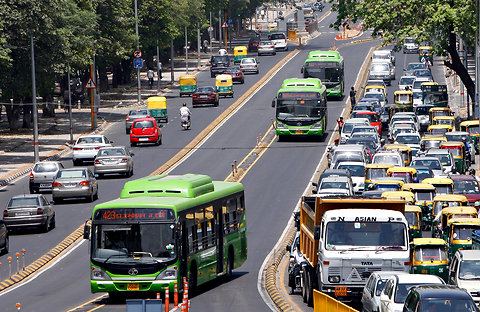 Photo: Prakash Singh/Agence France-Presse — Getty Images
Delhi’s experiment with efficient public road transportation, in the form of the Bus Rapid Transit corridor, has devolved into a court battle that pitches the city’s wealthy, car-owning minority against the majority of road users.
The next step may be the highest court in the land. The Delhi government plans to appeal to India’s Supreme Court to keep the corridor car-free if Delhi’s high court, which is hearing the case now, decides that cars should be allowed in the bus-only lanes, an official in Delhi’s Transport Department told India Ink on Monday.
Delhi’s buses are residents’ most important method of transportation in the city of over 16 million. Fewer than 20 percent of road users in Delhi travel in private vehicles, including cars and scooters, while about half of all road users in Delhi commute by bus, according to the RITES Delhi Traffic and Forecast Study. The rest use bicycles or three-wheeled auto-rickshaws, or go by foot.
The BRT corridor, which is modeled after other systems in high-traffic cities like Bogota, was designed to make bus and bicycle travel safer and faster, and encourage travel that does not involve cars. It features a bicycle-only lane and a center lane just for buses.
Whether the corridor, which was completed in April 2008, has been a success depends on which camp you ask. It has saved lives, but it has also increased the travel time for car drivers. Whether it has shortened bus travel times depends on which research you read.
Drivers and their advocates are so upset that they have filed a flurry of court petitions, demanding that the corridor be shut. News coverage in some English-language newspapers, particularly The Times of India, has often been sympathetic to these drivers, calling the corridor a “nightmare” and “a volcano waiting to erupt.”
An interim court order last week directed the government to allow private vehicles to use the corridor reserved for buses. A final judgment on whether to overturn it altogether is due this month from the Delhi High Court.
According to B.B. Sharan, a retired colonel who is one of the petitioners who wants the corridor open to all vehicles, “only 50 buses plied on the corridor in an hour while the number of other vehicles was 40 to 50 times the number of buses.”
Traffic jams are a common sight on the carriageway next to the bus lane, he said. “It is unfair to give so little space to car users. Not a single car user has started using the bus; nobody has benefited from this,” he added.
Not everybody agrees with his claim.
“The number of fatal accidents reduced from an average of 9 to 10 accidents per year between 2001 and 2006 to 2 in 2009 on the stretch,” said Geetam Tiwari, Professor for Transport Planning at the Indian Institute of Technology, Delhi.
Ms. Tiwari was one of the authors of the report “Delhi on the Move: 2005,” which proposed the BRT concept and was presented to the Transport Department in 1995.
“Fatal accidents involving bicyclists have not occurred in the bicycle lane since 2008,” she added.
Dunu Roy, director of Hazards Centre in New Delhi, a nongovernmental organization, agreed with this assessment. “After the BRT became operational, not only have fatalities gone down dramatically, accidents have gone down too,” he said.
Private vehicle use is rising fast in New Delhi and most Indian metropolises: An average of 1317 vehicles, including auto-rickshaws and scooters, were added to Delhi roads every day during the 2010-11 fiscal year according to Delhi Statistical Handbook 2011, of these 95 percent were private cars and two wheelers.
Soon, Delhi’s roads won’t be able to handle the traffic, transportation experts say, making introduction of systems like the BRT necessary. “The capacity of roads in Delhi will be exceeded by 2021 on most major roads and junctions,” said Ms. Tiwari.
Convincing private vehicle owners to use public transportation remains a difficult task in India. Car-pooling web sites have sprung up recently, but bus transportation is widely seen as inconvenient, crowded and unsafe for women.
Advocates of the Bus Rapid Transit corridor argue that the interim court decision negates the corridor’s original purpose. “Allowing other vehicles in the corridor essentially destroys the corridor. There is space for everyone, but the concern of minority car users seems to influence the city engineers and traffic managers,” Ms. Tiwari said.
Even research related to the BRT is controversial. Mr. Roy of the Hazards Centre said there are multiple problems with an interim report by the Central Road Research Institute (CRRI), a national research organization, which is the basis of the interim high court order.
The CRRI had conducted a trial run between May 12 and May 23 allowing private vehicles in the bus corridor. In its report the institute concluded that traffic moved faster when other vehicles were allowed in the corridor than when they were barred, but the report did not make note of accidents or fatalities.
“Their report is completely unscientific,” Mr. Roy said. He pointed out that in the Terms of Reference the government asked for comparisons with the BRT corridor and mixed vehicle corridors on other roads. Instead, Mr. Roy said, “the CRRI modified the BRT corridor itself and compared the results.”
Subhamay Gangopadhyay, director of the institute declined to comment on the findings of the interim report and said that he would only speak once the final report is submitted to the Delhi High Court on July 12.
Zubeda Begum, the lawyer representing the Delhi government’s transport department, said that she had not looked at the CRRI interim findings but said that the organization was not an expert on the matter.
Despite the pending legal dispute, the Press Trust of India quoted Sheila Dikshit, Delhi’s chief minister, last month as saying that her government “will commission more BRT routes in the city as a means to promote public transport, as a bulk of passengers were ‘happy’ with the existing facility,” but provided no further details.
¿Comments? ¿Opinions? ¿Similar News? Send them to us!
Tweet
BRTdata.org Updates
 Source: EMBARQ
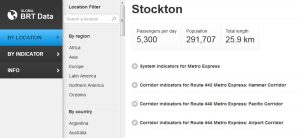
BRTdata.org, which features more than 90 geographic, statistical and service-level indicators, has been releasing updates, adding information on new lines from Mexico City to Rio de Janeiro.
The website features the most comprehensive, public database of bus rapid transit (BRT) systems around the world, launched on April 2 by our Centre of Excellence and EMBARQ, in collaboration with the International Energy Agency.
The last updates includes data now includes 143 cities’ BRT systems, representing more than 23 million daily riders. Some key updates added in this update include the Database’s newest cities, Winnipeg, Canada; Jaboatão dos Guararapes, Brazil; Stockton, the United States; Miyagi, Japan in addition to corridor updates in several South American cities in Brazil and Colombia, Australia and Japan.
The changes are listed in the Changelog of the website. Here are the highlights:
New corridors
- Jaboatão dos Guararapes, Brazil
- Stockton, the United States
- Miyagi, Japan
- Winnipeg, Canada
Modifications to existing systems/corridors
- Bogotá: city population, metropolitan population
- Guadalajara: station boarding level
- Lima: station boarding level
- Mexico City, corridors línea 1 and línea 4: # trunk routes
- Pereira: station boarding level
- Rio de Janeiro, all corridors: daily demand, peak load, # stations and station spacing
- Santiago: station boarding level
- Sydney, all corridors: system length
- Uberlândia: capital cost, infrastructure cost and equipment cost
- Vancouver: # trunk routes
- All Latin American systems: year system commenced
- Porto Alegre, all corridors: daily demand and peak load
- Santiago, all corridors: daily demand, peak load and frequency
- Santiago, corridors Parajitos Norte and Pajaritos Sur: corridor length, length of segregated lanes, # stations, and station spacing
- Santiago, corridors Suiza-Las Rejas and Santa Rosa Norte: length of segregated lanes
“This database helps researchers, transportation agencies, municipal authorities and NGOs to understand and make decisions to improve systems and BRT bus lanes in their cities” says Dario Hidalgo, director of research and practice for EMBARQ and member of our CoE.
BRTdata.org will continue to publish new or updated data on the second Thursday of each month.
¿Comments? ¿Opinions? ¿Similar News? Send them to us!
Tweet
Public transport pre-pay tickets: Understanding passenger choice for different products
Growing cashless services in the Sydney metropolitan region are motivated by the clear supply-side benefits associated with the prepayment of public transport fares. This paper examines the effect on prepay following the ‘MyZone’ fare and ticket reform in New South Wales introduced in April 2010. ‘MyZone’, introduced two new discounted and standardised prepay products, including a new, multimode ticket. Whilst these changes had implications for all public transport providers in the Sydney Metropolitan area, it had significant ramifications for the many private bus operators who, for the first time, could provide and accept tickets, which integrated their services with the state-run rail, ferry and bus network.
With empirical data collected from two surveys of passengers of a private bus operator in northern Sydney this study analyses the ticket purchasing behaviour of passengers both before the fare reform, when passengers only had access to operator-specific prepay products, and post-MyZone, when the new standardised prepay products were available. The results clearly show there are significant differences in the characteristics of passengers using multi-modal versus pay-as-you-go tickets and that this difference is driven largely by age, income and whether or not the journey involved interchange. Prior to MyZone, prepay users were easily predicted and the fare and ticket reform was successful in transitioning some cash users to prepay but prepay users were no longer predictable unless separated into prepay product groups. This suggests that a policy designed to exploit the supply-side benefits associated with cashless services needs to consider that introducing only one prepay product will not address the market need of frequent users. Passengers who continued to pay cash after the fare and ticket reform showed high sensitivity to public transport cost and are those passengers with the lowest incomes. This raises policy questions of how to mitigate against the upfront costs often associated with prepay to transition less affluent, but frequent passengers, onto cashless ticketing.
Opinion Pieces: The simple logic of getting people out of their cars and onto public transport
Opinion Pieces: since 2007, Prof. David Hensher has written an opinion column in the Australasian Bus and Coach magazine, where he monthly discusses a lot of different transport-related hot topics. In this section we are revisiting these columns.
September 2011
This opinion piece may well turn out to be the most ‘influential’ piece I have written since we started the monthly series in October 2007. The careful selection of words is quite a craft and one that begs indulgence to have maximum impact. During the Emerging Crises Summit on Cities, Population, Climate Change and Energy titled Moving People Solutions for a Growing Australia in Parliament House, Canberra (July 6 2011), I was on a panel gazetted for Road Pricing Reform. The Chair decided that Road Pricing is a long way off in terms of political agendas (despite all the lip service), and that we should focus our panel discussion on themes where we believe governments might be interested, and where they could make a difference in public transport reform.
I (and Bob Carr, former Premier of NSW) was asked to identify one very specific initiative that government’s could support (especially Federal Government) that could make a real difference to improving the performance of metropolitan transport systems.
My response, almost as if it had been brewing for many years, was to “flood the market with buses”. I connected this response to my earlier question (Opinion piece June 2011) – How many buses could the NW rail project in Sydney buy? Allowing for extra drivers, which has significant employment benefits, the current 4,000 buses operating in the Sydney metropolitan area, could be increased to at least 12,000, a three-fold increase in service capacity.
In anticipation of a loud yell of disapproval, I anticipated what the response would be. Specifically, people have told me that this would create a crisis on the roads with horrendous traffic congestion consequent on buses mixing with cars and trucks. My response is simple and accurate – if the real drivers of getting people out of their cars and into public transport are connectivity (the door-to-door element of travel, including integrated seamless multi-modal ticketing), frequency, regularity and visibility, which most would agree are the key factors, then a 300 percent increase in the service capacity of buses spread throughout the metropolitan area (or at least in areas where we believe public transport can make a difference), must surely result is some noticeable modal switching from the car, with a consequent positive impact on traffic congestion.
Given the substantial three-fold increase in service capacity, if this fails to make a dent on car use and hence traffic congestion, then what hope is there for any public transport initiative (be it new infrastructure and or new service levels) to contribute to reducing traffic congestion? Surely the failure of this initiative would send a signal about the disconnect between building the NWRail project (as one example of spending a lot of money on one narrowly focused project given the needs of entire metropolitan areas) and what it will do as a narrow corridor-specific initiative in impacting on traffic congestion (which I personally believe it will have very little impact).
I suspect that many politicians would agree with me, but so few if any would say so.
Food for thought
¿Comments? ¿Opinions? ¿Similar News? Send them to us!
Tweet
Ridership Drivers of Bus Rapid Transit Systems
We have collected information on 46 bus rapid transit (BRT) systems throughout the world to investigate the potential patronage drivers. From a large number of candidate explanatory variables (quantitative and qualitative), 11 sources of systematic variation are identified which have a statistically significant impact on daily passenger-trip numbers. These sources are fare, headway, the length […]
Choosing public transport – some behavioural challenges