
Opinion Pieces: Expertise in government and industry – the major challenge facing the sector
Opinion Pieces: since 2007, Prof. David Hensher has written an opinion column in the Australasian Bus and Coach magazine, where he monthly discusses a lot of different transport-related hot topics. In this section we are revisiting these columns.
December 2010
Over the last year or so, it has been mentioned repeatedly to me that the biggest constraint the bus sector faces is the lack of expertise in the government sector in particular, but also a recognition that the industry of bus operators has not escaped this dilemma either. The expertise that has been highlighted relates to performance management, contracting processes and the strategic understanding of planning and monitoring bus transport as a system serving a network. Why has this occurred? There is a real problem in attracting new blood to an industry that undersells itself – there is no great sparkle when the community sees the industry as nothing more than a career in driving a bus, maintaining a bus, designing timetables and a bureaucratic career in managing bus contracts. It may come as a surprise to many in this industry that until new graduates actually work in the sector, they have no idea that there are challenging jobs in planning, strategic development, finance, marketing and dare we say strategic thinking.
It seems to be, observing from a distance, that there are too many people in the industry who lack a strategic focus and/or vision, are more concerned about the day to day operational issues and less concerned about the long term implications of such micro-detailing of issues that may appear important and urgent at the time, yet end up being non urgent and not important. I am sure all readers can relate to this. Compliance management has taken over from strategic commitment to worthwhile change. The level of detail in the growing array of documents that are produced in establishing formal relationships between the regulator and the operator might best be described as governance breakdown or institutional malfunctioning. Why do we need all this paperwork and detail when the requirements of service delivery are so much more simpler? Can someone please answer this question? It seems to me that it is worthwhile revisiting what I might describe as essential rules to ensure compliance, in contrast to the numerous rules that have been added over the years to numerous regulatory and implementation documents to ‘protect’ the transparency of a flawed process. My biggest concern is that despite all of this detail and unnecessary complexity (which produces nothing short of ambiguity and lack of clarity), we still remain somewhat data poor in understanding this great industry. My wish is that we start to recognize even more than we have to date, that there is so much wasted effort in competing bodies compiling data on the sector that is often in conflict in regards to the evidence. Can we one day sort this out.
Food for thought
¿Comments? ¿Opinions? ¿Similar News? Send them to us!
Tweet
An integrated real time transit signal priority control for high frequency transit services
Bus bunching affects transit operations by increasing passenger waiting times and its variability. In order to tackle this phenomenon a wide range of control strategies have been proposed. However, none of them have considered together both station and interstation control. In this study we tackle this problem aiming to determine the optimal vehicle control strategy for the various stops and traffic lights in a single service transit corridor that will minimize the total time users must devote to making a trip taking into account delays for both transit and general traffic users. Based on a high frequency capacity constrained and unscheduled service (no timetable) were real time information about bus position (GPS) and bus load (APC) is available, this study focuses, on strategies for traffic signal priority in the form of green extension, considered together with holding buses at stops and limiting passenger boarding at stops. The decisions regarding transit signal priority are taken based on a rolling horizon scheme where effects over the whole corridor are considered in every single decision. The proposed strategy is evaluated in a simulation environment under different operational conditions. Results shows that the proposed control achieve excess delay reductions for transit users close to a 61.4% compared to no control while general traffic only increases a 1.5%.
Event Wrap-Up: 1st Forum for Sustainable Transportation Technologies
Source: EMBARQ
EMBARQ Brasil presents on environmental benefits of bus rapid transit.
Brazilian BRT systems can significantly reduce carbon emissions and generate other important co-benefits, said EMBARQ Brasil President Toni Lindau at the 1st Forum for Sustainable Transportation Technologies in Rio de Janeiro. He also pointed out the need to evaluate the potential of alternative vehicle technologies and fuels using a life cycle analysis.
EMBARQ Brasil was invited to participate in the event by FETRANSPOR, the state federation of bus operators in Rio de Janeiro. This invitation was the result of the partnership between EMBARQ Brasil and FETRANSPOR initiated at the BRT Marketing Workshop held in May.
The forum was an important gathering of transport officials and members of the private sector, including the largest bus manufacturers and fuel providers. The forum focused on how to provide alternative energy sources for improved transportation systems, especially during the 2014 World Cup and 2016 Summer Olympics. Transport officials from across Brazil were exposed to the need to carefully consider vehicle and fuel choices in projects for both mega-events.
EMBARQ Brasil, together with EMBARQ Research and Practice, is now developing a holistic and detailed comparative study of alternative vehicle and fuel technologies, to help support the selection of technologies for the next generation of Brazilian BRT systems.
The forum was organized by FETRANSPOR and O Globo Jornal, with the support of EMBARQ Brasil. EMBARQ Brasil President Toni Lindau was a key speaker. Director of Development and Strategic Relations Rejane Fernandes and Transport Engineer Magdala Arioli also represented EMBARQ Brasil at the event.
¿Comments? ¿Opinions? ¿Similar News? Send them to us!
Tweet
Goiânia, Brasil: online information for transport system users (in Spanish)
Source: SIBRT
La integración entre el sistema de localización de los autobuses y el medio ambiente virtual ayudan con la disponibilidad de información.
En 2009, con la implementación de un nuevo modelo de gestión del transporte público de la Región Metropolitana de Goiânia (RMG), Brasil, la información proporcionada al cliente ganó un nuevo formato: plataformas virtuales e interactivas. El Servicio de Información Metropolitana (SIM) tiene como base lo más moderno que existe en procesos y tecnología. Con una inversión de más de R$ 50 millones durante los últimos 3 años, se ha desarrollado e implementado una serie de productos en las áreas de gestión de la información y relaciones con los clientes.
El entorno digital se caracteriza por canales que proporcionan la información generada a través de la integración de dos herramientas principales: el sistema ITS4MOBILITY instalado en todos los 1.371 vehículos de la red (compuesto por GPRS y computador a bordo) y la cartografía de la ruta de las 276 líneas en funcionamiento y de los más de 5.700 puntos de parada. Con eso, la pantalla de puntos de parada, los caminos guión, i-Center, pagina web, WAP y SMS reciben información en tiempo real con datos como: tiempo para el próximo bus, las líneas para llegar de un punto a otro de la ciudad, su recorrido y frecuencia.
La opción más tradicional de servicio al cliente, el Call Center, también tiene buena aceptación del público. En el caso de la Red Metropolitana de Transporte Colectivo (RMTC), la peculiaridad de este servicio es el hecho de actuar como una herramienta para escuchar a los clientes, es decir, se transmite cada caso al área responsable, en busca de una respuesta para las cuestiones criticas, quejas o sugerencias y se refiere directamente a los clientes. En cuanto a la solicitud de información, las mismas se envían de inmediato por el empleado que habla con el cliente. Los elogios, por último, se envían al área o persona en cuestión con el fin de apreciar su trabajo. “Buscamos agregar valor a nuestros productos de información a los clientes”, dice el director general del Consorcio RMTC, Leomar Avelino.
Según el director de la empresa, que es el representante de las cuatro empresas de servicios públicos en el transporte de Goiânia y encargado de la gestión integrada de la operación, el diferencial del sistema desarrollada por el SIM es precisamente variedad de plataformas disponibles para el cliente. Además de los entornos virtuales, la planificación es estructurada para incluir informaciones donde los pasajeros tienen acceso en el cotidiano y la rutina. “No es suficiente la disponibilidad de la información. Es necesario información con estructura de manera que llegue a donde están nuestros clientes. Disminuimos los ruidos y la interferencia en el proceso, y, por supuesto, se ha hecho más fácil el uso del transporte público”, explica.
Más información
Página web
La primera versión del sitio de RMTC se puso en marcha en noviembre de 2009 con el objetivo de proporcionar informaciones pertinentes que puedan proporcionar al cliente una manera de planificar el uso del transporte colectivo de la Red Metropolitana de Goiânia.
En la actualidad son más de 60.000 accesos mensuales, en los cuales los visitantes pueden ver la ruta de cualquier línea de la Red, localizar e identificar el punto de parada deseado, planear el recorrido en bus con la herramienta “Google Maps” y tener acceso el tiempo de llegada de los próximos dos vehículos en cualquier punto de parada de la Red (en tiempo real).
Wap
Herramienta que proporciona, a través de la web en su teléfono, consultar, en tiempo real, los minutos restantes para la salida de los vehículos de un punto de parada en particular. El mensaje recibido ofrece, también, el número y nombres de las líneas que hay en el punto deseado.
Pantallas en Puntos de Parada
Tecnologia de primer mundo para el servicio al cliente RMTC. La pantalla utiliza la tecnología derivada de Volvo de Suecia – ITS4MOBILITY, instalada en todos los vehículos de la Red – permite al cliente realizar un seguimiento en las líneas y los minutos restantes para la llegada de los próximos dos buses en un punto de parada particular, así como el Wap.
En la actualidad hay 14 pantallas repartidas en ocho distritos de Goiânia y uno en Apareceida de Goiânia, instalados en lugares de intensa actividades, tales como supermercados, centros comerciales y universidades. La definición de los locales se realiza mediante el análisis del flujo de personas, para que el acceso a la información sea cada vez mayor por los clientes.
iCenter
Situados en los terminales de integración, es una gran pantalla interactiva que funciona al tacto (touchscreen). A través de ella, se puede planear un itinerario de viaje con la ayuda de Google Maps y ver los horarios y las rutas de cada línea.
SMS
Es un servicio innovador proporcionado por RMTC, único en Brasil en el área del transporte colectivo urbano. Con él se puede encontrar, en tiempo real mediante mensajes de texto en celulares, información acerca de cuantos minutos quedan para la llegada de los vehículos en cualquier punto de parada de la Red.
Call Center
La RMTC ofrece a sus clientes de Call Center gratis para las llamadas realizadas desde teléfonos fijos. El servicio se presta de lunes a sábados y recibe un promedio de 6.500 llamadas al mes, de los cuales el 90% son solicitudes de información.
Señalización de los Terminales
Proceso que proporciona información sobre los terminales de la RMTC de los medios de comunicación analógicos y digitales de una manera estandarizada y con reglas que tienen por objetivo facilitar la lectura y comprensión por los clientes. Todo el material gráfico de la Red es basado en proyecto de Diseño de Información, lo que explica los ajustes de color, diseño, tamaño y diseño de conjunto.
Enrutamiento
La herramienta permite al cliente planificar los viajes en transporte público. Mapas indicativos con los nombres de calles, puntos de embarque, visualización de la ruta elegida, el tiempo de viaje y el número de líneas disponibles para los usuarios del servicio.
¿Comments? ¿Opinions? ¿Similar News? Send them to us!
Tweet
TransMilenio: The Good, the Bus and the Ugly
Source: The City Fix
 The Colombian capital of Bogota has been praised for more than a decade concerning its dramatic transformation, which centered around the TransMilenio bus rapid transit (BRT) system, ushered in by former mayor Enrique Peñalosa. TransMilenio has been widely praised and imitated around the world and is considered the gold standard for BRT service. However, many consider the successful bus system to be struggling under its own success. What’s happened to the world’s most famous BRT? The myriad factors are complex, ranging from controversial public policy decisions, engineering mishaps, political contempt, marketing budget cuts and even earthquakes. This is story about TransMilenio in 2011: the good, the bus and the ugly.
“The big problem we’re facing now is nobody is talking about these system expansions, and it’s like this plan has been abandoned,” said Dario Hidalgo, former deputy general manager for TransMilenio and director of research and practice for EMBARQ.
The original TransMilenio plans for 2011 anticipated 170 kilometers of lanes. Instead, Bogota is currently coping with 84 kilometers of completed lanes, with an additional 20 kilometers under construction. While Phase I of the system was implemented seemingly overnight in two years, phases II and III have been delayed, taking 5 years and 7 years to start, respectively. The 20 kilometers of Phase III currently under construction are already 1.5 years behind schedule, with an estimated completion date of 2012, aggravating Bogotanos whose city is mired in public works projects.
The mayor of Bogota presides over nearly 20 percent of the Colombian population and consequently is one of the most powerful figures in Colombia. Colombian law limits mayors to three-year consecutive terms. As a result, politicians avoid fomenting their predecessors’ initiatives, knowing their rivals are waiting in the wings. Coincidentally, in Bogota, no project is more attached to a politician than TransMilenio is to former mayor Peñalosa. After Peñalosa’s ambitious term as mayor of Bogota from 1998 to 2000, he has been followed by three administrations unsympathetic towards TransMilenio.
“If you attach a project to a single character, especially a political figure like Peñalosa, then you’ll end up with the opposition attacking a project as a way of scoring political points,” Hidalgo said. “At the end of the day, it’s the citizen who is affected, not the politician.”
METRO ENVY
Since the 1950s, Bogota has been enamored with the thought of a metro, and this obsession has only grown since the mid ’90s, when Medellin, the country’s second biggest city (and Bogota’s bitter rival) began operating its above-ground metro service. Colombian federal finance funds 40 percent of all transit projects, while local government foots the rest of the bill. Bogota was close to getting federal funding for its long-awaited metro when those funds were diverted to earthquake relief and bank bailouts in 1999. While Peñalosa was willing to take federal funds to construct a metro system, his main intention as mayor was to create a sophisticated bus system. When the metro money dried up, so did his intentions of building it with city funds.
Bogota proves that BRT remains a cost-effective solution to mass transit challenges. Medellin’s metro serves 500,000 riders daily, while Bogota’s TransMilenio serves 1.7 million riders per day. Transportation experts recommend considering transit alternatives to provide the best use of limited resources. The estimated infrastructure investment for the metro was estimated at more than double the cost of the BRT system: US$4 billion versus US$1.97 billion. Moreover, the metro system would cover only 8 percent of the city, while the BRT system would cover 85 percent.
Hidalgo stresses that “BRT serves many more people, saving more lives, reducing accidents, pollution, and improving the quality of life of millions of people, as opposed to thousands of people.”
Hidalgo continues, “Metros are really attractive and no matter if you put the numbers on the table, how much it costs, how long it takes to build, how little coverage it may have, the general public just dismisses them by saying all the big cities in the world have a metro. It’s a just a question of image, not reality.”
According to a recent study performed by the Institute for Transportation & Development Policy, TransMilenio was awarded the gold standard in BRT service, receiving a score of 93 out of 100. If gold standard BRT becomes adopted in U.S. cities, such as the ambitious plans of Chicago, New York and in the Washington, D.C. suburbs, perhaps Bogota’s transportation envy will subside. Until then, TransMilenio’s accolades will most likely fall upon deaf ears.
“I strongly believe Bogotanos want better transport, and metro is the image of that; it embodies the promise, no matter the cost or the coverage,” Hidalgo said. “The fact that the TransMilenio has problems reinforces that idea.” Major problems include station crowding, poor road quality, bus frequency and passenger congestion in buses.
BUMPY ROAD AHEAD
Road quality along Avenida Caracas, the first phase of TransMilenio, has some of the worst road quality of the bus system. Foundations under concrete slabs were incorrectly designed and constructed. As a result, cracks and potholes proliferate along the route. El Instituto de Desarrollo Urbano (IDU), or the Urban Development Institute, is in charge of maintaining road infrastructure for the entire city, including the TransMilenio system, and has not been aggressive enough in road upkeep. Lack of maintenance has tainted the image of the system.
At peak hours, stations are uncomfortably crowded for passengers. People crowd around both the entrances and exits of the buses, making it nearly impossible for users to depart the bus at rush hour. Passengers at stations refuse to give right-of-way to exiting bus riders, creating stressful bottlenecks. It’s common to miss one’s stop because of the difficulty in exiting the bus. TransMilenio can currently serve up to approximately 45,000 passengers per direction per hour—a figure competitive with metro lines in Mexico City and London.
Most of the TransMilenio bus fleet is articulated buses, which have a capacity of 160 passengers, in addition to new bi-articulated buses, which offer maximum occupancy of 260. However, Hidalgo suggests occupancy should be less than 130 passengers per bus during peak hours to provide higher quality service.
“With 160 passengers per bus, you end up inviting a lot of users to motorcycles and cars,” he said. Bogota is expected to add approximately 300,000 new cars to its streets by the end of this year—an increase of 18.2 percent from last year.
Transmilenio is a public-private partnership that receives no subsidies from the government. The 1,700 Colombian peso fare (roughly US$1) is exorbitantly expensive for low-income users whose daily salary averages US$3.
“The way the planners, myself included, tried to fit the cost with the fare was to have a very busy system with a high occupancy of 160, but that doesn’t provide quality service, so we ended up shooting ourselves in the foot because we provided a system that is not high quality for financial reasons,” Hidalgo said. “If you don’t provide subsidies, the sustainability of the system is in jeopardy in the medium and long term.”
COMPETING PRIORITIES
During the implementation of the system, Mayor Peñalosa was adamant about not subsidizing TransMilenio, preferring to use those funds for other essential city functions, such as education, security, health and public space. Consequently, policy experts increasingly suggest a congestion tax at peak hours—akin to what’s being done in London or Singapore—to finance the subsidy. The city currently restricts drivers with a policy known as Pico y Placa, which restricts car use depending on license plate numbers on designated days of the week. Drivers have found a way around this policy by simply buying a second car and leaving it in the garage on restriction days. Instead of this money going to car dealerships, the money could be a tax that could be reinvested back in public transportation.
TransMilenio operators run a formal transportation system with electronic fare collection, state-of-the-art buses and tax payment, in addition to employing drivers for 6 to 8 hours per day with benefits. This is in contrast to Bogota’s collective bus system, whose drivers purchase routes from bus operators. These drivers are paid per customer and operate without formal stops. The city is currently developing the Sistema Integrada de Transporte Publico (SITP), or the Integrated Public Transportation System, an ambitious plan to integrate the collective bus system to TransMilenio. However, it comes with great risks, as the service under the TransMilenio agency’s jurisdiction will jump from 1.7 million users per day to nearly four times that size. TransMilenio’s planning and operational capacities are being spread too thin, focusing on the restructuring of the collective bus system, in addition to dealing with the struggling service.
While the TransMilenio agency has been upgrading service, Hidalgo senses the agency has not been aggressive enough. Station expansions have expanded capacity, and increasing farecard sales outside of stations has reduced pedestrian friction and congestion. But more aggressive measures are needed. The implementation of new trunk routes along Avenida Septima or Avenida Boyaca are needed to reduce demand along Avenida Caracas. Demand along this route is over capacity because of the stagnation of new routes, which would have connected the portal stations, thus reducing demand along the busiest parts of the system.
Part of the problem is bureaucratic: new infrastructure depends on the Urban Development Institute, whereas new routes and traffic measures depends on the Secretary for Mobility. Therefore, the TransMilenio agency’s role is limited.
FOCUSING ON THE USER
While many of the problems of TransMilenio are endemic problems requiring long-term engineering or policy solutions, issues involving customer morale and education could be implemented in a relatively short amount of time.
More maps and wayfinding tools are needed in both stations and buses. There are no maps located outside of TransMilenio turnstiles. Inside stations, there are typically two types of maps: a complex map detailing all stations and routes offered by the TransMilenio, and a more simplified map showing all routes leaving from the particular station where the passenger is located. These maps are effective and easy-to-use with practice, however, on average, there are only three to four sets of maps per station, and stations are typically three city blocks long, creating a scarcity of knowledge available to the rider. Inexplicably, bus interiors offer no maps whatsoever. The bus features digital displays alerting passengers of the two approaching stations, yet on a bus packed with 160 people, it can be difficult to see or hear the information.
Some users feel mistreated and, therefore, distrust the system. Education and courtesy programs could be implemented to aid and assist users about etiquette in the TransMilenio. “The key is first to improve the quality of the service and then user education, not the other way around,” Hidalgo said. “You can’t tell people to behave if they are mistreated.” Once service improves, marketing and advertisements to improve the branding of the TransMilenio might help to counteract the negative attention the media has given the system. (For more tips on marketing for mass transit, read EMBARQ’s guidebook, “From Here to There: A Creative Guide to Making Public Transport the Way to Go.”)
DRIVING TOWARD THE FUTURE
The triumphs of TransMilenio are well-documented. After a decade, Transmilenio has made great achievements to promote an affordable mass transit system that is a particularly successful and applicable model in developing cities where municipalities have finite resources and face numerous challenges. The success of TransMilenio explains why the model has been adopted in more than 100 cities on every continent. TransMilenio’s success is essential because it has served as a model for so many of the world’s BRT systems. Air quality has improved in Bogota, especially along TransMilenio routes. Road safety has significantly improved, too. Fatalities have decreased 60 percent from 1,299 in 1996 to 551 in 2007, according to the Ministry of Transportation of Colombia. Accessibility for the elderly, disabled, and mothers with small children has also improved, compared to the collective buses, which are not handicap-accessible. Furthermore, 1.7 million people per day use the TransMilenio and travel times have reduced by 32 percent. With the expansion of the system, this progress will only continue.
Filmmaker Woody Allen said, “A relationship, I think, is like a shark, you know? It has to constantly move forward or it dies.” The same could be said about the current state of the Bogota’s BRT: it needs to keep progressing to keep up with the demand of this growing city of more than 8 million people. The intention of this post was not to praise nor bury the TransMilenio. More needs to be done to address the issues confronting the decade-old system. The problems are complex and multifaceted, but a pragmatic and factual discussion must enter the public discourse in order to ensure the system’s success.
¿Comments? ¿Opinions? ¿Similar News? Send them to us!
Tweet
The complexity of BRT development and implementation
While bus rapid transit (BRT) has emerged as an attractive sustainable urban transport solution in many cities throughout the world, many systems have experienced challenges and shortcomings. This chapter discusses the complexities facing decision-makers in developing and implementing BRT as part of an integrated city-wide transport system.
One of the attractions of dedicated BRT systems stems from its comparison with other urban transport solutions such as light rail. BRT benefits from a combination of low cost structure and good service characteristics which allow the delivery of capacity higher than rail based alternatives at a much lower cost. For many cities, this has meant that the infrastructure cost has been less of a burden on the taxpayer since more infrastructure can be provided for a given level of funding.
Reviews of existing development and implementation of BRT systems around the world reveal common challenges and lessons from bus system improvements and BRT. These include issues relating to planning, implementation, and operations of BRT systems, and their interconnections with financial, institutional and regulatory constraints.
In many systems, initial problems were resolved in the early period of operation, but others had more profound issues leading to change and improvement adapted and improved over time. This chapter distils the lessons learned from BRT projects across Latin America, Asia, Africa and Australia.
R-TRESIS: Developing a transport model system for regional New South Wales
This paper sets out a demand modelling framework for the development of a regional transport and land use model system (R-Tresis), to be implemented for New South Wales (Australia). Traditionally, the focus of such a model system has been major metropolitan areas such as Sydney, where we have developed Tresis (Hensher, 2002). Given the growing concern about regional accessibility to many service classes, there is a need for a modelling capability that can be used to prioritize and guide policy decisions in regions that are often described as remote, rural, low density and small town. In developing a framework that is capable of integrating both demand and supply elements of transportation and land use activity, we recognized the challenges in developing primary data sources, and the high likelihood of a reliance on secondary data sources. This suggested an alternative approach to demand modelling that was not dependent on choice models; namely a suite of continuous choice models in which we capture the actual activities undertaken by each mode on both the demand and supply side at high spatial resolution.
Opinion Pieces: The continuing saga on corridors and networks and big project announcements
Opinion Pieces: since 2007, Prof. David Hensher has written an opinion column in the Australasian Bus and Coach magazine, where he monthly discusses a lot of different transport-related hot topics. In this section we are revisiting these columns.
November 2010
Almost daily we see media reports of State governments commenting on their transport priorities. While the political process is complicated and one respects the obligations of politicians to their constituents, it remains a great puzzle (dare I say frustration) that the focus is primarily on promoting a few big projects in a corridor in our metropolitan areas. If money was plentiful, then one might argue that we can go along with this (despite it not necessarily being the best spend in terms of value for money). Why is it that the message that the focus must be on the entire network and not on specific corridors simply is not getting through in at least two States of Australia? I guess the answer lies in votes that might be easier to capture with a couple of big ticket highly visible projects? Well, fair enough for those who might benefit from them (putting asides the date in the future when they may be operational); but what about the rest of the system that needs good accessibility (broadly defined by connectivity and frequency). At the end of the day the real test of value for money is system-wide – how are people benefiting in traveling from their origin (O) (where the trip starts – not a railway station or bus stop) to their destination (D) (where the trip finishes, not a railway station or bus stop)? It seems from my reading and listening, that opportunities to give all an attractive level of public transport service (in terms of OD connectivity and frequency) is simply not on the political agendas, except in fine words and aspirations – it certainly is not reflected in investment announcements (potential or actual). I look forward to the day when the political machine announces that we will be funding and investing in a fully integrated bus (on its own right of way – tunnelled or above ground) and rail network based on the OD needs of the public that is not defined by one or two very expensive (and likely to be poor value for money) projects in corridors. Think networks and systems please. It is no wonder that the car will reign supreme for the long future – even getting revised car use pricing on the agenda seems to be talked about but ignored as a sensible way forward to tame the car and fund public transport investment.
Food for thought
¿Comments? ¿Opinions? ¿Similar News? Send them to us!
Tweet
Public Transport Comes With Densities
Source: Thoughtlines with Bob Carr
Proud to have been chosen as keynote speaker for today’s big public transport conference in Parliament House in Canberra, sponsored by a coalition that includes rail, bus and bike groups plus local government and ( interestingly ) the Heart Foundation. The Gillard Government and its predecessor have made commitments to public transport, reviving – I said in my speech – the work of the Whitlam Government in urban policy.
Not before time. Capital cities generate 84 percent of economic growth in Australia and they are growing. By mid-century we will see Sydney and Melbourne at seven million. They won’t work without higher densities. Sydney is the only Australian city where more than half of new housing starts come in existing areas. In Melbourne it is only about 50 percent.
Here was my first proposal for boosting public transport: make sure that the metropolitan plans for our capitals mandate that, one, we increase the percentage of the population within 30 minutes by public transport of a major centre (like Parramatta or Liverpool) within the overall metropolitan area; two, we aim to have 80 percent of new housing within walking distance of public transport. Call these two ideas “key performance indicators” for city planning. They will nurture public transport. They do exist in the Sydney metropolitan plan where urban density and public transport reliance are the highest in Australia.
The Henry report recommended we move towards abolishing vehicle registration charges and fuel taxes for a system that charges drivers for distance travelled and time of journey. One of my fellow speakers suggested research towards ways of persuading private motorists that they could be better off under this model. And another speaker said marketing and politics can deliver this reform – and that we talk about distance-based charging instead of congestion charging.
Henry advocates variable congestion pricing and that heavy vehicles pay ”for their specific marginal road-wear costs.”
I reviewed the success of Bus Rapid Transit systems – designated bus expressways – which are being recognized as by far the most cost effective way of delivering public transport. Adelaide, Brisbane and Sydney offer good models. The Liverpool-Parramatta bus transit way, costing $346 million, boasts 35 stations and runs a bus every 10 minutes every peak hour. It has carved an hour off travel times. A speaker at the conference told me there was $1 billion allocated to light rail on the Gold Coast when an investment of only $50 million would have delivered an environmentally sound bus transit system. BRT gives you more kilometers of public transport.
The serious rail projects in Australian cities in recent years have been the $2 billion 13 kilometer Epping to Chatswood line, the $1.66 billion 72 kilometer Perth New MetroRail Project and the $650 million five kilometer South Morang Rail Extension in Melbourne. Heavy rail has its place where there are populations to support it – that densities argument again.
You cannot escape it.
Professor David Hensher, an advocate of Rapid Bus Transit, said that Sydney should not procede with the north-west rail project. He said that to relieve congestion it is better “to flood the system with buses”. Just a six percent shift away from cars ends congestion, he argues. And he argues that a single additional rail link – anywhere – won’t deliver the benefits that would come with more buses across the whole system. They offer flexibility and affordability. One restraint, however, is curb space. Already Brisbane is, according to one participant here, simply not able to accommodate more uses coming in from the suburbs at peak hours. There isn’t the space. A high standard of debate here.
¿Comments? ¿Opinions? ¿Similar News? Send them to us!
Tweet
Troncal de Aguablanca, new corridor in Cali, Colombia (in Spanish)
Source: SIBRT
Con una extensión de 5.6 kilómetros, conectará al centro del municipio con el corazón del Distrito de Aguablanca, una de las zonas donde se concentra la mayor cantidad de población de los estratos socioeconómicos menos favorecidos.

Una de las obras más ambiciosas que se hayan construido en los últimos tiempos en la ciudad colombiana de Cali, es la Troncal de Aguablanca del Sistema Integrado de Transporte Masivo – MIO. Con una extensión de 5.6 kilómetros, conectará al centro del municipio con el corazón del Distrito de Aguablanca, una de las zonas donde se concentra la mayor cantidad de población de los estratos socioeconómicos menos favorecidos y con mayor demanda de transporte público.
A su paso, ciclo ruta en ambos lados de la vía para favorecer el tránsito de los ciclistas, ocho estaciones de parada, una terminal intermedia y una de cabecera. Lafalse construcción de esta super estructura para el MIO genera dos mil empleos para los caleños, incluyendo oportunidades laborales para quienes habitan en las zonas de influencia de la obra e igualmente para personas en situación de discapacidad.
En su recorrido, la Troncal conecta hitos de movilidad tan importantes como las Autopistas sur oriental y Simón Bolívar, llegando igualmente hasta la ciudadela educativa “Nuevo Latir” ubicada sobre la Avenida Ciudad de Cali, facilitando de esta manera el futuro ingreso a los estudiantes.
Dos hundimientos viales hacen parte de los retos de ingeniería de la troncal para eliminar cruces semaforizados y permitir un eficiente flujo vehicular.
Pero la Troncal de Aguablanca significa más, porque le entregará a la ciudad 11 kilómetros de ciclo ruta, 30 mil metros cuadrados de espacio público renovado y 18.800 metros cuadrados de parques y plazoletas. Todo este paquete de renovación urbana incluye también la reposición de redes de servicios públicos.
La Troncal de Aguablanca es una obra desarrollada por Metrocali que representa una inversión aproximada de 85 millones de dólares.
Las obras avanzan a buen ritmo con la proyección de entregar en el mes de agosto la estructura de la vía y las ocho estaciones de parada para continuar con el proceso de la implementación tecnológica y así ponerla al servicio de los caleños.
¿Comments? ¿Opinions? ¿Similar News? Send them to us!
Tweet
Bus Rapid Transit eyed as speedy solution for U.S. 36 in Boulder County, USA
Source: Daily Camera
It’s time to go home. You head to Market Street Station in Denver, where you work, to board a bus for Boulder, where you live. You just missed the bus. No problem — they depart every five minutes. You grab the next one. As traffic bogs down around you, the driver slips into the dedicated bus lane and motors at a steady speed up Interstate 25 to U.S. 36, passing bumper-to-bumper vehicles by the hundreds. On the way to Boulder, the bus stops at several full-service stations, picking up passengers who already have paid their fare at kiosks — no fumbling for change, no wasted time. Thirty-five minutes after leaving downtown Denver, you pull into the Table Mesa park-n-Ride.
The upshot: A rush-hour bus trip along U.S. 36 that just a few years ago couldn’t come close to beating a car is projected by 2035 to have a 17-minute advantage over a single-occupant vehicle. Welcome to the future of travel in the U.S. 36 corridor — the result of a $536 million effort by the Regional Transportation District and the Colorado Department of Transportation to build the first phase of a Bus Rapid Transit system, or BRT. Advocates say the system should make commuting between Boulder and Denver as simple and reliable as jumping on a subway train.
«In many ways, you’re going to get service that acts like rail service,» said Boulder County Commissioner Will Toor, an outspoken transit advocate who has worked on making improvements to U.S. 36. «We think BRT is going to be a real workhorse for this corridor.»
Some of the elements of BRT are already in place on U.S. 36. Pedestrian overpasses and slip ramps, which allow buses to simply pull over on off and on ramps, were built at nearly all of the interchanges in the last few years.
Other features, such as a bike lane and managed lanes that buses and carpools can ride for free and single-occupancy vehicles can ride for a price, are still on the horizon.
But the choices and investments transportation officials make in the corridor over the next few years are critical, because the highway will more than likely serve as a BRT model in the state.
«What we in the U.S. 36 corridor do will set the standard for what we do with BRT in the rest of the region,» said Nadine Lee, project manager for RTD’s U.S. 36 Bus Rapid Transit program. «We have to give people a reason to ride it.»
‘Rail-like service’
Bus Rapid Transit often is pitched as having the most desirable aspects of rail travel — exclusive lanes, rapid speeds, signal prioritization, high frequency and stations with easy boarding and real-time travel information — but at a much reduced price tag.
«It’s a high-quality service at a price you can afford,» Toor said.
Most transportation experts point to Curitiba, Brazil, as the birthplace of BRT in the 1970s, with many cities in South America since then building systems that now serve as the global gold standard.
More than a dozen cities in the United States, including New York and Los Angeles, have some form of BRT as part of their overall transit picture. In Colorado, transportation planners have proposed a BRT system for a 40-mile stretch of Colo. 82 between Aspen and Glenwood Springs, while in Fort Collins, the city is planning a BRT route along Mason Street.
But the U.S. 36 project is unique in that it incorporates BRT into a high-speed, multi-lane highway corridor that also is slated to one day have commuter rail service.
Earlier this month, stakeholders from RTD, CDOT, Boulder County and other municipalities and agencies with an interest in the project traveled to Los Angeles to study that city’s BRT system. They rode the Orange Line across the San Fernando Valley and the Silver Line in and out of downtown L.A.
Scott Page, manager of service planning for L.A.’s Metropolitan Transportation Authority, said since the city consolidated a hodgepodge of bus lines on the Interstate 10 and Interstate 110 freeways into the Silver Line BRT route 18 months ago, travel time across the 27-mile stretch has dropped by 20 minutes and ridership has risen by 37 percent.
RTD projects that transit ridership along U.S. 36 will go from 8,180 per average weekday currently to 14,600 by 2035. But Lee cautioned that trying to divine travel times and make comparisons over time is complicated by the fact that congestion will increase in the U.S. 36 corridor as the result of population growth.
Even so, the agency projects that in 2035 a BRT bus rider coming from Denver will arrive at Table Mesa park-n-Ride 17 minutes earlier than a motorist driving in the general-purpose lanes. A passenger on an express bus — which makes no stops between Denver and Boulder — should get there 24 minutes earlier, RTD predicts.
«We’re trying to get to rail-like service,» Lee said.
Improvements soon
And while most of the travel time savings projections go out 25 years, Lee said transit passengers will see improvements much sooner than that.
More than $300 million — largely a mix of FasTracks funds and federal grant money — has been secured to build high-occupancy toll lanes in both directions from I-25 to 96th Street at Interlocken. Construction could begin as early as next year and wrap up by fall of 2015.
Funding for continuation of the managed lanes out to Table Mesa park-n-Ride hasn’t been identified yet and there is no timetable for getting that part of the project done. However, a slip ramp and pedestrian bridge at Table Mesa is slated to go in by early 2013.
John Schwab, U.S. 36 managed lane project director for CDOT, said the high-occupancy toll lane will be operated similarly to how the toll lanes on I-25 are run, with motorists paying for access via a transponder they attach to their windshields.
Preliminary plans call for a painted buffer between the managed lane and the general-purpose lanes on U.S. 36. Without a physical barrier, Schwab said, toll-jumpers could be problem.
«We’ll be trying to minimize violators so we don’t lose toll revenues to pay back the bonds,» he said.
Another challenge, he said, will be getting buses to move from the inside lane through the bulk of traffic to the highway exits to make stops at the slip ramp stations.
«It’s important to have an efficient BRT system,» Schwab said.
Selling it to the masses
A large part of the system’s efficiency and success will come from buses that run on a high frequency schedule and are instantly recognized by passengers as part of a BRT fleet. RTD wants to run buses on the line every five minutes during peak periods so that people won’t feel the need to lug around a bus schedule.
«One of the things we’re trying to do right now is determine service identity and provide a user interface that makes it easy to ride,» Lee said.
She said there are no plans to change out the regional buses that currently run along U.S. 36 with new, sleeker looking vehicles, but that could happen down the road.
In the meantime, the existing fleet could undergo a makeover as part of a new BRT branding effort.
«There’s the possibility that there will be painting and bus wraps for branding,» Toor said.
RTD and CDOT are preparing for the future with plans to run fiberoptic cables along the entire highway corridor to light up real-time electronic signs at stations announcing the arrival of approaching buses and variable-message signs on the road to notify drivers of changing toll rates.
Bike lockers should also be available at stations to encourage people to use as much alternate transportation as possible.
Boulder County Transportation Department Director George Gerstle said that at its core, the proposed BRT system along U.S. 36 is all about providing people with choices about how to get from Point A to Point B on any given day.
«It’s not forcing people to say ‘I’m a bus person’ or ‘I’m a car person’ — it’s saying, ‘I can make the best choice for my day,'» he said. «Right now, people don’t have a choice for every type of trip.»
Meshing rail, BRT
One of the travel choices not directly tied to the BRT improvements, but critical to the conversation about public transit along U.S. 36, is the Northwest Rail line.
The commuter train line connecting Denver to Longmont, which voters approved in 2004 as part of the FasTracks initiative to build 119 miles of new rail throughout metro Denver, is in limbo — hampered by a $2 billion shortfall at RTD.
The transit agency is considering whether to put a measure to increase sales tax on the ballot next year so that the line could be open for business by 2019.
But Bob Greenlee, a former Republican mayor of Boulder and a Camera columnist, said discussion about the train is «stupid.» He said funding for the Northwest Rail line, which is budgeted at $895 million, is better spent on top-of-the-line BRT improvements on U.S. 36.
«It’s an entirely ridiculous idea and the money that’s going to be wasted on the heavy rail system should have been spent enhancing the Bus Rapid Transit program,» he said. «These people have convinced themselves they need to do this train.»
He said buses are flexible and can be routed where they are needed and where growth happens in the future, while the static nature of rail means that where it goes is where it stays.
Both needed
But rail advocates counter that the Northwest Rail corridor and U.S. 36 serve different markets and that both are needed.
Rail, they argue, performs better in poor weather, and people living in Louisville, Longmont and east Boulder, where train depots are being planned, would greatly benefit from a train line.
Longmont Mayor Bryan Baum said voters approved rail and that it’s presumptuous for public officials to override that decision.
«We’ve put a lot of money into it and voters spoke and you’re bound to deliver what was spoken,» he said. «We voted for this and we want to see it completed.»
RTD’s Lee agrees, saying that those who knock the Northwest Rail line are being shortsighted and thinking myopically. She said not only would Louisville and Longmont benefit from the line, but residents of Westminster, Broomfield and Denver would, too.
«There are stakeholders beyond the U.S. 36 corridor counting on that rail project,» Lee said. «One thing RTD is trying to do is give people choices of how they want to travel.»
¿Comments? ¿Opinions? ¿Similar News? Send them to us!
Tweet
Event Wrap-Up: Forum for Sustainable Transport in Latin America
Source: EMBARQ
Newly signed Bogota Declaration establishes sustainable transport objectives for the region.
Last 24 June, 2011 in Bogota, Colombia, transportation ministers, delegations and experts from around the globe gathered to discuss the development of the Bogota Declaration, a new multinational agreement of sustainable transportation policies in Latin America.
The declaration was the result of the first Foro de Transporte Sostenible (FTS) para America Latina (Forum for Sustainable Transport in Latin America), which was organized by the Ministry of Transportation of Colombia, United Nations Center for Regional Development and the Inter-American Development Bank, with support from the Institute for Transportation Development and Policy, EMBARQ, and the Partnership on Sustainable Low Carbon Transport.
«The event in Bogota was successful in several ways, showing that Latin America is ahead of the game and can really ‘leapfrog’ in sustainable transport,» said EMBARQ Director of Research and Practice and member of our Centre of Excellence, Dario Hidalgo.
In the following video (in Spanish), Hidalgo calls on the responsibility of politicians to follow through on the goal of reducing emissions and improving quality of life in Latin American cities:
The Bogota Declaration was agreed upon by delegations from Argentina, Bolivia, Brazil, Chile, Colombia, Ecuador, Mexico, Paraguay and Uruguay. It subscribes to the “Avoid-Shift-Improve” (ASI) paradigm of sustainable transport and establishes clear objectives for the region. Hidalgo, who is the former deputy general manager of Transmilenio, Bogota’s world-renowned bus rapid transit (BRT) system, outlined the ASI approach as avoiding long motorized and unnecessary trips, shifting the tendency away from trips in individual motorized vehicles and improving the technology and operational management of transportation activities.
The declaration emphasizes the importance of sustainable transport in improving public health and quality of life, consistent with the goals of the Decade of Action for Road Safety, a worldwide effort declared by the United Nations General Assembly to save 5 million lives over a ten-year period.
The agreement also establishes periodic meetings among the country delegations, with support from the United Nations Centre for Regional Development (UNCRD), the Inter-American Development Bank (IDB), and other NGOs and transport experts.
EMBARQ was one of the supporting organizations of the forum and instrumental to its success in influencing the national and regional agenda for sustainable transport. EMBARQ was commissioned by UNCRD to prepare a background paper about sustainable transport in Latin America (see draft), and helped in drafting and reviewing the final Bogota Declaration, in consultation with the country delegations.
According to the organizers of the forum, transportation is vital to give adequate support to the rapid economic and social development of Latin America, but the current patterns and trends aren’t sustainable. The concentration of transport in individual vehicles creates adverse effects in terms of congestion, pollution, health, energy consumption and greenhouse gas emissions. It’s possible to confront these challenges and change the direction of transportation development with the current resources dedicated to transport. The result of these policy changes to sustainable transport would save lives, generate conditions for equitable economic development, and protect both the local and global environments.
German Cardona, Colombia’s minister of transport, emphasized his country’s focus on sustainable cargo and shipping, in addition to the creation of a new vice-minister of transportation position, which is currently filled by Felipe Targa. This position was created to exclusively oversee the sustainability of transport initiatives.
Distinguished guests elaborated upon the ASI approach. Adriana Lobo from the Center for Sustainable Transport in Mexico (CTS-México), gave a presentation on avoiding or preventing long and unnecessary motorized trips. Lobo presented a case study about Aguascalientes, Mexico, a new development outside of Mexico City whose residents often face 2- to 3-hour commutes and who spend approximately 30 percent to 50 percent of their income on transportation costs. Lobo stressed throughout her presentation how this model of growth must be avoided to improve the quality of life for people in cities. Lobo’s presentation emphasized the need for sustainable land use policies in order to avoid the construction of mono-functional communities that require individual car ownership. CTS-México made urban development and accessibility recommendations to improve the quality of life for the future citizens of Aguascalientes. The local government adopted about 70 percent of the design recommendations, which included mixed land use, improved public spaces, bicycle and pedestrian infrastructure, and public transportation.
Eduardo Vasconcellos of the National Association of Public Transportation in Brazil, and also member of our CoE, elaborated on how to shift the traffic of passengers to non-motorized options and away from individual motorized transportation. According to Dr. Vasconcellos, developing countries’ public policy needs to change the axiom to tackle the problems of efficiency and inequality. Latin American countries need to worry about the deep ingrained issues caused by inefficient transportation through the consumption of energy, the use of space, congestion, pollution and how these externalities affect society.
Edgar Blanco from the MIT Center for Transportation Logistics and José Barbaro of IDB outlined the great potential for freight as a way of reducing carbon emissions in Latin America. Other expert speakers included the following:
– Dr. Anup Bandivadekar (International Council on Clean Transportation)
– Sergio Sanchez (Clean Air Institute)
– Harald Diaz Bone (GIZ)
– José Luis Moscovich (San Francisco County Transportation Authority)
– Cornie Huizenga (SLoCaT)
– Michael Replogle (ITDP)
– Edgar Enrique Sandoval (Sigma Consulting)
– Luis Alberto Moreno (IDB)
The next forum is expected to be held in Mexico City in 2012.
For more information, see the official press release and additional media clips.
¿Comments? ¿Opinions? ¿Similar News? Send them to us!
Tweet
A new Metrovía corridor for Guayaquil in 2012 (in Spanish)
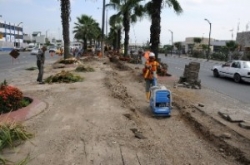 A buen ritmo avanzan los trabajos para la construcción de los carriles exclusivos. Se espera que todo esté listo para octubre del 2012.
Source: SIBRT
Guayaquil – Dentro de poco tiempo, los guayaquileños y quienes habitan en el puerto principal contarán con una nueva troncal de Metrovía; a buen ritmo avanzan los trabajos para la construcción de los carriles exclusivos de la troncal 25 de Julio, cuyo recorrido inicia en la terminal que lleva el mismo nombre ubicada en el sur de Guayaquil, hasta la terminal Río Daule.
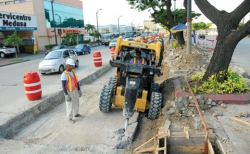
La empresa a la que se le adjudico la construcción de los carriles, ha instalado parte de la simbología en las calles y avenidas comprendidas dentro del proyecto. Entre ellas las avenidas 25 de Julio, Quito, Machala, de las Américas y Pedro Moncayo. La construcción de los carriles durará 18 meses, según lo estipula el contrato y cuyo presupuesto referencial es de 20954190.74 dólares. También se construirán 30 paraderos. Se espera que todo esté listo para octubre del 2012.
 Una de las cosas que más llama la atención en esta troncal es que habrá dos rutas. Una que recogerá y dejará pasajeros en todas las paradas y otra que solo lo hará en cuatro, a ésta se ha denominado express. Comprende: Las Acacias, Hospital Francisco de Ycaza Bustamante; Plaza Centenario y colegio Aguirre Abad.
Se prevé la movilización diaria de 250.000 pasajeros sólo en lo que corresponde a esta troncal, que sumadas a las 300.000 que actualmente lo hacen en todo el sistema, estaríamos hablando de unas 550.000.
El proyecto también incluye la construcción de cuatro pasos peatonales sobre la av. de las Américas en las estaciones del colegio Aguirre Abad, avenida Plaza Dañín, Juan Tanca Marengo y cdla. Simón Bolívar.
¿Comments? ¿Opinions? ¿Similar News? Send them to us!
Tweet
Opinion Pieces: The one thing we know about forecasts is that they are wrong: but by how much?
Opinion Pieces: since 2007, Prof. David Hensher has written an opinion column in the Australasian Bus and Coach magazine, where he monthly discusses a lot of different transport-related hot topics. In this section we are revisiting these columns.
August 2010
I have just returned from New Zealand where I gave three addresses on various aspects of transport reform. Over the total of 5 hours of talks it occurred to me that we have not progressed very far in improving our ability to forecast patronage and project costs of new major transport investments. Don Pickrell in 1992 blew the lid off of the USA Federal Government subsidy program associated with capital intensive projects since the program did not require state and local governments to be accountable for their forecasts and hence preference by States was given to such projects over other projects. The big errors occurred in ridership forecasts and capital cost estimates.
In the mid 1970, Dan McFadden (who received the Nobel prize for economics in 2000) demonstrated that a major reason for forecast errors in ridership of public transport is in the nature of the transport models used to study demand for travel (by mode, destination and frequency). Essentially, the models that contribute to significant errors back in the 1970s, known as four stage models, typically using highly aggregate data (at a traffic zone level – as if the zone travels) such that much of the explanatory power (or variability in travel behaviour response) is assumed away through working with average people and average behaviour. Essentially, the models that contribute to significant errors back in the 1970s, known as four stage models, typically using data describing the travel activity of the average traveller living in a defined physical area (like a postcode or a traffic zone) in terms of the average income, household size, age, and average trip time etc at a traffic zone level as if the physical zone travels; such that much of the explanatory power of the forecasting models in explaining travel demand is assumed away by working with average people and average behaviour.
Disappointingly all the consultants in Australia (with very rare exception) still use essentially the same methods as developed and applied in the 1960’s. Back then, McFadden and his team at Berkeley California showed the limitations of such transport models. So here we are in 2010, observing what has almost become a “law” of errors – if you want to get your forecast closer to reality, then halve public transport patronage forecasts and double capital costs. This also applies to toll roads.
Given we have known this for many years, why is the practice still blind to the evidence? Some have suggested it is because the numbers on ridership look on the low side to get Treasury support and indeed to enable an ultimate healthy benefit-cost ratio when subject to an environmental impact statement assessment. Others have suggested that if we ever want to get public transport built then we must “exaggerate” the evidence since no one really knows the truth anyway. This is known as strategic misrepresentation (which colloquially is known as lying). Well what to do given those in the know are fully aware of this.
Maybe we are safer simply buying more buses because no one apparently asks the question – how many more bums of seats will this deliver? Have you ever seen a benefitcost analysis or a patronage estimate associated with any request or announcement to increase the number of buses by 1 or 100 or 300?
Food for thought
¿Comments? ¿Opinions? ¿Similar News? Send them to us!
Tweet
A Look back at 1940s rail and freeway plans yields some surprises
Source: The Source
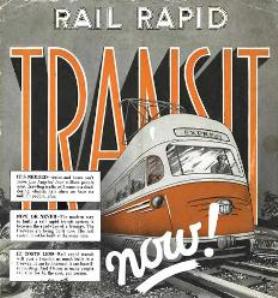 Los Angeles’ transit history often reveals something brand new: a map we never knew existed, an angle to a story that helps us connect the dots, or new information from the past that informs planning our future.
A closer look at competing transportation studies in 1948 turned up this hidden gem worthy of a double-take: the feeder routes for proposed rail lines running down freeway medians were referred to as “bus rapid transit.”
While the first bus rapid transit system was launched in Curitiba, Brazil in the early 1970s, plans for a local BRT were actually laid out a quarter century earlier…and more than 50 years before we launched Metro Rapid or the Orange Line.
The 1948 Rail Rapid Transit Now! campaign’s plan for building a comprehensive rail system in conjunction with freeway construction never materialized, but it set in motion other events in Los Angeles mobility for decades to come.
The full story can be found on the Primary Resources Blog produced by the Metro Transportation Library and Archive.
¿Comments? ¿Opinions? ¿Similar News? Send them to us!
Tweet
Urban bus services in developing countries and countries in transition: A framework for regulatory and institutional developments
Urban passenger transport has experienced major change in many developing countries in Africa, Asia, and the Middle East, as well as in countries of political and/or economic transition in the Commonwealth of Independent States (CIS) and China. Such changes have included planned market opening to private operators and new entrants; unplanned market opening by the entry of unlicensed operators; privatization and other changes to the ownership base of large public-sector transport companies; emergence of large-scale minibus and paratransit; and national and urban policies and programs to upgrade the transport supply and quality.
This paper presents a framework to understand regulatory and institutional changes in urban bus services in Africa, Asia, the Middle East, the CIS, and China. The framework identifies three types of changes: (i) changes in the role of the regulator and market structure; (ii) changes in the structure of the operator and of private sector participation; and (iii) changes in the transport supply. The paper then identifies critical factors leading to change in the urban transport sector, factors that can be identified with successful outcomes, and issues associated with the development of the minibus, paratransit, and the informal sector that have played major roles in the urban transport sector of developing countries and countries in transition.
New Siemens Electric Bus Rapid Transit system

Source: Gather – Electric Vehicles
The Siemens Electric Bus Rapid Transit system – or e-BRT for short – allows vehicles to run on electricity without overhead contact lines and without rails. The vehicles are quiet and comfortable, as they run on tires and electric motors.
Vehicles are equipped with electricity storage units that combine super-capacitors, batteries and converters, carrying enough power to reach the next stop. At each stop, the e-BRT vehicle is recharged for about 20 seconds, i.e. less time than passengers usually need to get on and off the bus. Electricity generated when the vehicles brake or slow down is also stored in the storage units.
While light rail, trams and trolley buses come with specific infrastructure and have restricted paths, e-BRT vehicles can travel on standard roads, sharing them with other users.
The only special infrastructure needed are bus-stops doubling as charging stations. In Siemens’ e-BRT system, such stations contain intelligence to help steer the electric buses in position as they approach the stops. This ensures more precise contact with the charging system and easy access for the passengers at a low-floor level.
Such innovations can also enhance the safety of bus travel. Bus stops can be equipped with automatically-controlled lights and announcements, complemented by warning signs at the stations in case passengers are standing too close to arriving vehicles. Video cameras and sensors on buses can help detect people and other vehicles, especially at spots that are otherwise hard to see for drivers.
The Siemens brochure e-BRT®: The sustainable development solution for Bus Rapid Transit lines describes its system as the ideal transport solution for medium-traffic routes, at a price a third to a half that of a tram line.
Check the following video, which shows how the system works:
¿Comments? ¿Opinions? ¿Similar News? Send them to us!
Tweet
The value of a promise: housing price impacts of plans to build mass transit in Ecatepec, Mexico
This research explores whether announcement of plans to build mass transit infrastructure had an effect on housing prices in Ecatepec, a fully urbanized municipality in the northeastern fringe of the Mexico City metropolitan area. The analysis compares prices of properties located within one kilometer of the future bus rapid transit (BRT) corridor with those of properties sold within the same distance of a similar corridor where no mass transit was slated to run. Differences are estimated before and after the announcement. The results contradict the hypothesis that transit project plans trigger an immediate windfall for property owners who capitalize on the expected benefits of enhanced accessibility before the start of operations. Instead, the mass transit plan appears to have had no impact on prices of lower-quality properties and in fact reduce rather than increase the prices of higher-quality properties.
Download full article.
A first glimpse on policy packaging for implementation of BRT projects
A BRT for the metropolitan area of Asunción (in Spanish)
Source: SIBRT
Asunción – El área Metropolitana de la capital paraguaya se prepara para el lanzamiento de las primera licitaciones de obras del primer troncal de Bus Rapid Transit (BRT), que será incorporado gracias al prestado otorgado por el Banco Interamericano de Desarrollo – BID, al Gobierno del Presidente Fernando Lugo. Coincidiendo con la visita de la vicepresidenta del BID, Julie Katzman, anunció la ampliación del primer troncal de BRT.
La representante del alto organismo financiero internacional, recorrió la zona donde se ejecutaran los dos proyectos financiados con aproximadamente U$S 160 millones compuestos por el BRT y el Proyecto Reconversión del Centro y Edificios de Gobierno, recientemente aceptado por el Gobierno Nacional, finalizando su recorrida por la zona de obras de la Avenida Costanera, el parque Bicentenario y la zona de Puertos donde existen componentes ambientales que serian de interés del Banco.
El proyecto de BRT, que inicialmente tenía previsto recorrer y conectar a tres ciudades en su recorrido, se amplía hasta la ciudad de Capiatá, ante la demanda de usuarios localizados en esa ciudad conforme a los datos arrojados por los estudios de Origen y Destino procesados en el marco de lineamientos que permiten hacer los ajustes al proyecto.
El proyecto, que inicialmente era de unos 18 kilómetros, en la actualidad fue extendido hasta Capiatá amplíando 10 Km su recorrido original debido a la demanda de usuarios desde esta ciudad cabecera de la capital paraguaya. En estos momentos se realizan todos los estudios que incluyen movimiento de pasajeros, origen, destino y nivel de demanda que propiciarán los horarios de los buses” remarcó el titular de la cartera de obras.
El Ministerio de Obras Públicas y Comunicaciones anunció que la licitación para el sistema BRT se realizará en julio y se espera su conclusión para fines de 2012 o comienzos del 2013.
¿Comments? ¿Opinions? ¿Similar News? Send them to us!
Tweet
Across Europe, irking drivers is urban policy
Source: The New York Times by Elizabeth Rosenthal
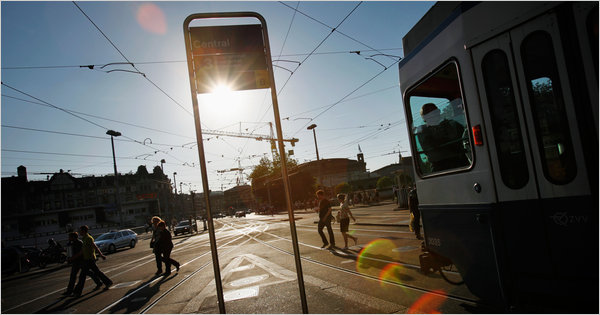
Pedestrians and trams are given priority treatment in Zurich. Tram operators can turn traffic lights in their favor as they
approach, forcing cars to halt. Photo: Christoph Bangert for The New York Times. More photos >>
ZURICH — While American cities are synchronizing green lights to improve traffic flow and offering apps to help drivers find parking, many European cities are doing the opposite: creating environments openly hostile to cars. The methods vary, but the mission is clear — to make car use expensive and just plain miserable enough to tilt drivers toward more environmentally friendly modes of transportation.
Cities including Vienna to Munich and Copenhagen have closed vast swaths of streets to car traffic. Barcelona and Paris have had car lanes eroded by popular bike-sharing programs. Drivers in London and Stockholm pay hefty congestion charges just for entering the heart of the city. And over the past two years, dozens of German cities have joined a national network of “environmental zones” where only cars with low carbon dioxide emissions may enter.
Likeminded cities welcome new shopping malls and apartment buildings but severely restrict the allowable number of parking spaces. On-street parking is vanishing. In recent years, even former car capitals like Munich have evolved into “walkers’ paradises,” said Lee Schipper, a senior research engineer at Stanford University who specializes in sustainable transportation.
“In the United States, there has been much more of a tendency to adapt cities to accommodate driving,” said Peder Jensen, head of the Energy and Transport Group at the European Environment Agency. “Here there has been more movement to make cities more livable for people, to get cities relatively free of cars.”
To that end, the municipal Traffic Planning Department here in Zurich has been working overtime in recent years to torment drivers. Closely spaced red lights have been added on roads into town, causing delays and angst for commuters. Pedestrian underpasses that once allowed traffic to flow freely across major intersections have been removed. Operators in the city’s ever expanding tram system can turn traffic lights in their favor as they approach, forcing cars to halt.
Around Löwenplatz, one of Zurich’s busiest squares, cars are now banned on many blocks. Where permitted, their speed is limited to a snail’s pace so that crosswalks and crossing signs can be removed entirely, giving people on foot the right to cross anywhere they like at any time.
As he stood watching a few cars inch through a mass of bicycles and pedestrians, the city’s chief traffic planner, Andy Fellmann, smiled. “Driving is a stop-and-go experience,” he said. “That’s what we like! Our goal is to reconquer public space for pedestrians, not to make it easy for drivers.”
While some American cities — notably San Francisco, which has “pedestrianized” parts of Market Street — have made similar efforts, they are still the exception in the United States, where it has been difficult to get people to imagine a life where cars are not entrenched, Dr. Schipper said.
Europe’s cities generally have stronger incentives to act. Built for the most part before the advent of cars, their narrow roads are poor at handling heavy traffic. Public transportation is generally better in Europe than in the United States, and gas often costs over $8 a gallon, contributing to driving costs that are two to three times greater per mile than in the United States, Dr. Schipper said.
What is more, European Union countries probably cannot meet a commitment under the Kyoto Protocol to reduce their carbon dioxide emissions unless they curb driving. The United States never ratified that pact.
Globally, emissions from transportation continue a relentless rise, with half of them coming from personal cars. Yet an important impulse behind Europe’s traffic reforms will be familiar to mayors in Los Angeles and Vienna alike: to make cities more inviting, with cleaner air and less traffic.
Michael Kodransky, global research manager at the Institute for Transportation and Development Policy (ITDP) in New York, which works with cities to reduce transport emissions, said that Europe was previously “on the same trajectory as the United States, with more people wanting to own more cars.” But in the past decade, there had been “a conscious shift in thinking, and firm policy,” he said. And it is having an effect.
After two decades of car ownership, Hans Von Matt, 52, who works in the insurance industry, sold his vehicle and now gets around Zurich by tram or bicycle, using a car-sharing service for trips out of the city. Carless households have increased from 40 to 45 percent in the last decade, and car owners use their vehicles less, city statistics show.
“There were big fights over whether to close this road or not — but now it is closed, and people got used to it” he said, alighting from his bicycle on Limmatquai, a riverside pedestrian zone lined with cafes that used to be two lanes of gridlock. Each major road closing has to be approved in a referendum.
Today 91 percent of the delegates to the Swiss Parliament take the tram to work.
Still, there is grumbling. “There are all these zones where you can only drive 20 or 30 kilometers per hour [about 12 to 18 miles an hour], which is rather stressful,” Thomas Rickli, a consultant, said as he parked his Jaguar in a lot at the edge of town. “It’s useless.”
Urban planners generally agree that a rise in car commuting is not desirable for cities anywhere.
Mr. Fellmann calculated that a person using a car took up 115 cubic meters (roughly 4,000 cubic feet) of urban space in Zurich while a pedestrian took three. “So it’s not really fair to everyone else if you take the car,” he said.
European cities also realized they could not meet increasingly strict World Health Organization guidelines for fine-particulate air pollution if cars continued to reign. Many American cities are likewise in “nonattainment” of their Clean Air Act requirements, but that fact “is just accepted here,” said Mr. Kodransky of the New York-based transportation institute.
It often takes extreme measures to get people out of their cars, and providing good public transportation is a crucial first step. One novel strategy in Europe is intentionally making it harder and more costly to park. “Parking is everywhere in the United States, but it’s disappearing from the urban space in Europe,” said Mr. Kodransky, whose recent report “Europe’s Parking U-Turn” surveys the shift.
Sihl City, a new Zurich mall, is three times the size of Brooklyn’s Atlantic Mall but has only 225 more parking spaces than Atlantic’s 625, and as a result, 70 percent of visitors get there by public transport, Mr. Kodransky said.
In Copenhagen, Mr. Jensen, at the European Environment Agency, said that his office building had more than 150 spaces for bicycles and only one for a car, to accommodate a disabled person.
While many building codes in Europe cap the number of parking spaces in new buildings to discourage car ownership, American codes conversely tend to stipulate a minimum number. New apartment complexes built along the light rail line in Denver devote their bottom eight floors to parking, making it “too easy” to get in the car rather than take advantage of rail transit, Mr. Kodransky said.
While Mayor Michael R. Bloomberg has generated controversy in New York by “pedestrianizing” a few areas like Times Square, many European cities have already closed vast areas to car traffic. Store owners in Zurich had worried that the closings would mean a drop in business, but that fear has proved unfounded, Mr. Fellmann said, because pedestrian traffic increased 30 to 40 percent where cars were banned.
With politicians and most citizens still largely behind them, Zurich’s planners continue their traffic-taming quest, shortening the green-light periods and lengthening the red with the goal that pedestrians wait no more than 20 seconds to cross.
“We would never synchronize green lights for cars with our philosophy,” said Pio Marzolini, a city official. “When I’m in other cities, I feel like I’m always waiting to cross a street. I can’t get used to the idea that I am worth less than a car.”
¿Comments? ¿Opinions? ¿Similar News? Send them to us!
Tweet
Configuration of Innovative Minibus Service in the Lisbon, Portugal, Municipality
The viability of implementing a new alternative intermediate transport mode in the Lisbon, Portugal, metropolitan area was examined. The intention of this new system was to combine the major strengths of both public transport and private vehicles to provide a competitive transport alternative for commuters from low and intermediate density areas, who do not create enough demand to sustain a high-quality public transport service. Conventional public transport systems can provide efficient space and energy consumption, whereas private vehicles have high levels of flexibility and are fast and always available. A comprehensive methodology is presented to encompass the generation of input data of the model on the basis of transport demand data involving spatial-temporal constraints, the possible location of the service stops, and the detailed characterization of the service operation. The global objective of the model is to design a self-sustainable system that would maximize the operator’s profit, not one that would satisfy all potential demand. The developed model uses supply parameters obtained through current bus operators in the region. However, the estimated values should be refined before service deployment. This assessment was performed, as an initial test bed for Lisbon and will be expanded to the whole metropolitan area. Results suggest that this service might be significantly profitable to the operator and a good alternative for single private car drivers. Implementation of this system may relieve some congestion during peak periods.
Indonesia’s transport initiatives
Source: The City Fix by Itir Sonuparlak
Jakarta’s chief of Railway Certification Department, M Sardjoko Hendrowijono, is asking for greater federal restrictions on private vehicle imports in an effort to balance the success of TransJakarta, Indonesia’s first bus rapid transit (BRT) system. “Hendrowijono admitted that TransJakarta bus had helped to overcome traffic congestion in Jakarta since it first operated in 2004,” reports Berita Jakarta, the city’s online media forum. “But if it is not counterbalanced by stopping the imports of both two wheels and four wheels vehicles, congestion will still continue to happen.”
Although Indonesia may still be accepting private vehicle imports, the citizens have spoken loud and clear: more car free days! Similar to Bogotá, Colombia’s Ciclovia or Minneapolis, Minnesota’s Open Streets, Jakarta’s Car Free Day, first conducted once a month, has gained so much positive attention that the city government is considering implementing it every week. Encouraging individuals to leave their cars at home, Jakarta’s Car Free Day opens the city streets to pedestrians and bicyclists, with only vehicular traffic being TransJakarta.
And although Jakarta citizens are excited about Car Free Days and the success of TransJakarta, Governor Fauzi Bowo’s administration has received poor ratings in dealing with traffic congestion. According to the Jakarta Post, only 29.4 percent of respondents thought that the Governor had performed well in providing decent public transportation. Despite Governor Bowo’s positive contributions to TransJakarta, like calling for improvements in driver recruitment and installing tracking devices in vehicles, 70 percent of the surveyed group still think that the Governor has failed in managing traffic.
Road construction and its effects on traffic may be part of the problem. Jakarta had initiated two construction projects on elevated roads back in January. Jakarta’s Traffic Police and Public Works had predicted that these construction projects would have a negative impact on the city’s already congested traffic at least until September 2011. Although the construction takes place between 10pm and 5am, the blocked lanes of construction have taken a toll on traffic.
Part of this construction is to provide a platform for the city’s ongoing Mass Rapid Transit System (MRT) project. The MRT will be a rail-based transport system that services over 110.3 km (68.5 miles) of Jakarta’s roads. The administration is relying heavily on the MRT to solve Jakarta’s congestion problems. With 7.34 million private vehicles in Jakarta today and a 9.5 percent growth rate in vehicular traffic in the past five years, public transportation does not seem to be a popular mode of transport. But even though public transport makes up only 2 percent of all trips, these services benefit 56 percent of all trips in Jakarta.
According to Tony Ibanez from Harvard University, a professor of urban planning and public policy, TransJakarta alone is capable in reducing private vehicle traffic. In fact, he encourages the city government to focus in developing BRT-based public transport schemes. “Each bus can accommodate 80-90 percent of passengers, more routes and lanes of TransJakarta bus must be built to serve the citizens,” Ibanez explained.
¿Comments? ¿Opinions? ¿Similar News? Send them to us!
Tweet
Assessing the cost of transfer inconvenience in public transport systems: A case study of the London Underground
Few studies have adequately assessed the cost of transfers in public transport systems, or provided useful guidance on transfer improvements, such as where to invest (which facility), how to invest (which aspect), and how much to invest (quantitative justification of the investment). This paper proposes a new method based on path choice,3 taking into account both the operator’s service supply and the customers’ subjective perceptions to assess transfer cost and to identify ways to reduce it. This method evaluates different transfer components (e.g., transfer walking, waiting, and penalty) with distinct policy solutions and differentiates between transfer stations and movements.
The method is applied to one of the largest and most complex public transport systems in the world, the London Underground (LUL), with a focus on 17 major transfer stations and 303 transfer movements. This study confirms that transfers pose a significant cost to LUL, and that cost is distributed unevenly across stations and across platforms at a station. Transfer stations are perceived very differently by passengers in terms of their overall cost and composition. The case study suggests that a better understanding of transfer behavior and improvements to the transfer experience could significantly benefit public transport systems.
Opinion Pieces: Pricing must be a priority, so must keep mentioning it
Opinion Pieces: since 2007, Prof. David Hensher has written an opinion column in the Australasian Bus and Coach magazine, where he monthly discusses a lot of different transport-related hot topics. In this section we are revisiting these columns.
July 2010
The Henry Review tells us that we must rethink the charging regime for cars and trucks. The two specific recommendation is that “Governments should analyse the potential network-wide benefits and costs of introducing variable congestion pricing on existing tolled roads (or lanes), and consider extending existing technology across heavily congested parts of the road network. Beyond that, new technologies may further enable wider application of road pricing if proven cost-effective. In general, congestion charges should apply to all registered vehicles using congested roads. The use of revenues should be transparent to the community and subject to further institutional reform.”
This must be of interest to the bus sector since the adage ‘to make public transport more attractive we must make the car less attractive’ still holds. Anyone who thinks you can build a solution through an injection of investment in public transport alone is foolhardy since it will do little to ease congestion on our transport networks. You have to manage congestion and not assume you can build your way out of it. What we need is an integrated program of carrots and sticks, linked to network operating plans, HOT/HOV lanes, improved public transport to attract car users, better land use/transport integration, and crucially, pricing reform, as recommended in the Moving People documents produced by BIC and UITP.
I remain fearful that governments of all persuasions in Australia will continue to ignore the crucial role of pricing of car use as a non-blunt instrument (one of the few such transport instruments we have). This issue is squarely in the space of politicians and marketing – the economic and technical issues of efficient charging of car use are more or less solved.
We can be thankful that The Netherlands is doing something about it with a congestion charging scheme that varies the price by location and time of day. We watch and hope it works and we can learn and follow. NXP Semiconductors and IBM have announced the final results of a landmark road pricing trial conducted in the Netherlands, which demonstrated that with the help of technology, drivers can be motivated to change their driving behaviour, reducing traffic congestion and contributing to a greener environment. Key findings of the trial included (i) 70 per cent of drivers improved their driving behaviour by avoiding rush-hour traffic and using highways instead of local roads; (ii) On average, these drivers in the trial saw an improvement of more than 16 per cent in average cost per kilometer; (iii) it showed that a clear system of incentives is critical to changing driving behaviour; and (iv) instant feedback provided via an On-Board Unit display on the price of the road chosen and total charges for the trip are essential to maximizing the change in behaviour.
What we have to do is continue to build the case with examples that show the buy in from stakeholders. This is referred to as stakeholder acceptability and is tied up with how the revenue raised is spent. Road pricing can raise significant revenue. The distribution of this money is an important consideration in a road pricing program development, and one which transport professionals, who traditionally struggle to obtain rather than disperse money, may be unprepared to evaluate. Using revenues to fund transportation improvements and broad economic benefits to residents through reduced taxes, rebates or community programs may provide the greatest overall benefit and earn the widest political support. Persons who are much more aware about a definite introduction of road pricing generally develop a more positive attitude towards road pricing than less convinced persons, i.e., the strength of conviction about the introduction of road pricing has a strong effect on the attitudinal evaluation of road pricing. Thus it is clear that we must keep the debate alive in the popular press as well as in the professional outlets – as they say, the more we talk about it the easier it will be to make it happen.
Food for thought
¿Comments? ¿Opinions? ¿Similar News? Send them to us!
Tweet
L.A. Council OKs bus-only lanes along Wilshire Boulevard

The 7.7-mile stretch between MacArthur Park and Centinela Avenue is expected to cut 11 minutes from the trip. Officials hope to begin construction of the lanes in the summer of 2012 and open them in mid-2013.
Source: Los Angeles Times by Ari Bloomekatz
Wilshire Boulevard, the most heavily used bus corridor in Los Angeles with lines running every couple of minutes and tens of thousands of passengers enduring lengthy and crowded rides, is about to get a facelift designed to bring riders some relief.
To streamline and speed commutes from MacArthur Park to Centinela Avenue at the eastern edge of Santa Monica, the Los Angeles City Council voted Tuesday to construct bus-only lanes along 7.7 miles of that stretch. Officials estimate that it will shave 11 minutes off a nearly one-hour trip.
«It’s a real breakthrough,» said Sunyoung Yang of the Bus Riders Union. «The city has taken a huge step forward to prioritize transit over single-passenger automobiles.»
Yang and representatives of other transit advocacy groups had hoped the council would approve a longer stretch for the bus-only lanes, but still felt the 7.7-mile route was an achievement.
The original proposal called for 8.7 miles of the special lanes, but a one-mile section west of Beverly Hills known as Condo Canyon was excluded after residents and some officials said the lanes would create difficulties for motorists entering their driveways and were not necessary in that section.
When the council approved the 7.7-mile route Tuesday, members made a point of supporting the full route and asking the Metro board to reconsider the Condo Canyon exclusion.
If the MTA does reverse course, the project would return to the council for a new vote. Officials with the city, Metro and the Los Angeles County Board of Supervisors must all approve the same project to be eligible for $23.3 million in funding for the bus-only lanes from the Federal Transit Administration.
The project is expected to cost $31.5 million, Metro officials said, with the remainder coming from other transportation funds.
Councilman Bill Rosendahl and some Brentwood and Westside residents had sought yet another alternative: a 5.4-mile stretch of bus lanes that would stop east of Beverly Hills. But Rosendahl found little support on the council for that proposal.
Some Westside speakers said they were worried that the new lanes would increase traffic congestion and decried claims that they were prejudiced and classist.
«We’re not NIMBY’s, we’re not racists, we’re not against bus lanes,» said Marylin Krell, president of the South Brentwood Residents Assn. «We’re against gridlock,» she said.
Allison Mannos of the Los Angeles County Bicycle Coalition pushed for the full alignment and suggested that those «folks who say congestion will increase should get on the bus» rather than drive cars. Several council members, including Richard Alarcon, said exceptions made to the full alignment were driven purely by political influence.
Brad McAllester, Metro’s executive officer for long-range planning and coordination, said the bus-only lanes would be established on both sides of the street in the current curb lanes — which would be repaved.
Only a half-mile segment would need an additional lane, McAllester said, and there would be other improvements to the corridor such as widening in some areas, restriping, signal improvements and changes to some left/right-turn lanes.
Only buses would be allowed in the designated lanes from 7 a.m. to 9 a.m. and from 4 p.m. to 7 p.m. on weekdays. Officials hope to begin construction of the lanes in the summer of 2012 and open them in mid-2013.
«We’re looking to make the best use of the transportation system as a whole,» McAllester said, adding that officials will look to Wilshire’s success — or failure — to see if similar efforts can work in other places in the county.
«I’m absolutely in favor of it,» said 40-year-old Jason Friedrich, who takes the Metro 720 Rapid from Wilshire Boulevard and La Brea Avenue to work in West L.A. each day. «There’s a huge bottleneck created by traffic coming off and on the 405,» he said.
His morning trip generally takes about 35 minutes, but sometimes after work it can take more than an hour because of traffic, he said.
«This city needs more people on transit,» Friedrich said. «We’re not getting anywhere in our cars.»
¿Comments? ¿Opinions? ¿Similar News? Send them to us!
Tweet
Xiamen BRT to take measures to ease rush hour jam
Source: What’s On Xiamen

According to an online survey on passenger satisfaction released by Xiamen BRT, 90% of the passengers rated the BRT service as ‘crowded’. In order to ease the rush hour jam, Xiamen BRT will take measures suggested by passengers starting from June 15th, reports Strait Herald.
First, LED screens at BRT platforms will be remade. Passenger information systems in LED screens will be distinguished by red, green and yellow. The new information system is expected to be finished in mid-July.
Second, rails will be set up to direct passengers to queue up for the BRT buses orderly.
Third, considering short-distance passengers (1-3 stations) accounting for a large proportion, BRT may raise prices of the short-distance ticket to limit passenger flow volume during rush hours. (It takes less time for short-distance passengers to take buses than BRT)
Fourth, based on passenger flow volume, BRT lines will be adjusted and directly sent to some stations with large passenger flow, such as Xiamen Railway Station (daily highest passenger flow volume: 40,000) in rush hours (7.am-8.am and 5.pm-6.pm).
Finally, some seats will be removed to offer more space for passengers. However, considering long-distance passengers, it is impossible to remove parts of seats in all BRT‘s.
¿Comments? ¿Opinions? ¿Similar News? Send them to us!
Tweet
Transport Economics: An Overview
The relationship between bus contract costs, user perceived service quality and performance assessment
In contract tendering or negotiation there is a growing interest in identifying and integrating user perceptions of service quality into the determination of contract costs. This article develops a framework within which a cost–service quality relationship is quantified, and then implemented to identify benchmark targets for cost efficiency improvements required to achieve a pre-defined service […]
Valuation of Travel Time Savings in WTP and Preference Space in the Presence of Taste and Scale Heterogeneity
A major concern with the derivation of willingness to pay (WTP) distributions from mixed logit models is the incidence of values over a range that are deemed ‘behaviourally questionable’, with respect to the sign and magnitude. Recent research in redefining the ‘space’ within which a choice model is estimated as WTP space, instead of preference-space, has offered encouraging evidence in reducing the range of behavioural implausibility. This paper develops models to compare the empirical evidence when a mixed logit model is estimated with unconstrained distributions on random parameters in WTP and preference space, taking into account scale and the correlation between the attributes. The findings suggest that the gap between the evidence in WTP and preference space narrows significantly when both scale and preference heterogeneity are identified.