
Transit ridership up due to rising gas prices
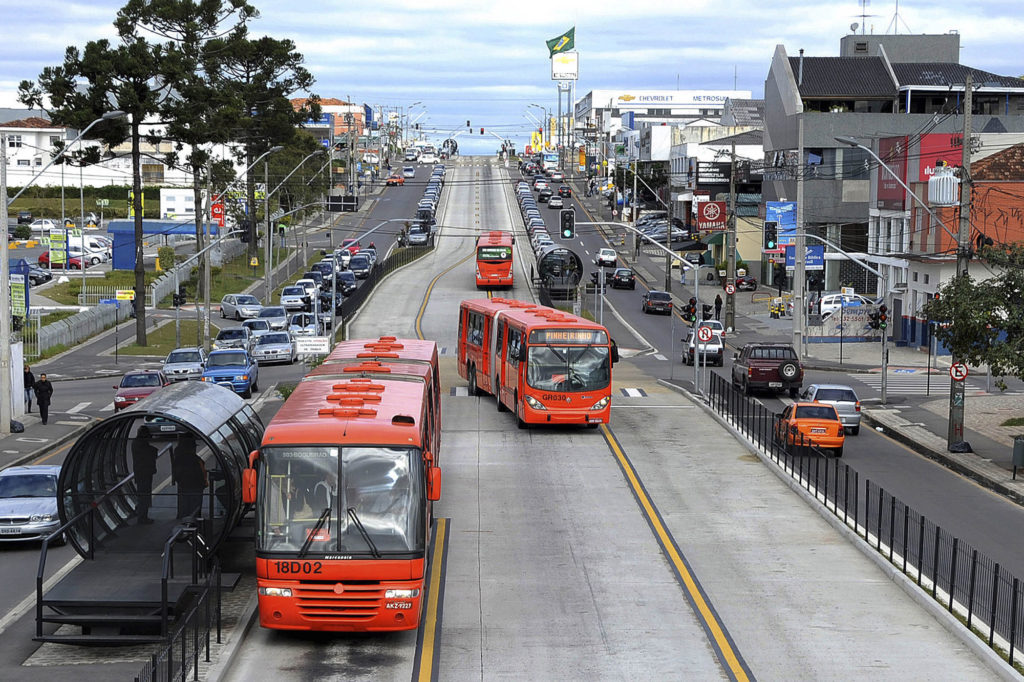
Source: AltTransport by Joseph Cutrufo
It was only a matter of time: Transit agencies are reporting increased ridership in USA due to higher gas prices.
With the national average for a gallon of regular unleaded now at $3.98, motorists across the nation are switching to public transportation. We saw it in 2008, when the national average reached $4, and we’re seeing it all over again.
According to the American Public Transportation Association, $4 per gallon is the tipping point where people begin to drive less and use transit more – a lot more. If gas prices stay this high, we can expect an additional 670 billion transit trips made this year nationwide.
In Boston, transit ridership is up 5 percent overall, with 7 percent increases on rapid transit lines. Highway and airline traffic are also up, but this is mostly attributed to the recovering economy.
The Gold Line, a light rail line that connects Pasadena, CA to Union Station in Downtown Los Angeles, saw a 10 percent increase in ridership in March 2011 over March of 2010. Transit officials expect even higher ridership as the area’s 12 percent unemployment rate goes down and people head back to work.
It’s not just in big cities with subways and light rail where travel behavior is changing. In Wichita, KS, ridership is up 5 percent despite a recent $.25 fare increase. Wichita Transit expects even more new riders when the average gas price hits $4 a gallon there.
Ridership is up 4.7 percent in Wilkes-Barre, PA in the first quarter of 2011 compared to the first quarter of 2010. The Luzerne County Transit Authority secured a flat $2.56 per gallon price on diesel that will last through June, and they’re replacing older buses with diesel-electric hybrids in 2012.
In McAllen, TX, it’s not just gas prices but also flashy new lime green buses and cheap fares that transit officials are giving credit for increased ridership in 2011.
With all this increased ridership nationwide, let’s hope a transit-friendly transportation bill passes. It’s probably not a good idea to slash funding for public transportation when we have so little control over the cost of the alternative.
¿Comments? ¿Opinions? ¿Similar News? Send them to us!
Tweet
Can the clean development mechanism bring Bogota's 'surface subway' to your city?
Source: E&E Publishing by Nathanial Gronewold
BOGOTA, Colombia — A 10-year public transit project here has fast become a model for developing cities the world over. But could it next be the model for a major expansion in international carbon offsetting efforts?
Fully operational from 2001, the TransMilenio service is famous as an ideal bus rapid transit system, an innovation that by some estimates is roughly 1,000 times cheaper than building a subway. The model is now being copied elsewhere in Latin America, Africa, Asia and even the United States.
Less well-known, TransMilenio was the first public transportation project in the world to win U.N.-approved greenhouse gas emissions offset credits. Developed in tandem with the United Nations’ Clean Development Mechanism (CDM), the methodology for counting the climate change-combating benefits of mass transit was designed with TransMilenio in mind. It is now being adopted by other municipalities eager to trade reduced carbon dioxide emissions for CDM cash.
Alone just a few years ago, TransMilenio is now one of six registered CDM transportation projects, with 36 more in the works. Advocates are hoping that hundreds more will follow, eager as they are to spread the benefits of carbon reductions, cleaner air and smoother commuting in rapidly expanding developing-world cities while simultaneously reducing the dominance of China, India and Brazil in the CDM.
But some say that the slow growth of transportation projects in the CDM shows why one of the best options for diversifying the geographic spread of these international carbon offsetting projects may fail to live up to expectations.
Daunting paperwork needs to be simplified
While some see transportation becoming one of the fastest-growing areas of the CDM, others knowledgeable of Bogota’s experience doubt that such projects will ever expand in number beyond the handful that exist today. The complexity of counting the avoided CO2 from reduced car trips, policed rigidly by U.N. regulators eager to avoid fraud or scandals, is too great for many city governments to bother, they say.
«If you don’t simplify the process, you will have large projects come for it, but they will be a minority of projects,» said Jürg Grütter of Grütter Consulting.
Grütter’s firm helped Bogota with its CDM application and is busy with other projects around the world. It aided with the second successful transportation applicant to the CDM, a bus rapid transit system in Guangzhou, China, and has team members in India, Brazil and Vietnam.
But in an interview, Grütter complained that the hurdles such projects have to go through to win the CDM credits, known as Certified Emission Reductions (CERs), are so numerous that they will never proliferate at the rate that the most optimistic proponents would like.
Aside from the difficulties of proving that projects need the CER income to be viable, the costs and complications from counting and tracking the cuts in CO2 levels attained make it likely that most developers will choose to stay away from the CDM, he and his team believe. Counting emissions reductions from thousands of tailpipes, it turns out, isn’t nearly as straightforward as dealing with a single source.
«When the public sector is involved, they are very fearful of this type of contract,» Grütter said. «It’s much more difficult to define the product and define the quality and to define what you are in fact contracting.»
The operators of the Bogota system themselves, however, are more optimistic that CDM administrators and public transit advocates can find the right balance. The reason, they say, is that every time they host a foreign delegation on a tour of TransMilenio, they are asked in detail how they managed to secure CDM financing for the project.
«That is one of the top presentations that we have,» said Arturo Fernando Rojas Rojas, deputy general manager of TransMilenio, in an interview.
Designated bus lanes unsnarl traffic
With more than 50 miles of designated bus lanes separated from the normal traffic flow, TransMilenio is still the largest bus rapid transit, or BRT, system in the world, though it’s modeled after a much older one in Curitiba, Brazil.
The concept is often called «surface subway» by its proponents.
Using streets freed from passenger vehicles, pre-boarding fare payment systems and transfer stations, bus rapid transit operates very similarly to a rail system but is much less expensive, relying largely on existing infrastructure. Transportation experts say it costs roughly $1 billion to build a mile of below-ground subway track in the United States, whereas costs for bus rapid transit are put close to $1 million per mile.
Commuters say that within the past decade, TransMilenio has managed to tame Bogota’s famously snarled city traffic, especially the notorious congestion on Caracas Avenue. A trip that once took an hour and a half is now estimated to last only 45 minutes using the buses. Green «feeder buses» deliver passengers to the main stations, where they can board the articulated red buses on the physically separated lanes.
To date, Rojas estimates that TransMilenio has earned his public firm about $2.63 million selling CERs, all on a contract with the government of the Netherlands. The money is but a small fraction of the cost of operations, but TransMilenio officials insist that it is money badly needed to finance sustainability efforts and environmental monitoring of their system.
Andres Jara, who runs the Bogota office of the Institute for Transportation and Development Policy (ITDP), said the system has completely transformed his hometown. TransMilenio is now undertaking phase three of its 30-year expansion plan, which the city hopes will eventually include more than 200 miles of designated bus lanes and will incorporate all of the dozens of remaining independent bus operators into one centralized system.
Copycats look for CDM money
«The situation right now in developing countries and developing cities is that we have a lack of resources,» Jara said. «So what we showed with TransMilenio and BRT systems is that you can develop a strong transportation system with high quality, high efficiency, at a fraction of the cost.»
That lesson hasn’t gone unnoticed. Jara estimates that he has traveled to more than 100 countries in the past four years educating city planners on the BRT model, including China, where he aided Guangzhou’s efforts. The idea has since spread to South Africa, India and Indonesia, and new growth is expected in Mexico, Brazil, Argentina and possibly Tanzania.
Like Rojas at TransMilenio, Jara says that all transit planners he has met with expressed interest in tapping the CDM. He says it’s a wise move and he can see transportation CDM projects booming in popularity in the years to come.
«It’s not a lot, but it’s an additional income that is always helpful, useful, if you want to make more research on how you can improve the operation,» Jara said.
The CDM offices in Bonn, Germany, usually require project developers to show that their efforts couldn’t happen without the benefit of the carbon offset credit sales. But that hard requirement, termed «additionality,» has been watered down over the years as developers complain it is too rigid and has stymied the spread of CDM projects to smaller developing nations.
TransMilenio SA officials admit that they don’t need the CER cash to survive. But experts point out that public transportation projects are rarely profitable and almost always rely on significant outside financing for support, a strong argument in favor of CDM support. And much of the cash goes back into the emissions monitoring regime demanded by Bonn regulators.
«There are difficult aspects that we have to bear in mind, and the money helps us to be more sustainable,» Rojas said. «We can in fact work without this extra income. However, this income is very important for us.»
The other potential benefits for cities looking to follow Bogota’s example are numerous.
Cuts in traffic, pollution and crime
By taking cars and dirtier buses off the road, the city estimates, TransMilenio has prevented more than 2 million tons of CO2-equivalent greenhouse gases from entering the atmosphere. The city smog has been reduced, and health officials expect there will be fewer asthma-linked deaths. Residents even report that safety and security have greatly improved — robberies in traffic jams or on the city’s minibuses were common occurrences, so the city combats this with cameras in buses and stations and police patrols.
If future growth plans are rolled out as scheduled, Bogota officials expect further reductions in traffic, air pollution and crime, even as the city’s population expands and cars get cheaper. By 2030, TransMilenio officials say, 100 percent of Bogota’s public transit network will be theirs, cutting the number of total buses from 16,000 on the streets today to just 12,000.
And though he enjoys the CDM income today, Rojas admits that he’s worried about what may happen should nations fail to reach agreement on a new international climate change treaty and extend the life of the carbon offsetting system. The credits should continue to come in for another 10 years, as the European Union will still trade in CERs up to 2020, but beyond that, Rojas said, he will either have to seek out deals in the voluntary carbon market or come up with an alternative solution.
With the December 2012 Kyoto Protocol deadline looming, carbon offsetters will face pressure to get CDM projects registered as soon as possible. But Grütter says the cost and hassle involved in getting all the paperwork sorted out ahead of time will keep developing world public transportation projects from ever becoming as big a part of the CDM as he and others would like.
«If transport is to really play a larger role, you have to simplify the whole procedure quite a lot,» he said. «Very large cities with very large projects, they might go for it. But when you have a huge amount of intermediate cities, between half a million to 1 million, in developing countries, the project itself currently will be too small to warrant all these transaction costs.»
¿Comments? ¿Opinions? ¿Similar News? Send them to us!
Tweet
Opinion Pieces: Plans, plans and action! Or is it a promise?
Opinion Pieces: since 2007, Prof. David Hensher has written an opinion column in the Australasian Bus and Coach magazine, where he monthly discusses a lot of different transport-related hot topics. In this section we are revisiting these columns.
February 2010
February 2010 has been a month of new plans to ‘sort out’ Sydney’s ailing transport system. First we had the Sydney Morning Herald (SMH) Transport Blueprint with an almost total emphasis on public transport (some have said it should have been a transport and land use plan and not a public transport plan!). Then we had the NSW Government’s Metropolitan Transport Plan (previously announced as a Blueprint but downscaled). In many ways the SMH blueprint has outshone the government’s plan (the latter printing 50 shiny copies which is also available online here).
Now that the dust has settled, what might we observe about the two plans? First we have to recognize that much of what is offered will not even be started until well after the government’s current term in office. However this is not unusual since major infrastructure takes time to put in place. However, given that what we now have is at least the 5th plan with little action (in line with the plan) over the last 10 years, and that many of the proposed projects have been lightly appraised in respect of impact on key objectives, such as reducing congestion, improving accessibility and delivering value for money, it is not unreasonable to ask about the chances of specific projects ever happening?
The most dramatic feature of the government’s plan is the scrapping of the Metro and the almost total focus on central business district (CBD) centric transport investment. This may prove to be a mistake given that it was meant to go out West to Westmead and was more than a CBD metro, and most importantly was designed to create competition and to break the stranglehold on Cityrail and union power in the delivery of rail services which have been anything but efficient and effective. So this is a win for Cityrail, the union and wasteful spending. What we now have is a promise for line duplication to the west and the north.
The $50.2bn metropolitan transport plan pledges $6.7bn for a new train service to outer northwest Sydney (the Hills district), with work to commence in 2017. But while the blueprint promises «quadruplication» of the rail line between Chatswood and St Leonards on Sydney’s north shore, it makes no commitment to extra capacity on the harbour crossing. Two new rail tunnels will be needed under the harbour, at an estimated cost of $3-4bn. I commented in the Australian recently that «If a quadrupling of the line is needed because there’s evidence to suggest demand will require it and it will remove a bottleneck, there’s going to have to be recognition of getting across the Harbour Bridge.» and “likely public opposition to any proposal to add an extra deck to the bridge would leave the government with no option apart from tunnelling.” «What we’ve got here is very high-level commitments to projects that were once on the books and were taken off, but are now back on for political reasons.» A weakness of the transport blueprint was its assumption future rail users would want to take trips in and out of the city rather than making «circumferential» journeys. «Why are we quadrupling the line there in the first place?» A spokesman for NSW Transport Minister David Campbell said that an additional harbour crossing would be considered in the future.
When and if the north-west rail link is recommenced as a project, it would be appropriate to revisit the options that were considered almost eight years ago. These include bus rapid transit in tunnels along the lines of the Brisbane system (and yes it can deliver the same capacity as a tunnelled railway for considerably lower cost, making it look like, smell like and act line a rail system).
Most importantly however, the continued failure to look at more efficient and fairer charging schemes for car usage (apart from a flat $30 registration increase for most car classes), denies the system of an opportunity to raise sizeable sums of money to put back into the overall transport system so car users and public transport users (and the freight sector) can all benefit. It remains a puzzle as to what certain politicians believe that ‘roads should be free’. Clearly this is sending a message that people put little value on saving travel time!
Food for thought
¿Comments? ¿Opinions? ¿Similar News? Send them to us!
Tweet
Raising revenues through bus advertisements

Source: The City Fix by Itir Sonuparlak.
Photo by Willamor Media
The Charlotte-Area Transit System (CATS) signed a five-year, $2.6 million contract with Titan, a transit advertising company, to allow advertisements on its fleet of buses and light rail. The agreement gives Titan the exclusive right to sell and manage advertising on the city’s public transit vehicles. The contract will allow exterior and interior advertising for buses and exterior advertising on the CATS light rail system. In return for the exclusive right to prime transit real estate, Titan guaranteed a $5 million profit to CATS in a span of five years.
CATS removed advertisements from its public transit vehicles in 2000 because the project was not cost-effective. CATS Marketing and Communication Manager Olaf Kinard believes the project will be more successful this time around because of the growth in Charlotte’s transit system. According to WSOC-TV, an ABC-affiliated television station in Charlotte, CATS’s fleet of buses grew from 120 to 330 since 2000. The LYNX Blue Line, the region’s first light rail service, is also a fairly new addition to the region’s public transit system, having started service in 2007. Overall, CATS provides transport to 25 million people annually with 70 bus and light rail routes.
This is an especially lucrative time for companies to advertise in Charlotte since the 2012 Democratic National Convention is scheduled to be held in the city’s Time Warner Cable Arena on September 3, 2012.
Charlotte is not alone in offering transit real estate for advertisements. New York City makes subway cars, buses, stations, panels on entryways to stations, and even the backs of metro cards available for advertisements, exposing these messages to millions of people who ride public transit every day.
But what do these advertisements mean to commuters? Kinard explains that the profits from this service can help cover costs, which could avoid an increase in fares. “It helps us manage our costs, especially with rising fuel prices,” he said in the interview with WSOC-TV.
¿Comments? ¿Opinions? ¿Similar News? Send them to us!
Tweet
EMBARQ India conducts training workshop on bus operations
Putting learning into practice to improve mass transit.
Source: EMBARQ
EMBARQ India, in association with the Institute of Urban Transport (IUT), conducted a three-day training workshop on bus operations for 27 officials from transport organizations and municipal corporations in 23 cities across India.
The workshop was based on materials contained in Bus Karo, a guidebook on bus planning and operations developed by EMBARQ India. The workshop covered topics including the role of buses in sustainable urban transport systems, planning for bus operations, including demand estimation and routing, methods of bus priority, technology and vehicles for bus operations, and financial analysis. The attendees also participated in field exercises in the city of Panjim, Goa.
In addition to three EMBARQ India staff – Madhav Pai, Amit Bhatt and Ashwin Prabhu – the workshop also saw presentations by Kishore Nathani from the Urban Mass Transit Company and Manjiri Akalkotkar of the Center for Environmental Planning and Technology University (CEPT).
As part of the Jawarharlal Nehru National Urban Renewal Mission (JnNURM), the Government of India provided 61 Indian cities with funding to procure more than 15,000 new buses. As a consequence of this program, city and state road transport projects have been undergoing a process of fleet expansion and renewal. Many cities without urban bus systems are planning to launch services with these new buses. Given the general lack of technical capacity in transport planning at the city and municipal government level, training in bus operations for transport officials is essential for developing high quality bus-based public transport systems.
The Ministry of Urban Development (MoUD) recently launched a large national capacity-building initiative in the field of urban transport. The Institute of Urban Transport (IUT), an undertaking of MoUD, is the nodal agency for implementing this initiative. This workshop was the first in a series planned by IUT in the coming year. EMBARQ India was invited to serve as the faculty for this workshop.
Funding for the workshop was provided by the Sustainable Urban Transport Project (SUTP), in partnership with Global Environment Facility (GEF) of the United Nations Development Programme (UNDP).
¿Comments? ¿Opinions? ¿Similar News? Send them to us!
Tweet
Assignment of work shifts to public transit drivers based on stated preferences
Transit agencies periodically assign each of their drivers with a shift describing when and for how long they will work each day in the following months. Since drivers are not indifferent to which shift they receive, transit agencies define different assignment methods often based on driver seniority. This article studies and compares different shift assignment policies assuming that the agency has some information regarding the approximate utility that each shift represents to each driver. Additionally, based on a study that analyzes driver utilities for flexible shifts (i.e. in which the weekly number of hours is not distributed uniformly along weekly working days), it shows that implementing flexible shifts offer a win-win opportunity for the agency and the drivers. On one hand drivers improve their productivity (i.e. fraction of the time in which drivers are actively working); on the other they increment their satisfaction with their job. This is particularly relevant since transit operational costs are strongly dependent on their labor force. Some of the benefits obtained by the firm should finally be captured by the users of the system.
Opinion Pieces: Going Dutch – listen to the future
Opinion Pieces: since 2007, Prof. David Hensher has written an opinion column in the Australasian Bus and Coach magazine, where he monthly discusses a lot of different transport-related hot topics. In this section we are revisiting these columns.
January 2010
There is a slow but growing realization that the future of public transport depends on the future of road pricing related to vehicle use, with a portion of revenue raised to be earmarked to public transport as a way of obtaining stakeholder buy in. The Dutch government is leading the way – it plans to scrap the road tax as well as the purchase tax on all new cars when the system is introduced in 2011. The Minister of Transport says this will provide a fairer system which taxes vehicle use, rather than ownership. Indeed, the minister says that more than half of Dutch road users will actually pay less under the road user charging scheme. According to calculations by motoring organizations, only motorists who drive more than 18,000kms a year are likely to be worse off under the new scheme. Currently in Sydney Private cars average 12,500km per annum, Household business cars average15,000kms per annum, and company cars average 22,000kms per annum.
A first implementation takes place in The Netherlands by 2011 for truck traffic and as of 2012 to 2016 for passenger cars. The motor vehicle tax (MRB) and the purchase tax (BPM) will be replaced by a system whereby the motorist pays depending on location, time and environmental aspects. The Automotive Telematics On-board unit Platform ATOP from NXP makes it possible to introduce pay-as-you-drive. It is safe, simple and very cost effective: it really is possible!
The Dutch government has determined that the costs of operating the national road user charge will not exceed five per cent of the proceeds. On November 16 last year the Dutch Cabinet agreed to the km charge for cars: 3 euro cents/km in 2012 increasing to 7 euro cents in 2017, equivalent of A$0.05/km in 2012 (or 50c/litre) or A$750 per annum (15,000km), compared to current registration fees (typically in Aust. around $300-$400). The 3 Euro Cents per km will increase to 6.75 Euro cents per km in 2018. The 3 euro cents is an average but varies by class of vehicle based on energy efficiency (A,B, C…). Hybrid vehicles will pay approximately 0.5-1 Euro cents per km. In 2012, however as part of a phase in program, the new charging regime will apply to only 20% of cars (selected via a lottery), with 100% covered by 2018. The charge will be a flat rate per km per class up to 2018; however from 2018 a peak rate will start, but only in Amsterdam, with a lower base (non-peak) rate when the peak rate is introduced. The entire scheme is designated as revenue neutral. It is claimed that 58% of people in entire country will be better off with significant reductions in congestion.
We look with great interest to the Netherlands. Will Australia like what it sees? It will certainly be much fairer than the very unfair (inequitable) system we have in place.
Food for thought
¿Comments? ¿Opinions? ¿Similar News? Send them to us!
Tweet
Thinking on public accountability: How to address quality of policy design and decision-making
T-MAPPER website launched
 Online database tracks actions to mitigate transport emissions.
Source: EMBARQ
EMBARQ and its partners are pleased to announce the launch of a new report and website, Transport Measures And Policies to Promote Emission Reductions (T-MAPPER), that provides information and data on national policies that help mitigate greenhouse gas emissions from the transport sector.
The transport sector currently accounts for a fifth of global carbon dioxide (CO2) emissions, and transport energy-related CO2 emissions are predicted to increase by 1.7 percent per year from 2004 to 2030. A large proportion of these emissions take place outside of Europe, and the largest growth is anticipated in developing countries.
The European Commission (EC) commissioned the T-MAPPER study to better understand and support the actions being taken outside of the European Economic Area (EEA) to mitigate transport emissions.
The project team was led by the Transport Research Laboratory (TRL), with support from the Istituto di Studi per l’Integrazione dei Sistemi (ISIS), the Energy Research Centre of the Netherlands (ECN), the Clean Air Initiative for Asian Cities (CAI-Asia), the German Technical Cooperation (GIZ) and EMBARQ.
According to the website, the project aims to:
- Provide a comprehensive understanding of policies being enacted outside the EEA to reduce the climate impact of the transport sector, some of which could be transferred to EEA countries, and;
- Provide information on possible mechanisms to support the reduction, or avoidance, of increases in Greenhouse Gas (GHG) emissions from transport (in other areas of the world).
To learn more, download the full report, two-page summaries for each of the 20 countries currently included in the database, or the data spreadsheets. EMBARQ contributed information about transport emissions reduction policies in the United States, Canada, Colombia, Mexico and Brazil.
Transport and climate experts are encouraged to submit information about policies that help cut transport-related greenhouse gas emissions by filling out this simple online form.
¿Comments? ¿Opinions? ¿Similar News? Send them to us!
Tweet
Managing Urban Mobility Systems
Urban mobility is currently a major problem all over the world. Space is limited, and individuals aim for a level of quality in mobility that is only achieved by largely motorised solutions, which have a detrimental effect on the urban environment. Careful analysis of urban mobility systems across the world reveals that consistent and effective policies can only be defined and implemented if the various components of the system and their interrelations are considered. This book addresses the problem of managing urban mobility systems in a novel way by considering the complexity and diversity of the conurbation and agents involved in a UMS, putting forward the evidence that urban mobility must be managed at system level. The value of this book lies in bringing together a sound theoretical approach to urban mobility systems supported by evidence from several cities across the world where this approach was either implemented or at least assessed, together with clear instructional guidelines. It constitutes a handbook for practitioners, politicians, researchers and students of urban mobility management.
Accessibility: User satisfaction, Authority satisfaction, or Society satisfaction?
Event wrap-up: "Best Practices in Integrated Transport Systems and BRT in Latin America"
Inaugural conference in Guayaquil, Ecuador draws more than 150 participants
Source: EMBARQ
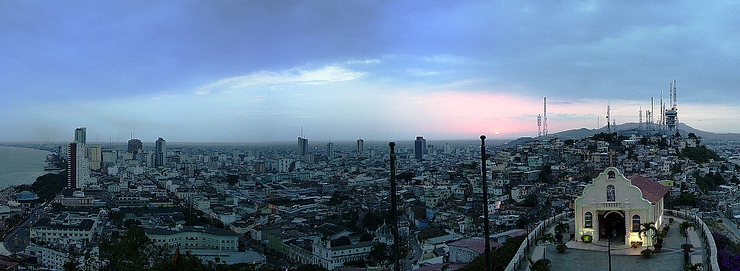
More than 150 representatives from cities across South America, Europe and Asia participated in the inaugural conference of Best Practices in Integrated Transport Systems and Bus Rapid Transit (BRT) in Latin America, also known as Congreso SIBRT, on April 25-27 in Guayaquil, Ecuador.
The four-day conference was hosted by the Latin American Association for Integrated Transport Systems and Bus Rapid Transit (SIBRT) and co-organized by Metrovía Foundation and EMBARQ, with the support of the Municipality of Guayaquil.
Senior representatives from Latin America’s most influential transit agencies shared experiences and best practices of integrated transport and BRT systems.
«Congreso SIBRT emphasized the benefits of developing sustainable transport systems in Latin America cities», said Fernando Paez, president of SIBRT. «It provided a space for cities to exchange goals and solutions to improve quality of life».
Paez underscored the importance of the SIBRT association, which is a strateg partner of our CoE, and for which EMBARQ serves as Technical Secretariat, for exchanging experiences and lessons learned among transit authorities, suppliers, traders, academics and citizens.
«It was a great opportunity to bring together representatives from cities that are different in terms of population and available resources,» said Daniel Marx Couto of BHTrans from Belo Horizonte, Brazil. «It is important for each one to know about all the different transport projects and to deploy those that best fit their city’s reality. This, surely, will help improve mass transit in Latin America.»
General Secretary of SIBRT Marcos Isfer, who is also the president of URBS in Curitiba, Brazil, shared similar sentiments: «It’s wonderful to have this opportunity to share successful experiences in implementing such transit systems, showing the managers of public transportation agencies that this is the solution of sustainable transport.»
Dr. Carlos Dora from the World Health Organization (WHO) emphasized the importance of data collection and benchmarking. «If this group of representatives from public transport agencies makes assessments about improvements in quality of life and public health, before and after the implementation of these transport systems, they can change the perceptions of public policies in this sector,» he said.
Luis Gutierrez, EMBARQ’s Latin America Strategic Director and member of our CoE, stressed the relationship between transport and health: «The lecture by Dr. Carlos Dora prompted many comments and people showed interest in developing metrics for the impact of transportation projects on three dimensions of health: air pollution, accidents and lack of physical activity.»
Several members of our CoE assisted and made presentations during the event. Juan Carlos Muñoz presented the ALC-BRT Centre of Excellence and its members, describing also its vision, goals, objectives and the work we are doing and plan to do in the short and long term.
Dario Hidalgo described the Status of the BRT Industry, which is part of the CoE ALC-BRT Observatory. He summarizes it as follows: «We advanced a survey of BRT around the world that shows an impressive growth of this type of applications, specially on the last decade. The influence of the Latin American systems has worldwide impacts. BRT has proven to be low cost, rapid to implement, and with high performance and significant positive impacts. BRT is now present or is an aspiration of most cities. Despite the evident success, several systems in the developing world suffer problems resulting from poor planning, implementation and operation, due to financial, institutional and regulatory constraints. In particular, high occupancy levels, resulting from the need to cover capital and operational costs out of the user fare, is hampering the attractiveness and medium term sustainability of the bus systems.»
Toni Lindau made a presentation at the event on Mobility for Big Events: FIFA World Cup and the Olympic Games in Rio de Janeiro, where he described the challenges imposed to the city by these and other mega events occurring from 2011 to 2016 and the hundreds of km of BRS (Bus Rapid Services) and BRT systems that are under planning/implementation stages (for more information, read this interview to Toni).
¿Comments? ¿Opinions? ¿Similar News? Send them to us!
Tweet
Understanding spatial variations in the impact of accessibility on land value using geographically weighted regression
Opinion Pieces: Beyond the words – action is now increasingly more visible
Opinion Pieces: since 2007, Prof. David Hensher has written an opinion column in the Australasian Bus and Coach magazine, where he monthly discusses a lot of different transport-related hot topics. In this section we are revisiting these columns.
December 2009
2009 was a watershed year with more State governments finally showing an increasing positive active commitment to public transport, as well as earlier initiatives starting to deliver tangible patronage growth outcomes. Whether we agree with the specific infrastructure and service propositions or not, there is now very tangible evidence that investment in improved public transport has begun. In Sydney we see planning well advanced on rail projects (e.g. The Metro in the CBD and out to Westmead, the South- West Rail link), and the roll out of 300 additional buses. In Victoria we see the high frequency Smartbus Route network grow to 198 kms.
The Bus Association of Victoria suggests that the success of bus patronage growth is attributable to frequency, span of hours, better network planning, and geographical coverage. We would not argue with this, but would also add capacity. We might also remind governments of all persuasions that within the limits of likely funding on public transport, achieving these four objectives will requires some careful thought on how much of the financial pie is available to serving the entire metropolitan network. We are seeing a risk associated with a focus on a few corridor specific projects that will leave little for the rest of the system.
The author, with Professor Corinne Mulley of ITLS-Sydney, and a PhD student at the University of Newcastle (UK) recently evaluated the impact of a high quality bus service known as Superoute (having some similarities to the SmartBus Routes in Melbourne), which can be delivered with relatively low amounts of financial investment. The ‘Superoute’ brand was designed and introduced to offer passengers high quality services across a number of the major corridors on local services within Tyne and Wear, to encourage greater use of public transport. Buses operating on a ‘Superoute’ offer higher frequencies than other routes, bus priority measures where appropriate to secure better punctuality, a high standard of shelters and information at stops, and modern vehicles including easy access for wheel chairs and prams. A total of 40 ‘Superoutes’ are operating across Tyne and Wear following their launch in 2002. Patronage on the ‘Superoutes’ is on an upward trajectory since the introduction of quality improvements, whilst the rest of the network continued to decline. On average there has been a 30 percent growth in patronage over each two year period.
These examples highlight the need for greater partnership between government and operator, as well as a rethink about how restrictive existing contracts are in encouraging any initiatives such as the one above. In particular we would suggest that there are greater opportunities for Local Government to engage much more with bus operators (beyond current activity which mainly relates to the provisions of roadside furniture such as bus shelters) in sharing financial inputs where State Governments are not involved, since relatively small investments in quality partnerships like the Superoute initiative in the UK (which was not funded by Central Government) can deliver strong transport benefits while taking pressure off of the road budget.
Food for thought
¿Comments? ¿Opinions? ¿Similar News? Send them to us!
Tweet
Planning for the future of Indian cities
EMBARQ experts highlight importance of sustainable transport.
Source: EMBARQ
Naya Raipur Development Authority (NRDA) and EMBARQ organized a half-day workshop on March 25 highlighting the importance of sustainable transport in Indian cities.
The workshop involved more than 50 senior goverment officials and delegates from the state of Chhattisgarh.
Dario Hidalgo presented on «Urban Transport: Problems and Perspectives» to share principles of sustainable transport from around the world. EMBARQ India’s Senior Transport Specialist Amit Bhatt gave a presentation exploring the possibility of extending a bus rapid transit (BRT) system in the new city of Naya Raipur.
Naya Raipur, a greenfield city, is being planned as the new administrative capital of Chhattisgarh. Naya Raipur is planning a BRT system that would improve mobility for people living in the new developments of Naya Raipur, as well as the current capital city of Raipur.
EMBARQ is assisting NRDA in planning and designing the new city. Further meetings are planned with the Raipur Municipal Corportation and Raipur Development Authority.
Other workshop participants included:
- Mr. Rajesh Munat, Minister for Urban Development, Housing & Environment, Government of Chhattisgarh
- Mr. P. Joy Oommen, Chief Secretary, Government of Chhattisgarh
- Smt. Kiranmai Nayak, Mayor of Raipur
- Mr. Anil Baijal, former Secretary, Ministry of Urban Development, Goverment of Indi
The following it the presentation by Dario Hidalgo:
¿Comments? ¿Opinions? ¿Similar News? Send them to us!
Tweet
OUT NOW: Updated and improved "Modelling Transport" 4th Edition, John Wiley & Sons

«…a book which should be on the shelf of every theoretical modeller and practitioner…» (Euro Jnl of Transport and Infrastructure Research, Vol.2, No.2, 2002)
Authors: Juan de Dios Ortúzar, Luis G. Willumsen
Already the market leader in the field, Modelling Transport has become still more indispensible following a thorough and detailed update. Enhancements include two entirely new chapters on modelling for private sector projects and on activity–based modelling; a new section on dynamic assignment and micro–simulation; and sizeable updates to sections on disaggregate modelling and stated preference design and analysis. It also tackles topical issues such as valuation of externalities and the role of GPS in travel time surveys.
Providing unrivalled depth and breadth of coverage, each topic is approached as a modelling exercise with discussion of the roles of theory, data, model specification, estimation, validation and application. The authors present the state of the art and its practical application in a pedagogic manner, easily understandable to both students and practitioners.
- Follows on from the highly successful third edition universally acknowledged as the leading text on transport modelling techniques and applications.
- Includes two new chapters on modelling for private sector projects and activity based modeling, and numerous updates to existing chapters.
- Incorporates treatment of recent issues and concerns like risk analysis and the dynamic interaction between land use and transport.
- Provides comprehensive and rigorous information and guidance, enabling readers to make practical use of every available technique.
- Relates the topics to new external factors and technologies such as global warming, valuation of externalities and global positioning systems (GPS).
For more details, you can find the book on Amazon.
¿Comments? ¿Opinions? ¿Similar News? Send them to us!
Tweet
Continuous Mobility Surveys: The State of Practice
In this paper we challenge the prevailing practice of conducting one-off cross-sectional mobility surveys, making a case for change on the basis of usefulness and cost-effectiveness. We believe that urban areas over say, one million inhabitants, should collect mobility data on a continuous basis as part of their efforts to guarantee sustainable development. This would allow them to gain a proper understanding of the pressing environmental and transport-related issues of today’s world, as well as of the effects of economic growth and price (especially for fuel) volatility. In our scope we include panel data (i.e. information from a smaller sample of respondents who are interviewed at different points in time, hopefully during several years), as this type of information is unique in its ability to help understanding behavioural changes and the impact of time-related effects, such as habit and inertia. We revise the state of affairs in different parts of the world, not limiting ourselves to urban data.
Modelling Transport
Opinion Pieces: Towards a higher level of trust between operators and the regulator
Opinion Pieces: since 2007, Prof. David Hensher has written an opinion column in the Australasian Bus and Coach magazine, where he monthly discusses a lot of different transport-related hot topics. In this section we are revisiting these columns.
November 2009
Legally binding Commercial Arms-Length Contracts will work better if there is greater trust in the partnership between operator and regulator
The 11th International Conference on Competition and Ownership in Land Passenger Transport (Thredbo 11) was held in Delft, The Netherlands in late September (2009). A number of bus operators, consultants and regulators from Australia attended (including all the Executive Directors of the Bus and Coach Associations in New South Wales [NSW], Queensland and Victoria and the President of BIC). Over 4 days we discussed and debated developments in reform agendas throughout the world as well as updating experience with contract systems already in place. A number of very useful experiences and recommendations were tabled. Some of the most pertinent ideas and actions around the world that should be shared with Australia are summarized below. As NSW in particular begins its next round of contract negotiations in the next 12 months, it is timely to reflect on what we have learnt.
In terms of the experiences with the NSW contracts, research undertaken by the author has identified a very low degree of contract clarity in respect of ‘incentives to improve performance and grow patronage’, ‘contract renewal procedures’, and ‘ad hoc claims’. There was however a high level of contract clarity on ‘maintenance of accreditation currency’, ‘obligations regarding bus maintenance with the contract’, ‘agreements and obligations in respect of rights of operators in adjacent locations in joint service provision (integrated networks)’, and ‘payment procedures’. We also investigated how successful the bus operation has been under the contract in addressing (or resolving) issues that have arisen during this first contract period. We found that the most successful issues that have been resolved through communication are ‘contract renewal procedures’, ‘maintenance of accreditation currency’, ‘contract end procedures’, and ‘adherence to contract matrix’. The issues where success has been perceived as quite ineffective have been ‘depot upgrades and expansion’, ‘change events’, and ‘incentives to improve performance and grow patronage’. This evidence should be taken into account in the next round of negotiations. Overlaying all this evidence was a finding that where operators reported a higher level of trust between themselves and the regulator, there was greater communication and quicker resolution of issues, saving money and time.
Looking to other countries we find that:
1. Building and using Trust is not a vacuous construct but one with pre-conditions: Stakeholder Competence, Confidence, Consistency, Commitment, Common core objectives (The 5 C’s), Contract Clarity (before signing the contract), and Clarity of obligations once the contract is signed.
2. Evidence suggests that the greatest challenge in terms of ambiguity after a contract is signed is on the demand side with Service planning, Network design, and Marketing.
3. There is growing support for Gross Cost Contracts (GCC) which include strong and effective incentives and profit and loss sharing, mindful of budget constraints of Treasury. An example in Holland is Gross cost plus BIG incentives, with bonuses based on Satisfaction of passenger, Satisfaction of authority (with operator), and Growth in patronage. There is a shared benefit (25%) of extra passenger revenue, and a maximum bonus of 1 million Euros p.a. (approx 4-5% of turnover). There is also a recognition of a sensible budget constraint (crucial issue often neglected – which helps Treasury).
4. In Holland however, there is a strong interest in revenue-based contracts with budget subsidy incentives, although it is too early to decide their effectiveness.
5. Net cost contracts have come under criticism in Europe. The problem for the authority is managing evidence on revenue, and operators not reinvesting super profits back. As well, operators often have little or no risk over fares, network and actual potential market.
6. Up-skilling of all stakeholders but especially regulator/PT authority is crucial in building trust.
Finally a crucial challenge that regulators should recognise and advise on is ‘how much of patronage growth can be attributed to the specific contract design, and how much is due to other factors?’
Food for thought
¿Comments? ¿Opinions? ¿Similar News? Send them to us!
Tweet
New videos of our projects!
We uploaded some new videos of our current projects to our YouTube Channel. We hope you enjoy them!
These are the topics:
Development of a Framework to Measure and Model the Performance of BRT Systems ITLS
David A. Hensher
Corinne Mulley
John Stanley
Institute of Transport and Logistics Studies – The University of Sydney
Implementing BRT: Controversies, Alliances and Emergent Actors pt1
Implementing BRT: Controversies, Alliances and Emergent Actors pt2
Claudia Gutierrez (PUC)
Manuel Tironi (PUC)
Onésimo Flores (MIT)
Chrispher Zegras (MIT)
Assessment of Needs in Training and Educational Gaps
Rosário Macário
José Viegas
Instituto Superior Técnico – Universidade Técnica de Lisboa
Exploring the Complexity of Policy Design
Rosário Macário
José Viegas
Instituto Superior Técnico – Universidade Técnica de Lisboa
¿Comments? ¿Opinions? ¿Similar News? Send them to us!
Tweet
New video: Guangzhou’s Bus Rapid Transit system
Source: The City Fix and Streetfilms.
Streetfilms, in collaboration with the Institute for Transportation and Development Policy (ITDP), recently released a video highlighting Guangzhou, China’s bus rapid transit (BRT) system. Guangzhou’s BRT system won the 2011 Sustainable Transport Award for making great strides in increasing mobility, reducing greenhouse emissions and air pollution, and improving safety for pedestrians and cyclists.
The 23-kilometer (14.3-mile) corridor is the first BRT in China that integrates bicycles in its design. According to Karl Fjellstrom, vice-director at ITDP, there are 5,000 bikes and 5,500 parking docks included in the BRT.
“What the Guangzhou BRT has done is to raise the bar,” Fjellstrom says. “So this is more than three times bigger than any other BRT system in Asia, 800,000 passengers a day and 27,000 passengers per hour carried in a single direction.”
The most significant improvement in the views of the citizens has been the decrease in travel time. Distances that once took 40 minutes to an hour have now been reduced to 10-20 minutes thanks to the multi-modal integrated BRT.
You can learn more about Guangzhou’s BRT by visiting their website.
¿Comments? ¿Opinions? ¿Similar News? Send them to us!
Tweet
Opinion Pieces: Talking about road pricing
Opinion Pieces: since 2007, Prof. David Hensher has written an opinion column in the Australasian Bus and Coach magazine, where he monthly discusses a lot of different transport-related hot topics. In this section we are revisiting these columns.
October 2009
The Bureaucrats are at Least Talking about Road Pricing, but can Federal Talk translate to State action UNLESS there is a sting in tail?
It is very pleasing to see the Head of Treasury in Canberra promoting road pricing reform as a headline in his tax reform agenda. Ken Henry said that “There would be few areas in economics [road pricing reform] where such a clear and rational set of policy directions have so consistently lagged in practice.”
It is well known that, most of the time, cars impose minimal costs on other road users. However, in major cities we experience significant congestion during extended peaks, seven days a week, when each vehicle imposes costs on other drivers and does not contribute to the cost of so doing. This results in a… “predictable ‘tragedy of the commons’ estimated to waste around $9 billion a year in avoidable congestion costs, increasing to around $20 billion by 2020. Such costs will only increase with faster population and economic growth.”
Ken Henry makes an admirable stance “In the face of these [congestion] costs, why have we stuck to the traditional ‘fuel tax and rego’ model for roads, when sensible pricing seems to offer such large benefits? The Federal government likes its fuel tax, and the State govt likes its vehicle registration charges.
While it is pleasing to see a senior Bureaucrat talking about Road Pricing, one wonders how Federal Talk is likely to translate into State action UNLESS there is a sting in the tail? The concern that needs addressing is that a congestion charge is very likely to be collected by State governments and not Canberra, and so one wonders what incentives have to be put in place for any suggestions from Canberra to be actually taken seriously by the States.
The Premier of NSW Nathan Rees (Front page Sydney Morning Herald Sat 1 Nov 2008) soon after his appointment said: “…there should be a public debate about whether or not congestion charging should be introduced for the CBD” AND”.. he wants cashless tolls on all of Sydney’s major roads so motorists pay varying fees at different times of the day – an effective congestion tax to cut peak-hour traffic.” This is encouraging. However we have a climate where the NSW government has announced its intention to remove the toll from a major tollroad next February. Hence one wonders about the preparedness to consider much more sensible efficient and fair pricing regimes. It is apparent that at least one State government believes that roads should be ‘free’, and that they are hence committed to paying with time and frustration, rather than with money. Feel free to oppose it, but do not complain about the traffic. Opposing efficient pricing means you are choosing to endure continual congestion problems.
Food for thought
¿Comments? ¿Opinions? ¿Similar News? Send them to us!
Tweet
Opinion Pieces: The new era of zero emissions is in sight – good news for public transport? Maybe
Opinion Pieces: since 2007, Prof. David Hensher has written an opinion column in the Australasian Bus and Coach magazine, where he monthly discusses a lot of different transport-related hot topics. In this section we are revisiting these columns.
September 2009
There is a growing swell of opinion that the energy sources that has the current highest probability of replacing fossil-fuels is electricity via ‘replacement advanced battery technology’. For those in the know, there is a lot happening in the development of vehicles driven on battery-power accompanied by a network of battery replacement stations (much like petrol stations).
It was announced on October 23, 2008 that Australia will become the third country in the world to have an electric car network (up by 2011) in a bid to run the country’s 15 million cars on batteries powered by green energy. The international company Better Place (head office Canada) has teamed up with AGL Energy and Macquarie Capital Group to set up a network of «charging spots» and «battery exchange stations» to power electric vehicles in Brisbane, Sydney and Melbourne. The electric car networks, as they are called, allow zero emission vehicles to run on clean energy grids in order to reduce the dependence on oil. As we all know, but often fail to remember, there may be a shortage of oil but there is no shortage of energy.
Denmark and Israel have already begun to lead the way on this initiative by moving to establish the world’s first electric car networks. Under the plan, charging spots, to top up batteries, are being located in places where cars park, such as home garages, shopping centres and office carparks. The charging spots, which would look like parking meters, provide cables to connect batteries to a green energy grid. AGL Energy provides the power from renewable sources including hydro and wind. On the urban fringe and on freeways, «battery switching stations» would exist for trips longer than 161 kilometres. A driver would enter a switching station (much like they do toady with filling up the fuel tank at a petrol station), and replace the car’s battery before continuing on their journey.
Most notably, the advanced battery technology which looks very much like a flat disc will be slid into the undercarriage of a car and as a new battery is able to deliver power for up to 160 kilometres, which is plenty spacing between existing petrol stations which will become battery switching stations. As one approaches the battery switching station, one enters a facility that in a maximum of 40 seconds (once one is out of the queue), the flat battery is attached to the ground unit, slid out and a new battery placed in the undercarriage and away you go (after paying naturally! using electronic equipment much like an ETAG for a toll road). Battery technology at present has a maximum of 160 kms before recharge (or switching), and this deteriorates over time. After a number of recharges the batteries being switched in the long distance interurban context loose power and can be relocated to other switching stations in metropolitan areas where the kilometres between switching and hence recharge are less. There will come a point in time after a number of recharges where the battery will no longer be of use (much like batteries in mobile phones).
It has been estimated that the operating costs of these vehicles will be as low as 3c/km, in comparison to 12c/km for petrol-powered vehicles. With less moving parts the maintenance costs will also be lower. We are told that such vehicle swill cost around $20,000 to purchase. This all sounds too good to be true! But it is happening and Canberra has started the process.
Although the focus is on cars initially, the evidence, if realised, will send a message about the carbon footprint of cars and (which should almost disappear – even allowing for the sourcing of battery technology and its power), and provide encouragement for the entire bus industry to move this way where it will be much easier to implement the battery switching network.
There must be a downside surely? Well if we fail to rethink the whole charging regime for car use, we will end up with much greater car use and hence traffic congestion in the big cities. In the rural and regional areas the lower cost of fuel and vehicle prices should mean that some who are disadvantaged but can drive will be better placed to buy a car. Hence it the cities this may signal greater urgency in introducing variable user charging where you pay per kilometer, so that we can properly reflect the cost of lost time, something I have explained in detail in previous opinion pieces. The bus industry can both benefit through lower operating and maintenance costs but also worry about the possible increase in costs due to traffic congestion and the move away from buses in favour of low cost energy-efficient zero carbon footprint cars.
Food for thought
¿Comments? ¿Opinions? ¿Similar News? Send them to us!
Tweet
Buenos Aires Bus Rapid Transit line takes shape

Source: ITDP
Photo: Lope de Vega Station
Buenos Aires residents are counting down the days until the first Bus Rapid Transit line in Buenos Aires, indeed in all of Argentina, opens for business. ITDP has provided technical assistance to the Government of the City of Buenos Aires and served as the leader of a team of experts.
The first line was originally slated to open in 2010 but the system planners wanted to construct additional infrastructure to prevent flooding in case of major storms. The system now appears to be on schedule for May 2011. Stations and dedicated running ways are rising along the 12 km corridor, that will connect opposite ends of the city, linking two major train stations and two subway lines.
The fully accessible, 21 station system is expected to cut travel time by 40%, providing a faster, smoother and more comfortable ride for the anticipated 100,000 daily users.
As opening day for Line One draws closer, ITDP continues to work as part of a group, which includes LOGIT, GSD+ and IRV and is financed by the Corporación Andina de Fomento (CAF), on data collection and planning for lines two and three.
Learn more about Metrobus in Buenos Aires.
¿Comments? ¿Opinions? ¿Similar News? Send them to us!
Tweet
Bogotá's rise and fall
Can Enrique Peñalosa restore a tarnished municipal model?
Source: The Economist
The bright-red articulated buses of Bogotá’s TransMilenio, with their dedicated lanes and station-style stops, were once the symbol of a city that had been transformed from chaos and corruption in the 1980s into a model of enlightened management admired and imitated across Latin America. Today the chaos and corruption seem to be back. The TransMilenio buses are horribly overcrowded even at off-peak times, attracting muggers and pickpockets. Though murder rates continue to slide, only 20% of those asked in a poll in September said they felt safe in their city and 27% said they had been victims of crime in the previous year. Road-building at more than 200 separate points across the city of 7.4m people is choking traffic. Things will get worse in May when work starts on Carrera Septima, one of the main arteries.
Bogotanos blame this backward slide on their mayor, Samuel Moreno, a populist from the left-wing Democratic Pole party. In a poll last month by Gallup, 85% of respondents disapproved of his administration. Contractors claim that the mayor and his brother, a senator who resigned this month from the Democratic Pole, have demanded kickbacks for public works. “Lies, lies, lies,” says the mayor. The government’s independent inspector-general has begun an investigation all the same. The inspector has already forced the sacking of the city’s comptroller, Miguel Angel Moralesrussi, and banned him from public office for 20 years.
Whatever the outcome of the inquiries, the city is due to elect a new mayor in October. The candidate comfortably leading the Gallup poll is Enrique Peñalosa (with 39%). As mayor from 1998 to 2001, he did much to change the face of Bogotá. As well as TransMilenio, he built more than 200km of cycle paths, a network of public libraries and got private schools to run new public schools in the poorer south of the city.
But Mr Peñalosa, who was once talked of as a future president of Colombia, is better at urban management than at politics. Mr Moreno beat him easily in 2007 by promising to start building a metro—a pledge which he has yet to keep. Mr Peñalosa, ever the technocrat, pointed out in vain that TransMilenio offered much better value for money.
Can he win this time? His political alliances are wide but potentially contradictory. He is standing for the Green Party, co-led by another former mayor, Antanas Mockus. But Mr Peñalosa also enjoys the backing of Álvaro Uribe, Colombia’s conservative president between 2002 and 2010. Mr Mockus unsuccessfully ran for president last year against Juan Manuel Santos, the man whom Mr Uribe eventually backed as his successor. Mr Uribe is anathema to many of the Green Party’s leftish rank and file. Several prominent members have defected; others have tweeted their disgust. Many in the U Party of Mr Uribe and Mr Santos are not happy either, arguing that they should field their own candidate.
Mr Peñalosa doubtless hopes that the voters will be less sectarian than the activists, and that above all they want their city to be run well. But he is taking no chances. “Having several metro lines would be extraordinary,” he said recently. Extraordinarily expensive, he might add.
¿Comments? ¿Opinions? ¿Similar News? Send them to us!
Tweet
Opinion Pieces: I tolled you so!
Opinion Pieces: since 2007, Prof. David Hensher has written an opinion column in the Australasian Bus and Coach magazine, where he monthly discusses a lot of different transport-related hot topics. In this section we are revisiting these columns.
August 2009
Have you ever stopped to think about how much people spend each year on tolls, compared with petrol, in using their cars in cities where there is an extensive and growing tolled road network? Let’s look at Sydney (see the Figure below).
It is generally assumed that the average kilometres that a car is driven per annum (privately and company registered vehicles) is 15,000 kms. Given the current average retail price of unleaded petrol of around $1.25 (accounting for premium unleaded in the mix), and an average fuel efficiency of say 9 litres per 100kms, then the average fuel bill per annum is $1,687. Depending on where one lives in Sydney, as well as where one visits (including the work location), tolls paid per annum can be as high as $4,400 per annum for someone living in the Hills district, working in the CBD and using the M2/Lane Cove Tunnel/Harbour Bridge each day of the week for 45 weeks per annum. If you choose to avoid Lane Cove Tunnel, the annual toll impost is $3,100 per annum. Tolls in Sydney for those regularly using tollroads from the Hills district put the price of fuel in perspective!
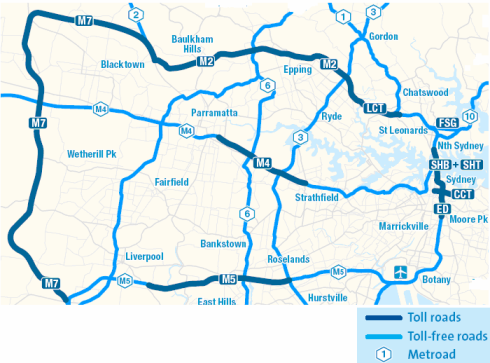
Figure: The network of Sydney’s Toll roads
Note: Metroad is the non-tolled metropolitan freeway network
Source: NRMA
| Tollroad | Length | Current tolls (GST included) |
| M2 | 21km | Based on the toll plaza and vehicle size |
| M4 | 40km | $2.75 for Class 2 |
| M5 | 22km | $2.75 for Class 2 |
| M7 | 40km | Distance based charge, 33.25 cents per km (< 20 km), $6.65 trip cap for all vehicles |
| CCT | 2.1km | Based on the route and vehicle size |
| LCT/FSG | 3.6km | $2.72 (LCT) and $1.36 (FSG) for Class A; $5.45 (LCT) and $2.72 (FSG) for Class B |
| ED | 6km | $5.00 for Class 2 vehicles; $10 for others (Northbound only) |
| SHT | 2.3km | Time of day tolling (Southbound only) |
| SHB | 1.15km | Time of day tolling (Southbound only) |
Of course, not everyone uses toll roads, and indeed the 38 kilometres of tollroads do not cover all trip contexts. Indeed 18 percent of all residents in Sydney regularly use tollroads, and from the Hills District we are talking about over 80,000 trips each way per day where tolls are paid, the equivalent of approximately $125m per annum. This is equivalent to approximately $3,300 per car per annum.
The fact that tollroads are getting expensive for many trip situations around the Sydney metropolitan area, should raise questions about how long people will be willing to pay increasingly high tolls? The answer must lie in part with the travel time savings offered and the service levels of alternative modes of transport. It is interesting to note that 9 of the top 10 roads with the slowest speeds in Sydney in the peak periods are toll roads (the worst road in Sydney being a free road – Victoria Road). With buses benefitting by a dedicated lane on a number of the tollroads, and which are often seen speeding past the crawling car traffic, the elements of a clear message that bus services can do a better job than the car is starting to emerge. What also is emerging, however, is the apparent patience of many commuters who would still sit in their air conditioned/heated car, especially in the cooler months, without coughing commuters on buses and trains, and having to stand for quite a high percentage of the journey. Clearly we are prepared to pay
a lot for getting a seat, which is guaranteed with car use but not for bus and train (and appears to be getting worse for train in particular).
Food for thought
¿Comments? ¿Opinions? ¿Similar News? Send them to us!
Tweet
Decentralization as an institutional determinant for the performance of urban mobility systems
"Plan of Action" defined to improve Lima's Metropolitano BRT
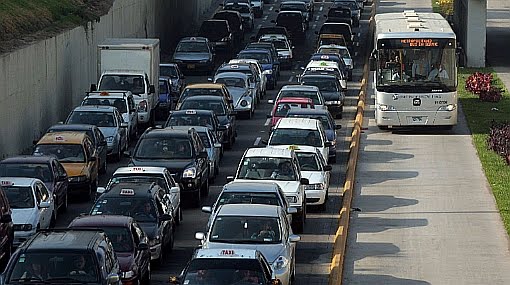
Source: EMBARQ
The Center for Sustainable Transport and Health in the Andean Region (CTSS-Andino) and Peru’s Development Finance Corp. (COFIDE) defined a «Plan of Action» to overcome operational problems of Lima’s Metropolitano bus rapid transit (BRT) system.
The recommendations follow an intensive Value Assurance Review (VAR) of the system. Results were presented to the Mayor of Lima Susana Villarán, who agreed to allocate $20 million to deal with problems confronting the city’s BRT.
Recommendations are related to operations, production cycles and programming, technology platforms, institutional aspects, and economic and financial performance. Problems and corrective actions were identified by a team of international experts, overseen by EMBARQ Latin America Strategic Director Luis Gutierrez, and CTSS-Andino Director Jorge Jara.
The plan of action requires an integrated set of corrective actions to be implemented both in the short term, within the next five months, as well as in the longer term, by December 2011.
These activities are part of the agreement signed between CTSS-Andino and COFIDE on January 17 to execute an ambitious five-year program to support urban development and sustainable mobility in nine Peruvian cities.
¿Comments? ¿Opinions? ¿Similar News? Send them to us!
Tweet
A topological route choice model for metro
This article presents a route choice model for public transit networks that incorporates variables related to network topology, complementing those found in traditional models based on service levels (travel time, cost, transfers, etc.) and users’ socioeconomic and demographic characteristics (income level, trip purpose, etc.). The topological variables represent concepts such as the directness of the chosen route and user knowledge of the network. For both of these factors, the necessary data is endogenous to the modelling process and can be quantified without the need for information-gathering beyond what is normally required for building route choice models. Other novel variables in the proposed formulation capture notions of user comfort such as vehicle occupancy rates and certain physical characteristics of network stations. We conclude that these new variables significantly improve the explanatory and predictive ability of existing route choice specifications.
Social exclusion and the value of mobility
This paper investigates factors likely to increase a person’s risk of social exclusion, drawing on survey data specifically framed for this purpose. We use a generalised ordered logit model that accounts for observed and unobserved heterogeneity and derive the marginal effects for each influencing attribute. We find that people are less likely to be at risk of social exclusion if they have regular contact with significant others, have a sense of community, are not poor, are mobile, and are open to new experiences which enable them to grow on a personal level. The value of an additional trip is estimated at $A20.