
A first glimpse on policy packaging for implementation of BRT projects
Configuration of Innovative Minibus Service in the Lisbon, Portugal, Municipality
The viability of implementing a new alternative intermediate transport mode in the Lisbon, Portugal, metropolitan area was examined. The intention of this new system was to combine the major strengths of both public transport and private vehicles to provide a competitive transport alternative for commuters from low and intermediate density areas, who do not create enough demand to sustain a high-quality public transport service. Conventional public transport systems can provide efficient space and energy consumption, whereas private vehicles have high levels of flexibility and are fast and always available. A comprehensive methodology is presented to encompass the generation of input data of the model on the basis of transport demand data involving spatial-temporal constraints, the possible location of the service stops, and the detailed characterization of the service operation. The global objective of the model is to design a self-sustainable system that would maximize the operator’s profit, not one that would satisfy all potential demand. The developed model uses supply parameters obtained through current bus operators in the region. However, the estimated values should be refined before service deployment. This assessment was performed, as an initial test bed for Lisbon and will be expanded to the whole metropolitan area. Results suggest that this service might be significantly profitable to the operator and a good alternative for single private car drivers. Implementation of this system may relieve some congestion during peak periods.
Assessing the cost of transfer inconvenience in public transport systems: A case study of the London Underground
Few studies have adequately assessed the cost of transfers in public transport systems, or provided useful guidance on transfer improvements, such as where to invest (which facility), how to invest (which aspect), and how much to invest (quantitative justification of the investment). This paper proposes a new method based on path choice,3 taking into account both the operator’s service supply and the customers’ subjective perceptions to assess transfer cost and to identify ways to reduce it. This method evaluates different transfer components (e.g., transfer walking, waiting, and penalty) with distinct policy solutions and differentiates between transfer stations and movements.
The method is applied to one of the largest and most complex public transport systems in the world, the London Underground (LUL), with a focus on 17 major transfer stations and 303 transfer movements. This study confirms that transfers pose a significant cost to LUL, and that cost is distributed unevenly across stations and across platforms at a station. Transfer stations are perceived very differently by passengers in terms of their overall cost and composition. The case study suggests that a better understanding of transfer behavior and improvements to the transfer experience could significantly benefit public transport systems.
Transport Economics: An Overview
The relationship between bus contract costs, user perceived service quality and performance assessment
In contract tendering or negotiation there is a growing interest in identifying and integrating user perceptions of service quality into the determination of contract costs. This article develops a framework within which a cost–service quality relationship is quantified, and then implemented to identify benchmark targets for cost efficiency improvements required to achieve a pre-defined service […]
Valuation of Travel Time Savings in WTP and Preference Space in the Presence of Taste and Scale Heterogeneity
A major concern with the derivation of willingness to pay (WTP) distributions from mixed logit models is the incidence of values over a range that are deemed ‘behaviourally questionable’, with respect to the sign and magnitude. Recent research in redefining the ‘space’ within which a choice model is estimated as WTP space, instead of preference-space, has offered encouraging evidence in reducing the range of behavioural implausibility. This paper develops models to compare the empirical evidence when a mixed logit model is estimated with unconstrained distributions on random parameters in WTP and preference space, taking into account scale and the correlation between the attributes. The findings suggest that the gap between the evidence in WTP and preference space narrows significantly when both scale and preference heterogeneity are identified.
Identifying commuter preferences for existing modes and a proposed metro
In 2009, the New South Wales government announced that it would be proceeding with a feasibility study to identify the patronage potential of a new Metro rail system for Sydney. As part of this study, a new modal choice study was undertaken to establish the role of traditional attributes such as travel times and costs (and more recently, reliability) but also somewhat neglected influences such as crowding, where the later has a critical role in the calculation of capacity needs at railway stations. This paper focuses on the commuter segment and develops a new stated choice experiment in which travellers are able to compare the proposed new Metro with existing available modal alternatives for access, linehaul and egress trip stages, with a particular emphasis on the incorporation of crowding represented by the availability of a seat vs. standing in existing and new public transport modes. We present the error component choice model together with estimates of mode-specific willingness to pay for travel time components, service frequency and crowding, that latter expressed in terms of the probability of getting a seat and the probability of avoiding standing.
Embedding risk attitude and decisions weights in non-linear logit to accommodate time variability in the value of expected travel time savings
In recent years we have seen important extensions of logit models in behavioural research such as incorporation of preference and scale heterogeneity, attribute processing heuristics, and estimation of willingness to pay (WTP) in WTP space. With rare exception, however, a non-linear treatment of the parameter set to allow for behavioural reality, such as embedded risk attitude and perceptual conditioning of occurrence probabilities attached to specific attributes, is absent. This is especially relevant to the recent focus in travel behaviour research on identifying the willingness to pay for reduced travel time variability, which is the source of estimates of the value of trip reliability that has been shown to take on an increasingly important role in project appraisal. This paper incorporates, in a generalised non-linear (in parameters) logit model, alternative functional forms for perceptual conditioning (known as probability weighting) and risk attitude in the utility function to account for travel time variability, and then derives an empirical estimate of the willingness to pay for trip time variability-embedded travel time savings as an alternative to separate estimates of time savings and trip time reliability. We illustrate the richness of the approach using a stated choice data set for commuter choice between unlabelled attribute packages. Statistically significant risk attitude parameters and parameters underlying decision weights are estimated for multinomial logit and mixed multinomial logit models, along with values of expected travel time savings.
A simplified bus contract payment formula
World wide history of the development of BRT systems: key systems and policy issues related to BRT
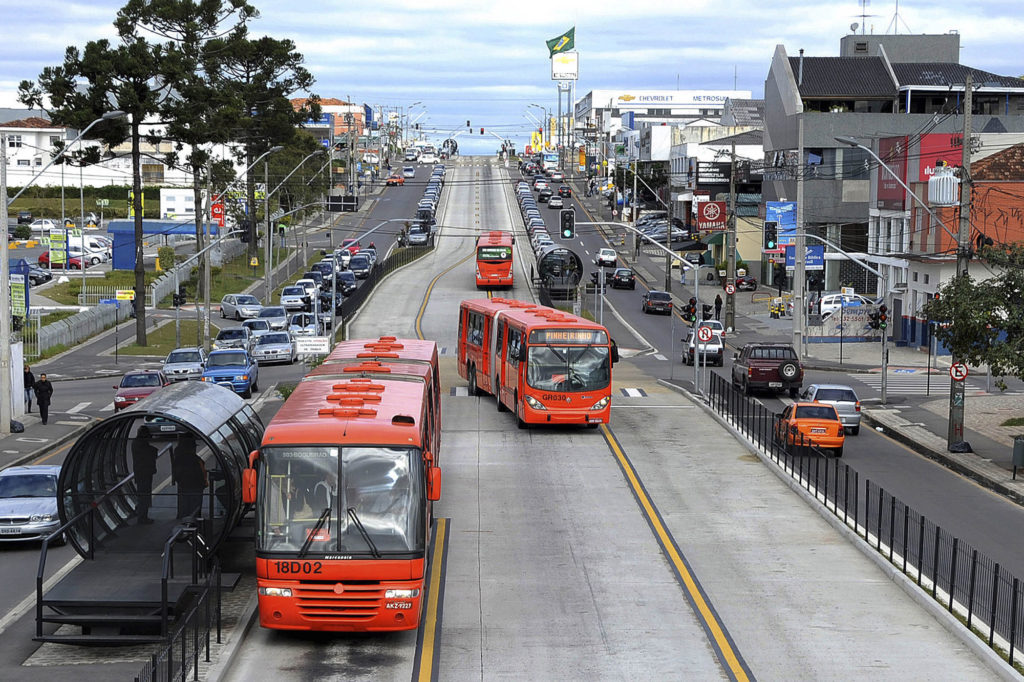
Bus rapid transit (BRT) can be defined as a flexible, rubber-tired form of rapid transit that combines stations, vehicles, services, running ways, and information technologies into an integrated system with strong identity [1]. Complete BRT systems offer fast, comfortable, and low-cost urban mobility [2]. BRT is an evolution of bus priority measures, such as designated […]
Passenger capacity in BRT systems: formula development and application to the TransMilenio System in Bogota, Colombia
Transit textbooks and engineering manuals indicate that the capacity of Bus Rapid Transit –BRT – systems does not exceed 20,000 passengers per hour per direction. The implementation of the TransMilenio BRT System, in Bogotá, Colombia, showed that the systematic combination of multiple platforms at stations, overtaking lanes, level boarding, prepayment, large buses with multiple doors, express and local services, and traffic engineering measures at intersections, allow for very large passenger throughput. Measurements indicate actual throughput of 43,000 passengers per hour per direction with an average bus occupancy of 150 passengers per articulated bus, and a commercial speed of 22-24 km/hour. According to special formulae developed for the analysis of high capacity BRT corridors, the critical section of TransMilenio has a practical capacity of 48,000 passengers per hour per direction with its existing infrastructure and 150 passengers per bus – 35,000 passengers per hour per direction with 110 passengers per bus. Changes in existing infrastructure, such as additional platforms, higher capacity vehicles, non-grade facilities at critical intersections, among other improvements, may increase the capacity, speed, reliability and quality of service of the system.
Bus Rapid Transit: in permanent evolution
Bus Rapid Transit can be defined as a flexible, rubber-tired form of public transport that combines stations, vehicles, services, running ways and information technologies, into an integrated system with strong identity, to offer fast, comfortable and low cost urban mobility. Currently, there are about 120 cities with BRT systems or corridors around the world, comprising about 280 corridors serving about 28 million passengers per day. As of January 2011, about 49 new cities were building systems, 16 cities were expanding their corridors, and 31 cities indicated they were considering BRT.
Crowding and public transport: A review of willingness to pay evidence and its relevance in project appraisal
This paper reviews public transport crowding valuation research, using a number of primary studies conducted in the UK, USA, Australia and Israel. We identify three measures used to value crowding (a time multiplier, a monetary value per time unit and a monetary value per trip), and associated ways of representing crowding in stated preference experiments. Although a number of different types of crowding in terms of location are identified, namely in-vehicle, access-way, entrance and platform/station, the majority of reviewed studies investigate only in-vehicle crowding. Despite the different characteristics of the reviewed studies, they all report that crowding would increase the value of travel time savings, which can be viewed as an additional component of generalised time. This paper also comments on the role that the WTP for crowding reduction can play in project appraisal, and suggests some important avenues for future public transport crowding valuation research.
Designing an express service for a bus corridor in Santiago, Chile
In transit systems with high demand levels, the use of express bus services that serve only a subset of stops along certain routes would seem to be a promising alternative given the benefits they offer to both users and operators. For users, express buses mean improved service levels in the form of lower travel times due to fewer stops and higher between-stop speeds, while for system operators they enable demand to be met with fewer vehicles thanks to shorter bus cycles.
In this article we present a work aimed at designing an express service to operate over a given corridor in Santiago, Chile in conjunction to another one that would serve every bus stop on the corridor (i.e. an all stop service). To do so, we had access to origin destination trip matrices between bus stops during the morning peak, and the off peak periods. These matrices were used to construct diverse demand scenarios for the corridor based on our expectations of the change that the new express service would cause.
Based on the studied scenarios we propose two different express services, one for the peak hour and one for the rest of the day. Results suggest that implementing these services would reduce social costs when compared to a solution where the corridor is served by a single all stop line. Users that make long trips would be the most favoured from this decision. We also conclude that the longer the trips and the larger the demand, the higher the benefits obtained from operating an express service.
Impact of design elements on the capacity and speed of Bus Rapid Transit (BRT): the case of a single lane per direction
Despite its booming growth, the BRT industry is still far from reaching maturity. As trial-and-error and empiric techniques were largely used as insights for innovations in design, some BRT systems achieved great successes in terms of performance and became world-class flagships whereas others would be most properly classified as busway systems requiring major improvements. In this paper we explore the performance of a single lane per direction no-overtaking BRT corridor, in terms of capacity and operating speed, by conducting a design of experiments that comprised the simulation of 324 alternative scenarios. In the simulation runs we varied demand levels, boarding and alighting rates, spacing of stations, vehicle loadings, quantity of berths per station, and traffic signal positioning in relation to stations. The qualitative analysis reveals that such a BRT system can achieve a capacity around 15,000 pass/h/dir along its critical section with an operating speed of 20 km/h. Preliminary statistical analysis enabled the estimation of a regression model representing the impact of BRT design elements on the operating speed. Our findings provide useful insights for designers of high-performance BRT corridors.
Assignment of work shifts to public transit drivers based on stated preferences
Transit agencies periodically assign each of their drivers with a shift describing when and for how long they will work each day in the following months. Since drivers are not indifferent to which shift they receive, transit agencies define different assignment methods often based on driver seniority. This article studies and compares different shift assignment policies assuming that the agency has some information regarding the approximate utility that each shift represents to each driver. Additionally, based on a study that analyzes driver utilities for flexible shifts (i.e. in which the weekly number of hours is not distributed uniformly along weekly working days), it shows that implementing flexible shifts offer a win-win opportunity for the agency and the drivers. On one hand drivers improve their productivity (i.e. fraction of the time in which drivers are actively working); on the other they increment their satisfaction with their job. This is particularly relevant since transit operational costs are strongly dependent on their labor force. Some of the benefits obtained by the firm should finally be captured by the users of the system.
Thinking on public accountability: How to address quality of policy design and decision-making
Managing Urban Mobility Systems
Urban mobility is currently a major problem all over the world. Space is limited, and individuals aim for a level of quality in mobility that is only achieved by largely motorised solutions, which have a detrimental effect on the urban environment. Careful analysis of urban mobility systems across the world reveals that consistent and effective policies can only be defined and implemented if the various components of the system and their interrelations are considered. This book addresses the problem of managing urban mobility systems in a novel way by considering the complexity and diversity of the conurbation and agents involved in a UMS, putting forward the evidence that urban mobility must be managed at system level. The value of this book lies in bringing together a sound theoretical approach to urban mobility systems supported by evidence from several cities across the world where this approach was either implemented or at least assessed, together with clear instructional guidelines. It constitutes a handbook for practitioners, politicians, researchers and students of urban mobility management.
Accessibility: User satisfaction, Authority satisfaction, or Society satisfaction?
Understanding spatial variations in the impact of accessibility on land value using geographically weighted regression
Continuous Mobility Surveys: The State of Practice
In this paper we challenge the prevailing practice of conducting one-off cross-sectional mobility surveys, making a case for change on the basis of usefulness and cost-effectiveness. We believe that urban areas over say, one million inhabitants, should collect mobility data on a continuous basis as part of their efforts to guarantee sustainable development. This would allow them to gain a proper understanding of the pressing environmental and transport-related issues of today’s world, as well as of the effects of economic growth and price (especially for fuel) volatility. In our scope we include panel data (i.e. information from a smaller sample of respondents who are interviewed at different points in time, hopefully during several years), as this type of information is unique in its ability to help understanding behavioural changes and the impact of time-related effects, such as habit and inertia. We revise the state of affairs in different parts of the world, not limiting ourselves to urban data.
Modelling Transport
Decentralization as an institutional determinant for the performance of urban mobility systems
A topological route choice model for metro
This article presents a route choice model for public transit networks that incorporates variables related to network topology, complementing those found in traditional models based on service levels (travel time, cost, transfers, etc.) and users’ socioeconomic and demographic characteristics (income level, trip purpose, etc.). The topological variables represent concepts such as the directness of the chosen route and user knowledge of the network. For both of these factors, the necessary data is endogenous to the modelling process and can be quantified without the need for information-gathering beyond what is normally required for building route choice models. Other novel variables in the proposed formulation capture notions of user comfort such as vehicle occupancy rates and certain physical characteristics of network stations. We conclude that these new variables significantly improve the explanatory and predictive ability of existing route choice specifications.
Bus dwell time: The effect of different fare collection systems, bus floor level and age of passengers
Understanding the nature of transit dwell time has potential benefits for both users and operators. In this article, multiple regression models are estimated to analyse the influence of different payment methods, the existence of steps at doors, the age of passengers and the possible friction between users boarding, alighting and standing, on explaining observed variation in dwell times. Using the estimated boarding and alighting average times, performance comparisons are simulated assuming a service with payment outside buses, a prepaid card validated inside buses and cash transactions. Results show the specific effect of all the variables involved in determining the bus dwell time at stops, in particular, that substantial time savings are accruable if payment methods are upgraded from slow techniques, such as cash transactions to the fastest one (fare paid outside buses) while intermediate technologies such as prepaid cards validated inside buses (with or without contact) fall in between. On the other hand, the existence of two steps at the front door makes the boarding process slower, and senior passengers are slower to board and alight than younger travellers. A friction effect was also found when passengers boarding form two queues through a single door, which increases the boarding time for one of the queues; and a crowding effect, as the presence of passengers standing inside the bus slightly slows both boarding and alighting.
Mobility, social exclusion and well-being: Exploring the links
Building on a growing research foundation, transport policy makers have begun to associate the ability to be mobile with having a role in the facilitation of social inclusion. However, the further connection to well-being is not as well understood. This paper explores the association between a person’s travel patterns, their risk of social exclusion and self-assessed well-being. Key influences on social exclusion are discussed, with trip making emerging as a significant influence. Trip making is not a significant direct influence on well-being but does exercise an indirect influence through the impact on risk of social exclusion. The modelling process enables a value for additional trips to be estimated, the value being about four times the values derived from conventional generated traffic approaches. Similar high values are found in separate metropolitan and regional case studies, confirming the significance of the results.
Road transport and climate change: stepping off the greenhouse gas
Transport is Australia’s third largest and second fastest growing source of greenhouse gas (GHG) emissions. The road transport sector makes up 88% of total transport emissions and the projected emissions increase from 1990 to 2020 is 64%. Achieving prospective emission reduction targets will pose major challenges for the road transport sector. This paper investigates two targets for reducing Australian road transport greenhouse gasemissions, and what they might mean for the sector: emissions in 2020 being 20% below 2000 levels; and emissions in 2050 being 80% below 2000 levels. Six ways in which emissions might be reduced to achieve these targets are considered. The analysis suggests that major behavioural and technological changes will be required to deliver significant emission reductions, with very substantial reductions in vehicle emission intensity being absolutely vital to making major inroads in road transport GHG emissions.
Bus congestion, optimal infrastructure investment and the choice of a fare collection system in dedicated bus corridors
Microeconomic optimisation of scheduled public transport operations has traditionally focused on finding optimal values for the frequency of service, capacity of vehicles, number of lines and distance between stops. In addition, however, there exist other elements in the system that present a trade-off between the interests of users and operators that have not received attention in the literature, such as the optimal selection of a fare payment system and a designed running speed (i.e., the cruising speed that buses maintain in between two consecutive stops). Alternative fare payment methods (e.g., on-board and off-board, payment by cash, magnetic strip or smart card) have different boarding times and capital costs, with the more efficient systems such as a contactless smart card imposing higher amounts of capital investment. Based on empirical data from several Bus Rapid Transit systems around the world, we also find that there is a positive relationship between infrastructure cost per kilometre and commercial speed (including stops), achieved by the buses, which we further postulate as a linear relationship between infrastructure investment and running speed. Given this context, we develop a microeconomic model for the operation of a bus corridor that minimises total cost (users and operator) and has five decision variables: frequency, capacity of vehicles, station spacing, fare payment system and running speed, thus extending the traditional framework. Congestion, induced by bus frequency, plays an important role in the design of the system, as queues develop behind high demand bus stops when the frequency is high. We show that (i) an off-board fare payment system is the most cost effective in the majority of circumstances; (ii) bus congestion results in decreased frequency while fare and bus capacity increase, and (iii) the optimal running speed grows with the logarithm of demand.
Assessing Gaps on Training and Education for BRT Systems
Assessing net effect on emissions of implementation of Bus Rapid Transit system in São Paulo, Brazil: case study and some hypothetical scenarios
The paper investigates the relative influence of factors affecting vehicular emissions in high-flow BRT – Bus Rapid Transit corridors. Emissions were estimated using the IVE – International Vehicle Emission model, which bases estimates on the vehicle driving cycle, and the results of emissions measurements conducted by IPT – Institute of Technological Research of the State of São Paulo for different bus technologies and driving cycles. The developers of IVE have collected data about the technological characteristics of the fleet and driving cycles for different types of vehicles in São Paulo, Brazil. Data about operations in bus corridors in São Paulo was obtained from local transport agencies. Two types of analyses were conducted. First, a before and after analysis of a selected BRT corridor in São Paulo looked at the impacts on overall emissions. The results show that the comparison should not be restricted to the bus system only or to traffic in the specific road affected. When the contribution of autos taking alternative routes after the implementation of the BRT system is included in the estimates of total emissions, important changes in results can occur. A second analysis considered a number of hypothetical scenarios, simulating the impact of different variables related to system planning, design and operation, choice of technology and other general policies. The results indicate that vehicular emissions are influenced by a number of factors that, when combined, can bring favorable results, but that policies aimed at the automobile and consequences of BRT implementation on car users and car traffic are paramount.