
Evaluation of pedestrian safety at midblock crossings, Porto Alegre, Brazil
This paper proposes a method to evaluate the potential risk of pedestrian crashes at midblock crossings, which can be applied in developing countries. The method is quantitative because it uses modeling techniques to represent the relationship of risk factors with the occurrence of pedestrian crashes. Application of the method described here comprised the analysis of reported pedestrian crashes in the city of Porto Alegre, in southern Brazil, between 1998 and 2006, and the identification of midblock crossings with the highest number of pedestrian crashes. Twenty-one midblock crosswalks were selected for evaluation. A Poisson regression model was developed to relate pedestrian crashes to the prevailing operational and physical characteristics of midblock crossings. The results indicate that pedestrian crash risk is influenced by a combination of interactive risk factors, such as the presence of busways and bus stops, the road width, the number of traffic lanes, and the volume of pedestrians and vehicles.
Implementing BRT: From Vision to Reality
Does the political and economic context influence the success of a transport project? An analysis of transport public-private partnerships
The construction and provision of infrastructure services such as transport nowadays is often based on a partnership between three main actors: public sector, private sector and multilateral lenders, under a framework of Public–Private Partnerships (PPPs). This type of partnership has been employed in a wide range of projects in the transport sector and in various contexts in developing and developed countries. Given this observation, the objective of this paper is to examine how countries’ economic and political characteristics contribute to the success of PPPs in transport investments. Special focus in the analysis is given to how the perception of corruption and democratic accountability may influence the success of a PPP project in different transport sectors. We examine a database with 856 transport PPP projects using a generalized linear model in the form of a logit model in order to evaluate the transport database covering data from 72 countries, classified in six regions. The study highlights the importance of national experience. Not only does national macroeconomic experience appear to have a relevant role, but so also does its past experience (either positive or negative) of transport PPP projects. An interesting finding from the analysis is the importance of the rest of the world’s perception of a country’s level of corruption and democratic accountability for the final outcome of a PPP project.
Incompleteness and clarity in bus contracts: identifying the nature of the ex ante and ex post perceptual divide
In the transport sector, many types of contracts exist. Some are very precise, and strive for completeness; others are very ‘light-weight’ and are incomplete. Bus and coach contracts, won through competitive tendering or negotiation, are typically incomplete in the sense of an inability to verify all the relevant obligations, as articulated through a set of deliverables. This paper draws on recent experiences in contract negotiation, and subsequent commitment in the bus sector, to identify what elements of the contracting regime have exposed ambiguity and significant gaps in what the principal expected, and what the agent believed they were obliged to deliver. We develop a series of regression models to investigate the extent of discrepancy between the principal and the agents perceived ‘understanding’ of contract obligations. The empirical evidence, from a sample of bus operators, is used to identify the extent of perceived incompleteness and clarity across a sample of bus contracts. A noteworthy finding is the important role that a trusting partnership plays in reducing the barriers to establishing greater clarity of contract specification and obligations, and in recognition of the degree of contract completeness.
The dimensionality of performance frameworks and performance measurement for bus rapid transit systems
Fundamental to all good business practices in the delivery of public transport is knowledge of how well the enterprise is performing, especially relative to other enterprises undertaking similar activities, as well as self performance over time. A commitment to performance management and benchmarking should transcend all institutional settings, be they subject to competitive tendering or negotiated contracting, and in the presence or absence of specific incentives and sanctions. This paper focuses on the development of a framework within which performance metrics can be defined and introduced in the context of meeting strategic, tactical and operational objectives in the public transport sector. We discuss the important matters of definition of performance, data requirements, standards, the hierarchy of integrated partial and global measures of performance and frameworks to compare enterprises, and to explain why there are differences, and what actions might contribute to closing the gap between relatively poor and better overall performance. The relationship between inputs, outputs and outcomes is central to the performance rubric, as well as an understanding of the processes that underlie the mappings between these three dimensions. An important aim of the paper is to ensure that the data collection activity planned for a global study of the performance of Bus Rapid Transit (BRT) systems is guided by an integrated and comprehensive framework for performance management, measurement, feedback, and improvement.
Passenger experience with quality-enhanced bus service: the tyne and wear ‘superoute’ services
This paper investigates the role that enhanced service quality introduced into a deregulated market has in improving the experience of bus travel by a sample of passengers in the Tyne and Wear area of England. A generalised ordered choice (GOC) model that accounts for preference heterogeneity through random parameters, as well as heteroscedasticity in unobserved variance, and random parameterisation of thresholds, is implemented to identify sources of influence on the overall experience of bus travel in the presence and absence of the quality-enhanced treatment of service. The GOC model is contrasted with a standard ordered logit model, and the marginal effects associated with the preferred GOC model are derived for each influencing attribute, taking into account the various ways in which each influence contributes to the utility associated with each level of bus experience. The paper supports a view that the introduction of quality improvements, via a Quality Bus Partnership, does contribute non-marginally to an increase in a positive bus experience, and signals a way forward through cooperative intervention, to grow patronage. Knowing which attributes successfully deliver a more positive experience (and those that do not) means that resources are effectively targeted at the aspect of service provision which will increase patronage and therefore revenues, satisfying the objectives of both the bus operator and the local authority partner.
Contracting regimes for bus services: What have we learnt after 20 years?
This paper reviews a number of themes that have played a crucial role in the debate on alternative contracting regimes for the provision of urban bus services. We have selected four crucial issues to reflect on: (i) contractual regimes (in particular competitive tendering as compared to negotiated performance-based contracts, as means to award the rights to provide service); (ii) contract completeness (focussing on ex ante and ex post elements); (iii) building trust through partnership; and (iv) tactical or system level planning for bus services. Experience in these areas suggests that competitive tendering has frequently not lived up to expectations and that negotiation is likely in many circumstances to deliver better value for money.
Scoping post 2012 climate instruments: nationally appropriate mitigation actions – NAMAs – Case Study on opportunities in Brazilian Cities – Belo Horizonte
BRT in Latin America – High capacity and performance, rapid implementation, low cost
Sixteen Latin American cities have embraced Bus Rapid Transit as a key component of their transit systems. BRT was already operational in several Latin American cities, before the acronym was coined by transit planners in the US in the late 1990s. This review concentrates on nine cities, and shows the systems’ high performance (5,000 – 43,000 passengers/hour/direction), general high user acceptance, comparatively low capital investment (US$ 1.0 million/km to US$ 12.5 million/km) and little or no operational subsidies. BRT has been a key element in transit reform, changing the way service is delivered. The systems have reduced travel time, transport cost, air pollution and greenhouse gas emissions, and accidents. Some cities have also experienced significant positive impacts in the built environment. BRT systems’ expansion is underway in most cities, and several additional Latin American cities have implemented or are in the process of implementing BRT systems. The cities have also faced some system implementation and operational difficulties due to institutional and financial constraints.
Global perspectives in developing countries
Movilidad Amable – Buses
Modernizing Public Transport: Lessons Learned from Major Bus Improvements in Latin America and Asia
Capacidad en sistemas de transporte masivo en buses – desarrollo de fórmulas y aplicación al caso de TransMilenio de Bogotá
Evaluation of the Delhi bus corridor: lessons learnt and recommendations for improvement
Bus rapid transit (BRT) has extensive applications in South and North America, Europe and the Far East, but it is a novel concept for South Asia. One of the initial projects in India, the Delhi Bus Corridor, has been controversial: media outlets highlighted problems for the general traffic and safety, while user surveys showed improved perception by bus users, bicyclists and pedestrians. The discussion of the benefits and problems of the corridor has been mostly based in perceptions and prejudices. The authors conducted an independent evaluation to contribute with technical arguments to this discussion and to provide suggestions for the corridor improvement. The results were also intended to contribute to the understanding of the BRT concept in the Indian context. The authors conclude that the Delhi bus corridor has improved people mobility along the initial stretch, but requires significant performance, safety and overall quality enhancements. The project only comprised major changes in infrastructure but lacked of integrated implementation of service plans, technologies and operations. User and community education was also insufficient. In addition to ongoing improvements, the authors identified the need to: i) establish a quality improvement program measuring the system performance, ii) focus on improving reliability and comfort; and iii) reevaluate the bus service plans to provide a better match of the supply and demand. The authors also recommend using median bus lanes with strong segregation as the preferred option for bus priority in Delhi. The bus corridor in Delhi provides invaluable experience for the enhancement of transit facilities and services in India and beyond.
TransMilenio de Bogotá, un sistema de alto desempeño e impacto positivo – principales resultados de evaluación ex-post de las fases I y II
The macrobus system of Guadalajara, Mexico: an evolved concept in BRT planning and implementation for medium capacity corridors
Bus Rapid Transit (BRT) is rapidly growing as an effective alternative for medium and high capacity corridors in developing countries. The Guadalajara BRT system represents an important reference for transit professionals considering low cost, rapid implementation, high impact transit alternatives. The initial 16 km line in Calzada Independencia, started operations on March 2009 and has received high ratings by the users. It includes 27 stations, 41 articulated buses and 103 feeder buses. The system operates at a high frequency with a relatively high commercial speed of 21 km/hr. It carries 127,000 passengers/day and 5,000 passengers per hour in the peak load section. Total capital investment was USD 61 million (USD 3.8 million/km). The BRT corridor positively compares with rail alternatives. The authors evaluated both the characteristics and the performance of the system as compared with high-end BRT paradigms. The corridor meets most of the high-end BRT components. Nevertheless, it did not start with all the elements in place. The corridor has also achieved important advances in performance. There is a need to continuously report performance indicators, mainly user perception, reliability, and comfort, so management actions for continuous improvement can be taken. The project was possible due to the strong political leadership; the support of a knowledgeable technical advisory team with international practical experience; adequate level of funding for planning and implementation; and a systematic approach that combines infrastructure, vehicles, operations and technology.
Bus rapid transit in Curitiba, Brazil: A look at the outcome after 35 years of bus-oriented development
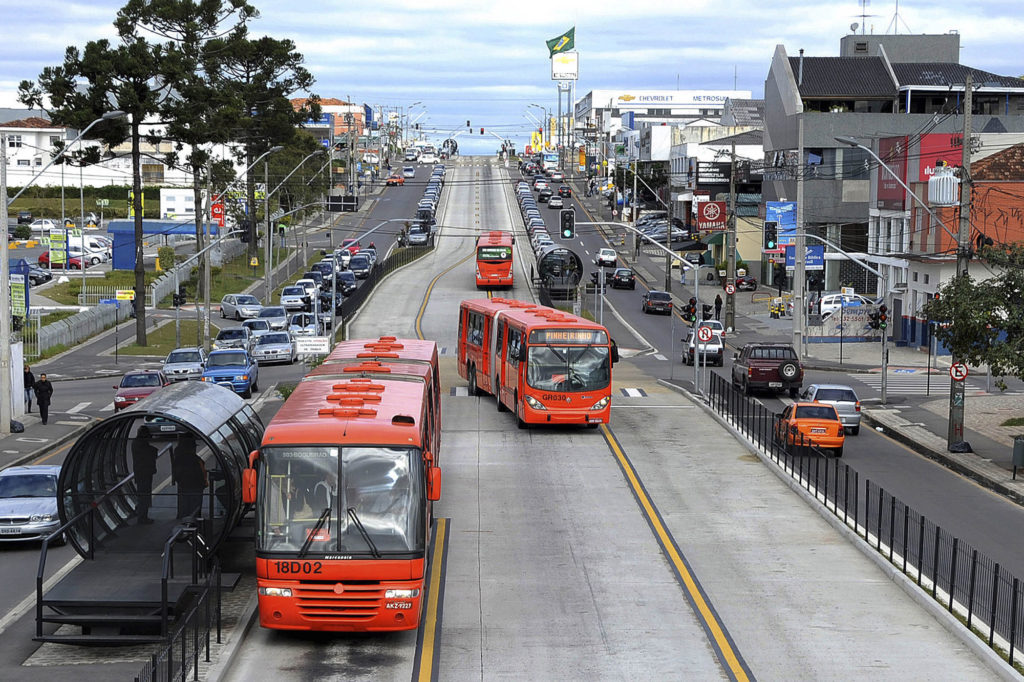
Curitiba, the world’s cradle for bus rapid transit (BRT), is an affluent city in Brazil. Its integrated transit network (RIT) is one of the most successful bus transit systems in the Western Hemisphere. RIT is the result of 35 years of continuous upgrades to bus service, which ultimately led to the creation of the BRT concept and lent structure to Curitiba’s urban development. The recently inaugurated Green Line (Linha Verde) is the backbone of a renewed urban structural concept, with a linear park and the redevelopment of low-density, industrial properties. The line takes full advantage of evolved BRT concepts, such as cleaner vehicles and fuels and the introduction of passing lanes at stations to increase capacity and improve commercial speeds. The success of Curitiba derives from a mix of political leadership, innovation, pragmatism, technocracy, and continuity. This paper presents Curitiba’s main transit milestones over time, barriers to planning and implementation, and measures adopted to solve or mitigate them. A series of recommendations includes (a) improvements in the delivery of quality of service to transit users, (b) conduct of a homebased origin-destination survey to identify the mobility pattern within the metropolitan area, and (c) consideration of value capture mechanisms and public-private partnerships in transit projects.
Curitiba, the cradle of bus rapid transit
Curitiba is the only city in Brazil that has directed its growth by integrating urban transportation, land-use development and environmental preservation. Since the 1970s Curitiba’s administrators have constantly achieved innovations with the city’s bus-based transit system through performance and capacity improvements. Originally, the bus system evolved from conventional buses in mixed traffic to busways, which were later fitted with at-level boarding, prepayment and articulated buses, creating the first full bus rapid transit system in the world. Later, the city introduced high capacity bi-articulated buses and electronic fare ticketing systems. In 2009 the integrated bus system was upgraded, again, with the introduction of the Green Line, its sixth BRT corridor which includes the operation of 100 per cent bio-diesel articulated buses. In 2010 Curitiba retrofitted one of the existing corridors, improving its performance to levels that are typical of metro systems. System operation will be further enhanced with advanced traffic management and user information systems.
No Car Lanes or Bus Lanes – which is best? An evaluation of priority lanes in Tyne and Wear
Bus priority covers a wide range of measures intended to speed up the progress of buses (and other selected groups of users, particularly the emergency services and sometimes taxis) and avoid congestion, especially in urban areas. The implementation of No Car Lanes as a method of allocating space on the highway is a relatively new […]
The effect of OD trip dispersion versus concentration in express service design
In public transit systems with high demand levels, the use of express bus services that serve only a subset of stops along certain routes would seem to be a promising alternative given the benefits they offer to both users and operators. In actual practice, express services in systems such as Transmilenio (Bogota, Colombia), Transantiago (Santiago, Chile), and Metro Rapid (Los Angeles, CA) have proven to be highly appealing. This raises the question about when express services are a reasonable option. Previous work has focused on how some characteristics of the demand structure of a corridor affects the benefits that express services can yield, showing that the load profile shape and the average trip length are crucial. This work presents some evidence that also the dispersion of the demand among different OD pairs (keeping the load profile and the total number of trips constant) affects the potential benefits of express services. As expected the more concentrated the demand into few OD pairs, the more cost savings that can be obtained. To answer this question we developed a methodology to generate OD matrices that share all relevant attributes but differ in variability among OD flows. Thirteen matrices were generated and their optimal sets of bus services with their respective frequencies were obtained. Using the coefficient of variation as a measure of matrix variability, we confirmed that more demand variability (i.e. more flow concentration) gives room to more express services and lower social costs.
Choosing the right express services for bus corridor with capacity restrictions
In public transit systems with high demand levels, the use of express bus services that serve only a subset of stops along certain routes appears to be a promising alternative given the benefits that they offer to both users and operators. In practice, express services in systems such as Transmilenio (Bogota, Colombia), Transantiago (Santiago, Chile), and Metro Rapid (Los Angeles, California) have proved highly appealing. To determine what types of express services would be attractive on a bus corridor given the characteristics of its demand, four parameters are defined for identifying corridor demand profiles: the base load profile shape, the scale of demand, the demand imbalance between the outbound and inbound directions, and the average trip length. A series of indicators was also defined to measure the potential benefits of express services in the scenarios studied. The results of the experimental simulations show that a crucial parameter for determining the potential benefits of express services is the average trip length along the corridor. The incorporation of express services is particularly attractive in corridors with demand profiles that increase or decrease monotonically. In addition, the results suggest that in other cases, the complexity of the demand shape could allow for more complex express service patterns.
Design of limited-stop services for an urban bus corridor with capacity constraints
In high-demand bus networks, limited-stop services promise benefits for both users and operators, and have proven their attractiveness in systems such as Transmilenio (Bogota, Colombia) and Transantiago (Santiago, Chile). The design of these services involves defining their itinerary, frequency and vehicle size, yet despite the importance of these factors for the network’s efficiency, no published works appear to provide the tools for designing high-frequency unscheduled services on an urban bus corridor, minimizing social costs.
This paper presents an optimization approach that minimizes these costs in terms of wait time, in-vehicle travel time and operator cost. Various optimization models are formulated that can accommodate the operating characteristics of a bus corridor, given an origin–destination trip matrix and a set of services that are a priori attractive. The models then determine which of these services should be offered at what frequencies and with which type of vehicles. A case study in which the model is applied to a real-world case of a bus corridor in the city of Santiago, Chile, is presented and the results are analyzed. Finally, the model is used on two different demand scenarios establishing which type of services tend to be good candidates on each case and providing preliminary insights on the impact of some key parameters.
Competing for level of service in the provision of mobility services: concepts, processes and measures
One of the most striking problems societies currently deal with is to assure adequate quality standards while improving accessibility within and between cities. In addition there is also a growing awareness that, to achieve a sustainable balance between private and public means of mobility, policies have to be able to send the correct signals in order to induce users adaptive behaviour, which in turn will provide the system with a reliable feedback on the needs for further investment and expansion of transport facilities. The definition and measurement of quality of service of the transport system is thus an objective aimed by both users and producers and it is often represented by the rather holistic concept of Level of Service (LoS). However, the LoS concept is not consciously used by users, on the contrary the user concentrates her comparative evaluation on what is simply known as quality. It is the planner that translates planned quality into LoS concept. So, LoS is a concept at the interface between the provider and the user. Given the interface character of the LoS concept an accounting framework for LoS should thus take into account the need to segregate the evaluation for passengers and freight transport and also distinguish between types of travellers in the case of passenger transport and types of commodities or logistic families in the case of freight transport. Moreover the bridge between the planner and the user view must be ensured. This paper reports the results of a research work dedicated to this topic.
Optimization of public transportation systems
Public transportation systems are intrinsically associated with a more sustainable motorized urban mobility. However, many cities struggle to offer their citizens a system providing high level of service. This article introduces the complexity involved with designing and operating a transit system going from the high-level strategic decisions to the low-level control mechanisms.
Critical issues in the design of contractual relations for transport infrastructure development
The increasing use of Public–Private Partnerships (PPP) arrangements in the provision of transport infrastructure seems to be a trend all over the world with a very particular incidence in Europe. The arguments supporting these public decisions are several and their validity varies with the different realities where these instruments are applied. The paper highlights the critical issues around the design and implementation of PPPs in the transportation sector and makes a brief presentation of the rational behind the structure of papers presented in this special issue.
Future challenges for transport infrastructure pricing in PPP arrangements
In this paper we report the conclusion of a research project dedicated to pricing regimes in public-private partnership contracts for the provision of transport infrastructure (Macário et al., 2009). Several elements have been brought to the bulk of knowledge that supports the design and implementation of public-private partnership in the transport sector. These developments have been achieved in the following domain:
• Understand difficulties of price setting within the PPP environment, given the potential conflict of interest among the different parties engaged, go beyond the discussion of first best versus second-best price setting mechanisms.
• Understand the role of government and regulators in the performance of a PPP.
• Translate the issue of asymmetries of information between parties into a risk taking language.
• Devise alternative contractual designs that will enable competitive price setting.
• Understand that a structural element is missing to conciliate the views of the different stakeholders over a PPP: a bridge between infrastructure costs and charges.
The objective of this paper is to overview the main challenges ahead of transport infrastructure pricing, considering the current and likely future policies as well as the field constraints. Moreover, a proposal is formulated to overcome some of the current pitfalls associated to transport infrastructure pricing.
On the development of public transit in large cities
This article presents a summary of the analyses and set of recommendations given by a committee of transit specialists gathered by the Minister of Transport of Chile aiming at improving Transantiago, the new transit system recently inaugurated for Santiago. This summary focuses on those recommendations directed towards improving the efficiency, service quality and sustainability of mass public transportation systems in major cities in the developing world and that could be implemented in a short term (within two years). Three broad dimensions of public transit are considered: competition and regulation; investment, financing, fares and subsidies; and the operation and use of infrastructure, design, inspection and control. Although the study grew out of the needs and characteristics of a city such as Santiago (Chile), and of the virtues and deficiencies of Transantiago, much of the analyses and recommendations could be adopted and implemented in the major cities of developed countries in Europe, North America and Asia.
Decision making process in successful city-wide bus reforms – same story repeats in three continents
The objective of this paper is to synthesize information from successful city-wide bus system reforms in three world cities, London (Europe), Sao Paulo (Latin America) and Seoul (Asia). All reviewed systems improved system wide ridership, significantly improved conditions for commuters and produced other positive externalities such as reducing air pollution and improving traffic safety. The reforms were undertaken amidst varying political, economic and social contexts. The main focus of the reviews was to identify the common elements in successful reform processes in an attempt to assist planners and decision makers implementing city-wide bus system reforms. Individual case studies were prepared for each city and are presented in separate documents. The reviews are based on material available on the internet. The following seven aspects or commonalties stood out as the key factors for implementing successful bus system reforms across the three cities.
1. Strong Political Leadership in the Decision Making process
2. Strong local technical institution developing demand based route planning
3. Implementing bus Priority and/or building segregated infrastructure for buses
4. Use of Technology
5. Innovations in contracting and tendering processes
6. Need for managed subsidies to improve quality of service
7. System Performance Monitoring and User Feedback.
The paper is divided in three sections. The first section provides a short description and indicator information about the performance of bus systems in each city. The second section examines each of the seven commonalties for each system. The final section summarizes the learning from the three systems.
A importancia de simular sistemas Bus Rapid Transit
Cresce o interesse por sistemas BRT tanto nas cidades dos países em desenvolvimento como nas nações desenvolvidas. Mais de 70 sistemas já foram implantados no mundo e o Brasil pretende inaugurar 500 km para a Copa do Mundo de 2014 e Jogos Olímpicos de 2016. O desempenho desses sistemas varia muito em função da configuração de projeto, podendo transportar até 45.000 passageiros/h/sentido. As estações e as interseções são os principais gargalos a limitar o desempenho de um BRT e, nem todos os corredores de BRT implantados no mundo foram projetados de forma a propiciar o seu melhor rendimento, havendo sempre margem para introduzir melhorias. Logo, é importante dispor de ferramental que propicie antecipar os problemas gerados por uma determinada configuração de projeto. Esse artigo apresenta o EMBARQ BRT Simulator, um modelo microscópico de simulação especialmente desenvolvido para representar o desempenho de sistemas de BRT sob uma variedade de configurações físicas e operacionais. O simulador foi calibrado com dados de Curitiba e Porto Alegre e foi empregado para testar e aprimorar os projetos dos corredores TransCarioca, no Rio de Janeiro e de Arequipa, no Peru. No caso do TransCarioca, o estudo demonstrou que, com pequenos ajustes no projeto, é possível aumentar a capacidade de 20 para 30 mil passageiros/h/sentido atendendo assim a demanda prevista para os Jogos Olímpicos de 2016. Em Arequipa, a simulação revelou a necessidade de antecipar a introdução de uma linha adicional de forma a aliviar a saturação no centro histórico da cidade que é patrimônio da humanidade.
Aproximación continua al fenómeno de apelotonamiento de buses
Los sistemas de transporte público urbano son susceptibles a perturbaciones en su operación que pueden llevar al apelotonamiento de los buses, afectando seriamente los niveles de servicio percibidos por los usuarios. De esta manera, resulta necesario analizar y comprender el fenómeno de formación de pelotones, para poder así definir estrategias de control. En este trabajo se propone un modelo continuo de la operación de los buses para el análisis del sistema, así como una sencilla estrategia de control cuya implementación no requiere de información en tiempo real. Las simulaciones de esta estrategia arrojan en promedio ahorros en tiempos de espera de los usuarios en torno a 33% y reducción en la variabilidad de los intervalos entre buses en torno a 50%.