Citizen Participation for Sustainable Transport: The Case of Living City
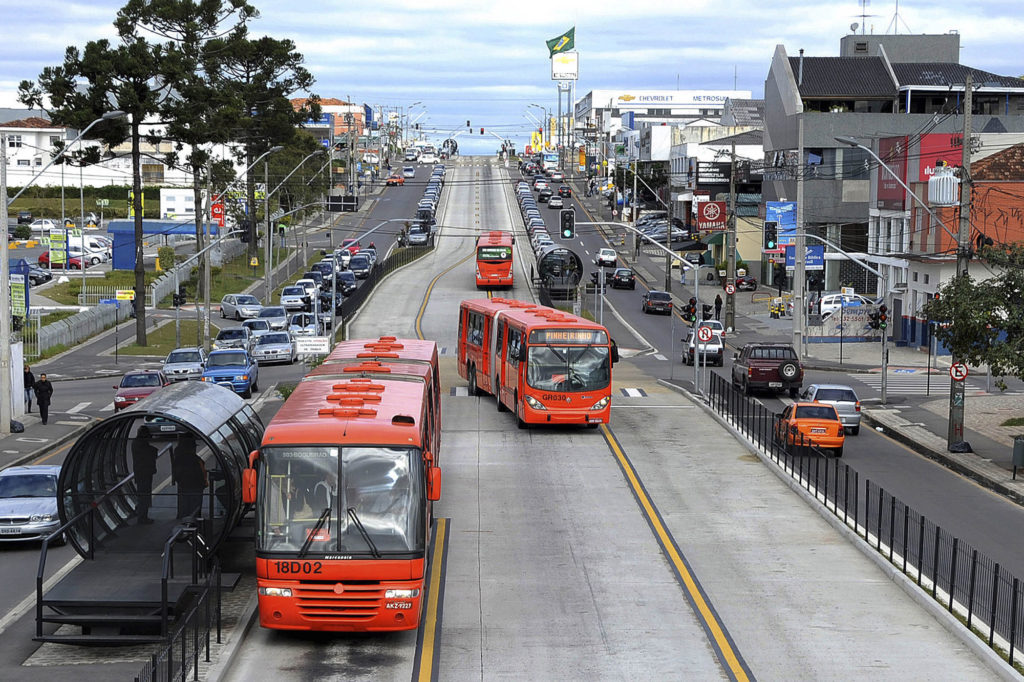
Twentieth century citizen “revolts” against urban highway projects have influenced thinking about public transport (Toronto, Vancouver, New York), governance (Portland), and cycling (The Netherlands) to this day. Less is known, however, about how these emerge in developing countries, and what they can tell us about citizens’ role in innovation to achieve more sustainable transport systems. […]
A Zonal Inference Model Based on Observed Smart-Card Transactions for Santiago de Chile
Abstract The collection of origin-destination data for a city is an important but often costly task. This way, there is a need for better and inexpensive methods of collecting information of citizens’ travel patterns. In this line, this paper presents a model to infer the zones of origin and destination for an observed trip between […]
Incentive schemes for bus drivers: the case of the public transit system in Santiago de Chile
Abstract Although many authors have studied regulatory schemes for bus operators of public transport provision, little attention has been given to incentive schemes for bus drivers in terms of economic incentives and labour conditions. Therefore, there is a need to analyse incentive schemes for bus drivers since the level of service of the bus system […]
Buenos Aires, Argentina Wins 2014 Sustainable Transport Award
Source: ITDP

Two nights ago, the City of Buenos Aires, Argentina, became the 2014 winner of the 9th annual Sustainable Transport Award. The City is receiving this international honor for their improvements to urban mobility, reduction of CO2 emissions, and improvement of safety for pedestrians and cyclists in the past year. The award was received by Buenos Aires Secretary of Transportation Guillermo Dietrich, saying the success of the Buenos Aires proves that «you can dream of a sustainable city».
The awards were hosted by former Transportation Commissioner of the New York City Department of Transportation, former Janette Sadik-Khan. Also in attendance were representatives from the three honorable mentions: Mr. Lee Jae-Joon, the 2nd Vice Mayor of Suwon, South Korea; Mr. Akash Tripathi, Collector for the iBus in Indore, India; and Mr. Wang Youping, director of Project Management in Lanzhou, China.
In 2013, Buenos Aires gave its 9th de Julio avenue, the widest avenue in the world, an impressive transit makeover. The city replaced several of 9th de Julio’s more than 20 lanes of car traffic with bus-only lanes for a high-quality bus rapid transit (BRT) system. The BRT has 17 stations along the median, accommodating 11 bus lines and improving travel for 200,000 passengers per day. In addition, Buenos Aires opened a new 23-kilometer BRT corridor, Metrobus Sur, and has transformed dozens of blocks in the city center into an environment that encourages walking and cycling over driving, and promoting a culture that prioritizes people over cars.
Walter Hook, Chief Executive Officer of ITDP, praised the city’s work, saying “the downtown area, known as the microcentro, is a completely new pedestrian experience. They city reconstructed the streetscape with seating, bollards, way finding, and redesigned intersections that give priority to the pedestrian. This sends a powerful message that this is a city for people, not just for cars.”
Each of this year’s honorable mentions were notable for implementing big changes in mid-sized cities. Indore, India won for for the successful implementation of iBus, the second true BRT corridor in India. iBus has set a new standard for public transport in India, providing a safe, efficient and high quality bus system for 30,000 passengers per day. The city has also fighting political pressure and an order of the High Court to open bus-only lanes to private car traffic. Mr. Tripathi, accepting the award, spoke hopefully that the city will prevail in preserving the dedicated lanes, as many in the governement have seen how well the system «is working for the common man».
[caption width="400" align="alignleft"] Suwon, South Korea’s Second Vice-Mayor, Mr. Lee Jae-Joon, accepts an honorable mention. [/caption]
Suwon, South Korea has made long term improvements to its cycling and walking infrastructure following the the 2013 EcoMobility World Festival. These improvements include wider sidewalks, cycle lanes, and creation of five “pocket parks”.
Lanzhou, China’s BRT system, which began operation this year, is the second highest capacity system in Asia, after Guanghzou, China (itself a past STA winner). Commenting on the city’s innovative and context specific station design, Ms. Sadik-Khan said the Lanzhou, BRT «has it all!». Lanzhou was also notable for its integration of Transit-oriented Development projects along the corridor.
ITDP congradulates all of the honorees for their leadership and vision in building sustianble cities.
The Sustainable Transport Award finalists and winner are chosen by a Committee that includes the most respected experts and organizations working internationally on sustainable transportation. The Committee includes:
- Institute for Transportation and Development Policy
- EMBARQ, The World Resources Institute Center for Sustainable Transport
- GIZ (Deutsche Gesellschaft für Internationale Zusammenarbeit)
- Clean Air Asia
- Clean Air Institute
- United Nations Centre for Regional Development (UNCRD)
- Transport Research Laboratory (TRL)
- ICLEI – Local Governments for Sustainability
Established in 2005, the Sustainable Transport Award has been given annually to a city that has implemented innovative and sustainable transportation projects in the past year. These strategies must improve mobility for all residents, reduce transportation greenhouse and air pollution emissions, as well as improve safety and access for cyclists and pedestrians. Finalists are selected by an international committee of development experts and organizations working on sustainable transportation.
Tweet
Less is more: BRT and metro avoid expansion of road infrastructure
Source: The City Fix by Sudhir Gota
[caption width="640" align="aligncenter"] In Bangalore, India, road expansion was required due to the absence of high quality public transport. Other cities might avoid this fate by including a consideration of the “supply increase” concept in the baseline assessment of transport projects. Photo by Sudhir Gota.[/caption]
In the realm of conducting transport economic and environmental assessments, the option of “doing nothing,” or “no project/investment,” is considered as the baseline for all projects. A baseline is a reference pathway against which the impact of a project is measured. Potential benefits of a project are always compared to the “do nothing” option – scenarios of inaction – before a decision is made. However, the notion that it’s possible to “do nothing” is a myth: the demand for transport is so strong in many countries that inaction entails the business-as-usual of building more roads. Considering this reality in baseline assessments could be a game-changer for sustainable transport projects, like Bus Rapid Transit (BRT) and metro, that would allow their benefits to shine even brighter in assessments.
Doing nothing: An outdated baseline for sustainable transport projects
No city has managed to sustain “doing nothing” as the cornerstone of its policy making. We can examine the “do nothing” concept in simple terms: if the total ridership of a proposed project – BRT or metro, for example – is 10 million over 20 years, the baseline would be the same amount of trips traveling in different modes of transport without the project. However, it’s illogical to assume that the same amount of existing roads would accommodate such a drastic increase in traffic volume without expanding or adding a suitable alternative. Indeed, the normal course of action for developing cities is to increase road supply to combat congestion. Thus, in practice the “do nothing scenario” actually implies “doing something” – increasing supply to sustain projected traffic. Incorporating this “supply increase” concept into the baseline has the potential to radically alter the project evaluation approach of sustainable urban transport options.
Impact of BRT and metro projects
In order to investigate the implications of road supply increase without implementing a suitable alternative, let us consider some public transport BRT projects: Ahmedabad, Cebu, Guangzhou, Pimpri, and metro projects: Chennai, Bangalore, Ho Chi Minh and Metro Manila.
All of these systems were justified based on mode shift – by shifting the projected vehicular trips, including those made on buses, to more efficient modes of public transport. The vehicle travel they prevented ranged from 2 to 25 billion over 20 years. All these projects assumed those trips would occur irrespective of a BRT or metro implementation in the baseline. However, it’s impossible for the baseline to accommodate billions of vehicle kilometer travel increase without also proportionally increasing road supply. This necessary increase in infrastructure is a cost of not implementing BRT or metro projects, which needs to be quantified.
Avoided infrastructure by BRT and metro implementation
In order to make the most conservative calculation of avoided infrastructure, I have considered Singapore’s approach to road expansion. Singapore does not follow the traditional approach of increasing road space as congestion increases. From 1991 to 2012, the vehicle kilometer travel increased by 2.2% while road supply (lane kilometers) only increased by 1%. Singapore has limited land supply, so road widening is only carried out when all other options fail. Considering Singapore’s experience with road supply increase, and translating its ratio on projected vehicle travel into a project baseline for any BRT or metro project, allows a conservative computation of infrastructure increase in the absence of new public transport project.
[caption width="671" align="aligncenter"]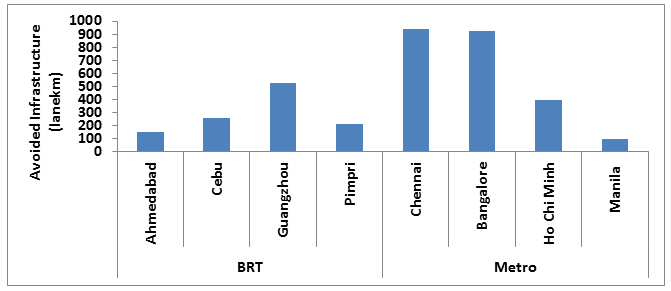 Avoided infrastructure in lane kilometers for BRT and metro projects in selected cities. Calculations and graph by Sudhir Gota.[/caption]
Both BRT and metro systems save substantial potential investment in expanding roadways. Avoided infrastructure due to construction of BRT and metro can range from 100 to 1,000 lane kilometers for different projects, based on the intensity of avoided travel.
The average avoided road space for a BRT and metro are two and three square meters per ridership, respectively. This is a conservative calculation modeled on Singapore’s experience, which doesn’t consider the impacts of road widening, such as parking space, increased traffic, and more. In terms of costs, BRT projects costs five to twelve times less than costs due to road expansion. With the addition of this single parameter to the baseline, cost effective projects would become economically viable, and benefits like emission savings, fewer road accidents, and positive health impacts due to less pollution would get more attention from policymakers.
[caption width="670" align="aligncenter"]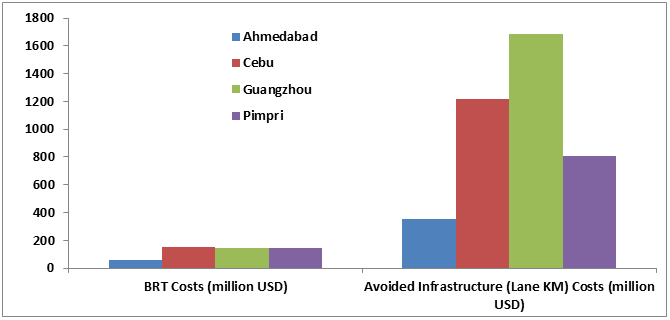 Avoided road space versus BRT costs. Graph by Sudhir Gota.[/caption]
The potential savings in terms of avoided infrastructure from implementing sustainable transport projects like BRT or metro systems are vast. Including a measurement of these savings in decision making processes has the potential to radically alter our perception of worthwhile urban transport projects. In light of growing requirements for transport financing, including this parameter would give more cost effective, sustainable solutions a boost.
Tweet
Opinion Pieces: Avoiding the Peak
[caption id="attachment_7018" align="alignleft" width="241"] Professor David Hensher[/caption]
Opinion Pieces: since 2007, Prof. David Hensher has written an opinion column in the Australasian Bus and Coach magazine, where he monthly discusses a lot of different transport-related hot topics. In this section we are revisiting these columns.
March 2012
Why is it that so many people who have the opportunity to travel outside of the very highly congested peak periods, especially in Sydney, Melbourne and Brisbane where congestion is getting worse, opt to still put up with the 7.30-8.45am peak of the peak period in the daily commute? This seems to me to be a very important question, since as little as a six percent reduction in car traffic during these periods can make the difference between stop/start and relatively free flow?
There are many reasons why people still do this, and we are talking about individuals who could indeed exercise the opportunity for more flexible trip times. But research I have undertaken suggests that many more people could begin earlier or later, work a little at home before starting later and still be productive, and all with the support of their employer. It is the fear of the unknown that drives a reckless commitment to the peak of the peak for at least enough people to make a difference to congestion on the roads.
As an example, I have been experimenting with travel in Sydney. I used to leave home at 6.45pm for my commute to the University and it took typically 60 minutes. On a good day we might get it to 45 minutes and on a bad day it is often 90 mins. So after getting tired of this, I started leaving home at 6am and my travel time was always 45mins with little travel time variability. Then I looked at a later start, leaving home at 9.30am, which gave me a 35-40 min trip almost every day. However, and most importantly, I would still get up and be at my computer by 7.15am, get all the emails (including spam) out of the way and do a solid 90 mins of productive undisturbed work before heading into the official office most relaxed and free of traffic congestion. I have found that I am doing as much productive work as before, but often exceeding what I did before. Is there a tinge of guilt by not being seen in the office at my previous time of 7.30ish? There was in the beginning, but not anymore. I am contributing far more, still doing all my duties and in contact by email, skype, phone as required.
So if more people at least experimented this way, I believe that they would have the approval of the employer, they would be less stressed, more productive and take pressure of the governments infrastructure needs budget.
Food for thought.
Tweet
Assessment of Adoption of Sustainable Urban Passenger Transport Measures
Abstract To better understand urban sustainable transport status and catalyze changes, this paper assesses the adoption of selected “avoid” and “shift” sustainable transport measures in three fields: congestion pricing, low emission zone and vehicle quota system under vehicle demand management; bus rapid transit and metro under mass transit; and carsharing and bikesharing under shared vehicles. […]
Survey data to model time-of-day choice: methodology and findings
Purpose – Departure time choice not only depends on the desire to carry out activities at certain times and places; it is a complex decision making process influenced by travel conditions, congestion levels, activity schedules, and external trip factors. To estimate departure time choice models capturing the factors influencing it in appropriate form, a complex […]
Opinion Pieces: Pricing and Revenue Allocation
[caption id="attachment_7018" align="alignleft" width="241"] Professor David Hensher[/caption]
Opinion Pieces: since 2007, Prof. David Hensher has written an opinion column in the Australasian Bus and Coach magazine, where he monthly discusses a lot of different transport-related hot topics. In this section we are revisiting these columns.
March 2012
Attracting people to public transport will always be a major challenge, and in many situations where we promote the maintenance of a particular percentage modal share, we appear to be doing no more than fighting to keep the share at around 10-15%. The real ‘enemy’ is the car and despite claims to the effect that total car kilometres are dropping a little bit, public transport initiatives are at best protecting government objectives in respect of overall modal shares. This is admirable, but hardly enough if we really want to grow modal share and reduce car use.
Hindsight is a nice thing to have, but how often have we all indicated that we will never make public transport more attractive until we make the car less attractive, and at the same time we must have a much wiser view of what kinds of public transport services will be sufficiently attractive to enough current car users for them to switch out of the car. I suggest that the following common sense views are consistent with initiatives that are necessary if we are to rebalance the modal shares to give public transport a better future:
1. Recognise that Australian cities are low density with a significant number of origin and destination pairs being circumferential (i.e., not radially centric).
2. Recognise that public transport will not attract current car users unless it can deliver connectivity and frequency that will make a non-marginal difference to door-to-door travel times at times that suit.
3. Investing in a few transport corridors in cities will have very limited impact on road traffic congestion.
4. Public transport that is not spread widely in a metropolitan area will not have a noticeable impact on public transport modal share.
5. Spending heavily on one or two public transport projects is unlikely to impact on traffic congestion unless the services have a large physical geographic coverage.
6. Continuing to avoid a serious review of road pricing will support the relative attractiveness of car use (despite the levels of traffic congestion in many cities).
To add some light on what might happened if we introduced an additional road pricing charge on top of existing charges for car use, I evaluated, using ITLS’s transport planning model system (called TRESIS), what might be the outcome if we had a 10c/km charge for cars in Sydney. We find that this reduces overall car use by 6%, which is enough to remove most of the bad traffic congestion in the Sydney Metropolitan Area. This will give car users some serious travel time savings per trip, while at the same time contributing over $3bn per annum that can be used to fund new public transport investment.
In the discussion paper released on 24 February 2012 by Transport for NSW on the Long Term Master Plan it is stated that “Road pricing schemes internationally have different objectives. In considering what pricing mechanisms should be used or whether they are appropriate the road pricing debate needs to centre on the objectives that we are seeking to achieve, the extent to which they will achieve the priorities identified for the future and the impact on the customer who is paying for the service being delivered, including the quality of the service that is provided. Governments and communities around the world are all grappling with the issue of road pricing and what role it plays in supporting a more sustainable transport system.” (Section 8.2.2, page 92). If one of the objectives is to reduce traffic congestion so as to make our cities more livable while investing into public transport, then the example above must surely show real promise in achieving that outcome – it delivers quicker trips on the road while funding much needed public transport. Is there another set of instruments that can achieve this? I doubt it.
Food for thought.
Tweet
Complete Street Model featured in new Metrobus corridor
Source: ITDP
 Setting a new standard for BRT in Mexico, Line 5 of Mexico City’s Metrobus system officially opened November 5th with a ceremony presided over by Mayor Miguel Mancera. Line 5, first announced in June 2013, is the first Metrobus corridor featuring a “Calle Completa” (complete street) model, integrating bike lanes and pedestrian friendly features. The new corridor is part of Mexico City’s overhaul of transport and development plan to create a denser, more livable city.
ITDP Mexico director Xavier Treviño praised the opening, saying “with this project, Avenue Eduardo Molina has become a best practice of the ‘complete streets’ strategy, which provides adequate space for all uses, and gives priority to pedestrians, public transportation, and bicycles.” ITDP served as a consultant in the design process, and has worked closely with Metrobus officials throughout the construction of the project. Advocacy by ITDP for the inclusion of bike-friendly features and corridor extension helped shape the development of Line 5 from its early phases.
 Line 5 is notable as the first complete street BRT in Mexico City. In addition to bus lanes with state-of-the-art stations, signal prioritization at intersections, and biarticulated, low emissions buses, Line 5 incorporates 20 kilometers of bike lanes, bike parking at stations, and numerous pedestrian safety measures. The system is expected to reduce travel times by 40%, and have significant impact on carbon reductions.
The use of a complete street model is an exciting advancement for the Metrobus system. Previous Metrobus lines 1, 2 and 3 have been high-quality BRT corridors, all ranking Silver on the BRT Standard. Line 5, by adding in bike paths and pedestrian friendly spaces, simplifies intermodal connections, supports safety measures for all travelers, and addresses the “last mile” problem. Lowering these barries makes public transportation more attractive and more useful, in turn creating a healthier, more livable city.
Mexico City has made significant strides in recent years toward establishing a more sustainable, people-oriented environment. The local government has supported progressive policies and programs that have greatly reduced the city’s reliance on personal vehicles, including opening the EcoBici bike share in 2010, reforms in parking regulation on public space, and continued expansion of Metrobus, which first opened in June 2005 with a 20km corridor.
Tweet
New Analysis Shows Bus Rapid Transit Improves Quality of Life in Cities
[caption width="450" align="alignleft"] Photo by Benoit Colin/EMBARQ.[/caption]Source: EMBARQ
Research highlights Bogotá, Mexico City, Johannesburg and Istanbul
Editor’s note: See the new video, “Bus Rapid Transit: Social, Environmental and Economic Impacts”
Washington, DC (December 10, 2013) — New analysis of four iconic cities shows that commuters can save millions of hours of travel time by shifting to bus rapid transit (BRT) systems. The report from EMBARQ, the World Resources Institute program for sustainable urban transport and planning, draws primarily from case studies conducted in Bogotá, Mexico City, Johannesburg and Istanbul. Findings from Social, Environmental and Economic Impacts of Bus Rapid Transit System point to BRT’s capacity to improve quality of life by reducing travel time, improving local air quality, curbing greenhouse gas (GHG) emissions, and preventing road fatalities and crashes.
BRT is a city-based high-speed bus transit system where new and efficient buses travel on dedicated routes. As of October 2013, over 29 million passengers ride BRT daily in 163 cities, with an additional 143 BRT systems currently being implemented or expanded. BRT is a growing transport solution around the world, both in developed and developing countries.
“New research on the broad impacts of bus rapid transit demonstrates the potential for cities to achieve environmentally, socially and financially sustainable urban mobility,” said Holger Dalkmann, Director of EMBARQ. “Results from fast-growing cities that are implementing sustainable mobility around the world strengthen the case for BRT as a response to the challenges of urban transport.”
Key report findings show:
- In Istanbul, the average passenger on Metrobüs saved 28 workdays per year in reduced travel times;
- In Johannesburg, commuters stand to save an estimated 73 million hours by shifting to BRT between 2007-2026. The travel time saved is equivalent to over 9 million 8-hour workdays;
- In Mexico City, 2,000 days of lost work due to illness were prevented by reducing local air pollution and emission on the Metrobús Line 3. Additional benefits including prevention of 4 new cases of chronic bronchitis and two deaths per year will save an estimated USD $4.5 million over 20 years;
- In Bogotá, the city will save an estimated $288 million in avoided traffic injuries and fatalities between 1998-2017.
Recommendations in the report include steps for policymakers, technical experts and financing bodies to maximize the benefits of BRT projects. Of special note are national and municipal transport policies, physical and operational system design, and effective financing mechanisms.
“Our analysis shows the wide variety of benefits BRT can have on quality of life,” said Dr. Robin King, Director of Urban Development and Accessibility for EMBARQ and co-author of the report. “In addition to saving people thousands of hours on the road, BRT is safer and causes less pollution than business as usual. With the findings and methodology we present, city officials can make better informed choices when shaping the future mobility of their cities.”
BRT has received considerable interest from institutions financing infrastructure and transport projects, including HSBC, which supported this research and the accompanying video.
“With sustainable mobility, cities can become more successful and attractive to business and citizens. BRT offers the means to connect people to economic and social opportunities in a sustainable way for long term growth in cities,” said Graham Smith, Director of Export Finance at HSBC.
EMBARQ is also releasing the short video Bus Rapid Transit: Social, Environmental and Economic Impacts focused on the key benefits of BRT outlined in the report. The video features interviews with technical experts, planners, government officials, and BRT users.
Tweet
Cost and Fare Estimation for the Urban Bus Transit System of Santiago
In this paper, we estimate the cost function of bus operators of Transantiago and the budget balance fare to contribute technically to the discussion on the level of subsidies needed for transit system of Santiago. We estimate the cost function and an aggregate demand model. Our results show that there are economies of density and […]
Cost and Fare Estimation for the Urban Transit System of Santiago
In 2007 the city of Santiago, Chile implemented a new urban transit system (Transantiago), which integrated the Metro system with a redesigned bus network. The city was divided in several regions and each region was tendered and awarded to the highest bidder that fulfilled the requirements. After a very complicated start, the Government was forced […]
Incentive Schemes, Provision of Quality and Monitoring: the case of the public transit system in Santiago de Chile
Award to our real-time control of transit systems project
 A project for real-time control of transit systems with data from Global Navigation Satellite Systems (GNSS), which is being developed by our Pontificia Universidad Catolica de Chile team, obtained the second place –out of 16 participants- in the Mexico regional category of the European Satellite Navigation Competition (ESNC). Being held for the 10th time this year, the ESNC is part of a leading global network of experts in GNSS, and the competition is aimed to innovative solutions and high potential products and services that rely on GNSS. The transit control tool, which has been awarded a technology transfer subsidy from the Chilean government, seeks to regularize transit operations and address the phenomenon known as bus bunching (two or more buses of the same line arriving together at a bus stop). This enhances the level of service experienced by users as well as allowing bus companies to have a smoother and more stable and efficient operation. The software is in the process of implementation in some of Transantiago (Santiago´s bus transit system) lines.
Tweet
Winners of the BRT Workshop Masters Thesis Fellowship
Our BRT Centre of Excellence invited the students enrolled full-time in the MIT-PUC BRT Corridor Design Workshop (Aug-Dec, 2013) to apply for a Masters Thesis Fellowship. Qualified students were invited to submit proposals for Fellowships to support Thesis Research directly related to some aspect of the work undertaken as part of the BRT Corridor Design Workshop.
Three students were selected for these fellowship:
 LUCÍA VALENCIA VARGAS, Pontificia Universidad Católica de Chile, Architecture, Design and Urban Studies Faculty, Master in Urban Project
Home city: Leon, Mexico.
Reasons why you chose to participate in the BRT Workshop and whether and how it has made you think differently about BRT and urban development strategies: The BRT Workshop was part of the program of the master in Urban Project that I am studying. Prior to the Workshop, we had one semester of preparation and research on the item so in fact it has been almost a year of learning how a BRT system works and its potential for improving the quality of life and space in the city. This work has tought me a lot about BRT systems and the connectivity dilemmas, but especially has made me see the BRT system as a serious possibility to improve the quality of life and equity not only in the direct area of influence of the corridor but of the whole city. To achieve this goal it should be an integrating project with high quality public space associated and immersed in a strategic plan that should be able to potentiate their benefits.
What do you hope to achieve with your research project? Based on the premise that the BRT stations are expected to cause an economic and real estate development around them, and that it should be capitalized to improve the quality of public space and the quality of life, with this research I hope to be able to determine what would be the best design of a BRT stop and the services and amenities associated with it which could cause a greater positive effect on urban regeneration in the particular case of the corridor project of the Grand Avenue (Gran Avenida-Santiago).
For me there are two main objectives: one is to be able to contribute on a vision of the corridor of the Grand Avenue that could overcome the obstacles so we can finally see this corridor physically carried out one day. The other is, eventhough considering that each case should be analyzed particularly, be able to raise a possible general strategy of design for the BRT stops and associated amenities aimed at achieving a successful urban regeneration.
What do you hope to do after you finish you Masters degree? I hope to be able to continue learning, experiencing and proposing on the possibilities of the BRT as urban project that improves the public area and the landscape of the city in pursuit of a better quality of life and a fair city. I would like to do this both from the academy and the professional activity.
 RINAL CHHEDA, MIT, Master of Science in Transportation
Home city: Mumbai, India
Reasons why you chose to participate in the BRT Workshop and whether and how it has made you think differently about BRT and urban development strategies: The opportunity to participate in a project that extends to a global scale, studying corridors in Chile and Boston and chance of understanding how the planning and strategy in both cases would be different, is what mainly attracted me to the BRT workshop. Both the sites had unique and different set of challenges that needed to be addressed keeping in mind the local attitudes.
The workshop has changed my way of thinking towards urban development projects. Firstly, it emphasized on how a corridor design extends far beyond the corridor to create a livable space keeping in mind aspects ranging from housing, economic development, transportation and finance. The various case studies that teams presented showed precedents from across the world indicating scope for creativity and innovative thinking in making the process successful. BRT (and any other urban development project) has ripple effects that reach far beyond the immediate areas where they are implemented.
What do you hope to achieve with your research project? The crux of my research is to identify how transit oriented development (TOD) changes people’s mode choices. In many cases, transit usage is connected to user’s perception of the transit system and if we can change that perception by some types of TOD then we could decrease people’s auto-dependency. I want to find out if there are some TODs that help to achieve a high transit mode share (alternatively, fewer auto trips or lower auto mode share). I want to develop a model for people’s mode choices based on these TODs.
What do you hope to do after you finish you Masters degree? After my Masters degree, I want to work at the World Bank or at a public transportation agency where I will be able to apply my expertise to projects that will make an impact on people’s lives and continue learning from the process.
 NATAN WAINTRUB, Pontificia Universidad Católica de Chile, School of Engineering, Master of Science in Engineering
Home city: Santiago, Chile
Reasons why you chose to participate in the BRT Workshop and whether and how it has made you think differently about BRT and urban development strategies: I chose to participate beecause I find it really interesting to work on the subject of making more liveable cities by mixing Engineering, Architecture and Urban Planning. It is a problem that can be better attacked by working together instead of each discipline by itself, as it is ussually done. Particularly in this workshop I have realized the potencial of BRT systems in creating and transforming the cities. It can help in the development of the city by the generation of activities around it, instead of only helping people to move from one place to another.
What do you hope to achieve with your research project? With my research I plan to find and value the incentives that real estate developers should consider in the decision of developing a project. Also, I intend to discover how do the projects over a transport axis impact the decisions of the real estate developers.
I expect that the results will lead me in the creation of tools that aloud local and regional government to manage the parameters that the real estate developers found relevant. In this way, an integral development around public transport corridors of bus or subway could be achieved (Transit Oriented Development, TOD).
What do you hope to do after you finish you Masters degree? after I finish mi Masters degree, I plan to work as a consultant or researcher in subjects were transport engineering and urbanism are involved.
Tweet
Keeping Cities Moving
Source: Credit Suisse
 More and more of the world’s people are living in (sub-)urban settings. This is stretching many mass transport systems to the breaking point. Sustainable transport expert Dario Hidalgo says governments need to rethink public transport, focusing on quality, safety and integration.
Richard Hall, from Credit Suisse: How did you get into mass rapid transit (MRT) and bus rapid transit (BRT)?
Dario Hidalgo: After completing a PhD in urban transport planning in 1997, I joined Mayor Enrique Peñalosa’s team and worked on planning the TransMilenio bus system in Bogotá. The government had initially wanted a metro, but it became clear that a BRT network could be built more quickly and at lower cost. It was part of a large-scale urban transformation in my home city and was an instant success. I have since been involved in more than 20 projects worldwide – including in cities in Mexico and others as diverse as Lima, Accra, Istanbul and Indore.
The TransMilenio BRT project in Bogotá has become quite famous. Why?
TransMilenio is a low-cost, high-impact system. The first phase (40 km) was completed in just three years (1998–2000). It captured international attention due to its high capacity – more than 40,000 passengers per hour, per direction – and an innovative public-private partnership model. The city builds the infrastructure, and local entrepreneurs (currently seven groups with nearly 2,000 buses) own and operate the fleet – profitably and without subsidies. Today the BRT is 106 km long and carries more than two million passengers a day. Its success helped mainstream the concept worldwide. Our database indicates that 150 cities have BRT and bus corridors; 115 of these have been created since 2000.
Can you describe some of the typical pitfalls you face when building a BRT network?
Experience around the globe shows the great potential of BRT, but planning, financing and organizational difficulties should not be papered over. The important thing is not to rush into implementation until all the planning has been thought through. Also, every city is unique, so copy/ paste doesn’t work. Most of the obstacles are institutional rather than technical. Such projects are inherently complex as they involve aligning a baffling array of interests. Strong political leadership and well-crafted communications are essential. One of the big advantages of BRT systems is that they can frequently be realized within an elected leader’s term of office.
A new report written by the Institute for Transportation and Development Policy and EMBARQ is titled «The Life and Death of Urban Highways». Your thoughts?
Traditionally, urban transport planning has been all about moving cars, not necessarily people. As a result, most cities in the world have focused on expanding road networks. The result has been appalling. Clearly, creating more roads does not solve congestion; it brings more cars to the streets. It’s like trying to fight obesity by expanding the size of our pants! Several cities – Seoul, San Francisco, Toronto, Vancouver – have actually begun removing urban highways and replacing them with public-transport infrastructure. We urgently need to reallocate funding from urban parking and highways to sustainable transport.
Where are you currently involved in BRT projects? How important is it to be on site?
We support sustainable mobility and urban development initiatives in Mexico, Brazil, Peru, Turkey, India and China. We also work with researchers from Chile, USA, Portugal and Australia via the ALC-BRT Centre of Excellence and support 30 Latin American transit agencies in their quest for quality and integration. On-site meetings are particularly important when it comes to convincing decision makers.
Where are the biggest BRT projects today?
The construction of a 150 km BRT network in Rio de Janeiro in preparation for the FIFA World Cup and 2016 Summer Olympics, and the expansion of Metrobús in Mexico City from 95 to 200 km are two notable examples. The introduction of BRT in Mumbai and Bangalore may be among the most challenging, and capacity enhancements in the saturated corridors of Bogotá and Istanbul will certainly be major undertakings. We expect around 30 cities to introduce BRT in the next five years, primarily in Asia – but also, in the near future, Africa.
How is MRT/BRT changing mobility patterns in both the developed and developing world?
We have observed a cultural shift in Europe and, increasingly, the USA. People used to aspire to live in a house in the suburbs and commute. Today, more and more people want to live in the city itself – in denser, mixed-use areas. We don’t know how this trend will evolve in the developing world, but mass transit planning provides an excellent opportunity to influence the future shape of cities. Places such as Copenhagen, Curitiba and Singapore show how successful strategies that dovetail land use and transport planning can be. We must adapt these models to fit the needs of rapidly emerging economies. This needs to happen fast before car-centric urban sprawl takes root. Interestingly, the Chinese cities of Wuhan and Hangzhou have set up the two largest bike-sharing programs in the world (90,000 and 60,000 bicycles, respectively). Hangzhou plans to expand to 175,000 bikes by 2020. It’s a revolution on two wheels! China now also leads the world in metro systems, with Beijing and Shanghai already surpassing London as the longest networks.
Public transport usage is very high in Latin America. In US cities, it accounts for just 3–4 percent of urban trips. How do you see this evolving?
Transit ridership is growing rapidly in the USA. More people are choosing urban lifestyles. In the major urban centers a culture of membership rather than ownership is emerging thanks to social networks and car-sharing programs. In Latin America, on the other hand, we see the opposite trend: a growing middle class is now able to own more cars and motorcycles, and public transport usage is declining in most cities. The key in Latin America is to improve service and safety, which may require subsidies, and to introduce congestion charging and parking management schemes.
How do you see the future of MRT/BRT as cities expand and technology develops?
Some of the key innovations are in vehicle technology. Trains are becoming lighter and more efficient; buses are catching up with cleaner propulsion technologies such as natural gas and hybrid electric. The overarching goal must be to create multimodal, integrated public-transport networks with «last mile» connectivity to onward transit services as well as car and bike sharing. Mobile user interfaces, which are improving all the time as smartphone penetration rises, play an increasingly important role here. Smart ticketing systems, including electronic purses, are likewise becoming available on mobile devices. I see these technologies being further integrated and refined rather than some fame-changing innovation turning everything on its head.
Can you describe your most unusual MRT/BRT journeys?
Crossing the Bosporus Strait and jumping on and off the fast and frequent Istanbul Metrobüs; gliding through The Strip in Las Vegas on a shiny golden bus-cum-tram; and rattling through hectic and historic Mexico City in a hybrid bus. My most surreal experience was sharing a train carriage with 700-plus people in Mumbai, which has the world’s highest throughput suburban rail system.
Dario Hidalgo has spent the last 24 years helping local and national governments in Latin America, Asia and Africa plan sustainable public transport systems. He publishes regularly in academic journals and holds training courses worldwide. Dr. Hidalgo is based at NGO EMBARQ’s office in Bogotá, Colombia.
Tweet
Identification of Key Factors in the Design and Implementation of BRT Systems in Developing Countries
New Postdoctoral Research Position in Public Transport Modelling
The Department of Transport Engineering and Logistics at the Pontificia Universidad Católica de Chile, host of the BRT Centre of Excellence, is currently looking for a postdoctorate or experienced researcher to work in our research group. We have a number of ongoing projects on different public transportation issues in which the successful applicant could participate, leading some projects and collaborating with other researchers at the BRT Centre on others. Individuals with research interests in any area regarding public transportation, ranging from the most strategic to the most operational aspects are especially encouraged to apply (i.e. planning, design, financing, economics, demand modeling, operations and control).
The researcher can also work with the new Centre for Sustainable Urban Development – CEDEUS currently being developed as a collaborative project between our department and other areas of the University. We welcome applicants with the ability to carry out interdisciplinary and collaborative research projects and an interest in the role transportation plays in urban sustainability.
Job Description: We are seeking applicants with a PhD or industry experience in an area related to public transport. Candidates need not be fluent in Spanish at the moment of applying; we welcome applications from within and outside Chile. They must exhibit excellent oral and written communication skills and an aptitude for teamwork. It is advantageous to have earned a Ph.D. in a public transport related field, with a demonstrated research potential. While industrial experience is desirable, a strong commitment to rigorous and relevant research is essential. We offer the attractive opportunity of a job working in the field of public transport within an international and interdisciplinary academic setting.
Requirements: Applicants must hold a Ph.D. in related discipline or be about to complete it. It is important that the applicant be able to work collaboratively, and international experience is desirable. Review of applications starts immediately and the positions will remain open until a successful candidate has been found. The position starts in the beginning of 2014 and is for a period of 2 years; however, this is flexible for the right candidate.
Information and application: To apply, interested applicants should forward their CV including a publication list, contact details of three reference writers and a one page description of their experience and research interests related to this position. Please send application information and/or request more information by sending an e-mail to Prof. Juan Carlos Muñoz (jcm@ing.puc.cl).
Tweet
Video: simple solution for subway station
Our Director, Juan Carlos Muñoz, explains a simple solution to a congestion problem in a subway station at Santiago, Chile.
Embarq Brazil’s Director Toni Lindau receives Brazilian Presidential Medal of Honor in Minas Gerais
Source: Embarq
[caption width="450" align="alignleft"] Toni Lindau with Antonio Anastasia, Governor of Minas Gerais, and Marcio Lacerda, Mayor of Belo Horizonte, at the “Medalha Presidente Juscelino Kubitscheck” award. Lindau received a Medal of Honor for EMBARQ Brazil’s work on the Belo Horizonte’s BRT project. Photo by Mariana Gil, EMBARQ Brazil.[/caption]
On September 12th, EMBARQ Brazil’s Director, Dr. Luis Antonio Lindau, was awarded the President Juscelino Kubitscheck Medal of Honor, by the Governor of Minas Gerais, Antonio Anastasia, and the former president’s daughter, Maria Estela Kubitschek. The award is named for President Kubitschek, who, among other things, is credited with envisioning and building the city of Brasilia. Lindau received the award in recognition of EMBARQ Brazil’s work to improve public transport in the city of Belo Horizonte.
Lindau was named to receive one of the most notorious state honors by the governor of the State of Minas Gerais and the mayor of Belo Horizonte, Marcio Lacerda, in recognition to EMBARQ Brazil’s work in partnership with BHTrans – the public organization responsible for transport services in Belo Horizonte. EMBARQ has worked on the project since 2010, aiding with BRT project development in the state capital, which will be launched early next year.
About 60% of EMBARQ Brazil’s recommendations on the Road Safety Audit reports were accepted by the city. Thanks to EMBARQ’s work, the Belo Horizonte high capacity bus system will be safer for the population.
«I welcome this Medal of Honor with huge satisfaction as recognition for the work developed by the EMBARQ Brazil team with BHTrans in the past years to implement a high quality BRT system in Belo Horizonte,” said Lindau as he accepted the award. “It’s been such a pleasure to work in partnership with a city like Belo Horizonte, whose Mayor prioritizes sustainable transport and urban mobility with the competent technical BHTrans staff. I appreciate the honor and assure you that we will keep working to improve the quality of life for the welcoming people of Minas Gerais», thanked Lindau.
The traditional ceremony that honors the former President occurs every September 12th in Diamantina, Minas Gerais, hometown of Juscelino Kubitschek. President Kubitscheck envisioned Brasília and made it a reality in 1950. «Kubitschek led the most important structural changes in Brazilian history, especially on transport infrastructure and energy; he had those goals even before being President,» said Geraldo Alckmin, governor of São Paulo and the speaker for the occasion.
The governor of Minas Gerais, Antonio Anastasia, granted the honor to 120 people and organizations that have provided relevant services to society, contributed to the improvement of governmental organizations, and aided the City, State or Country development.
Exhaust Emissions of Transit Buses: Brazil and India Case Studies
Meta-Analysis of Transit Bus Exhaust Emissions
This paper presents a comparative analysis of bus emissions associated with a variety of fuel types, specifically for developing countries. A large data set of in-use transit bus tests is compiled for commonly regulated transportation emissions including carbon monoxide, hydrocarbons, nitrogen oxides, and particulate matter. Carbon dioxide is included to help in understanding greenhouse gas […]
Integration of spatial correlation into a combined travel model with hierarchical levels
A combined travel model incorporating spatial correlation is derived from the optimality conditions of a multi-objective optimization framework, in which the trip generation and distribution steps are expressed as hierarchical logit functions. Different forms of spatial correlation are shown to be easily accommodated in combined models using hierarchical logit structures. An extension incorporates spatial correlation […]
Aggregate estimation of the price elasticity of demand for public transport in integrated fare systems: The case of Transantiago
Price elasticities of demand for public transport are a key determinant in evaluating the impact of changes in fares on user flows, yet in many integrated fare transit systems, estimating these indicators is often hampered by two realities: the fare changes for different modes are implemented simultaneously and their magnitudes are highly correlated. This strong […]
On the move: Pushing sustainable transport from concept to tipping point
Source: The City Fix, by Dario Hidalgo and Heshuang Zeng.
This is the third post of the “Sustainable Urban Transport On The Move” blog series, exclusive to TheCityFix. Preparation of this series was possible thanks to a grant by Shell. Its contents are the sole responsibility of the authors.
In previous blog posts of this series we focused on the need for a paradigm shift in urban mobility and the changes in the demand side for urban mobility spurred by generational changes. Starting with this post, we’ll feature selected “supply side” sustainable mobility solutions. These emerging solutions for the transport community will help address the vast challenges we are facing: increasing road fatalities, air pollution, physical inactivity, and greenhouse gas (GHG) emissions. We’ll take stock of whether we are making progress beyond rhetoric from a solutions perspective rather than from the impact side – an approach that is heading most countries in the wrong direction.
Where are we now? Let’s use a model to answer that question.
“Diffusion of Innovation” theory as a basic framework for sustainable mobility solutions
The “Diffusion of Innovation” theory from Everett M. Rogers can serve as a basic framework for examining sustainable mobility solutions. We will locate where various mobility solutions are in the innovation adoption curve, and whether they have crossed the critical point at which implementation is unstoppable, known as the “tipping point”.
The “Diffusion of Innovation” theory is generally used to explain the process by which an innovation is communicated over time among members of a social system. The social system subject to innovation is comprised of individuals that can be categorized into five categories: innovators, early adopters, early majority, late majority, and laggards (See Figure 1). Each category of individuals acts to influence the next group through idea diffusion.
 Figure 1. Five Stages of Diffusion of Innovation. Graph courtesy of Marco Derksen.[/caption]
Process of idea diffusion: Reaching the “tipping point”
The process of idea diffusion does not always occur naturally. In many social systems there is a gap between early adopters and early majority, which was coined as “the chasm” by Geoffrey A. Moore in Crossing the Chasm. Bridging that gap does not always happen gradually. There are cases in which the change is sudden. Once the innovation “crosses the chasm”, it is considered to have reached a “tipping point”. After this point, growth continues at an exponential rate until reaching the early majority of the population. Adoption then slows down as late majority and laggards still resist change.
This is the path the automobile followed throughout the changes of the last century. Inventions were rare during the last part of the 1800s, and only about 2,500 vehicles sold in the U.S. in 1899 by thirty different manufacturers (innovators). The tipping point occurred when Henry Ford introduced the Model T in 1908, the same year General Motors was founded. Mass production and standardization helped cross “the chasm”, and by 1913 a total of 485,000 automobiles were sold (early adopters). In 1927 the Model T was withdrawn from production, but 15 million units had already been sold: “automobility” had become a reality.
Translating idea diffusion to the scaling-up of sustainable transport
In sustainable transport development, idea diffusion can be seen as the scaling-up process that takes place across various geographies, mainly through the replication and adoption of new concepts from one city to another. The tipping point will occur when the adoption process accelerates from few cities to many cities, so that what were just a few iconic projects becomes the widespread norm.
When adapted to sustainable transport, the four stages of idea diffusion are:
- Emerging: The period when new ideas/concepts are developed and applied by one or two cities
- On the rise: The time when the new solution/ideas are gradually applied into a small number of other cities, or accepted by a small number of users
- Tipping: the period where the adoption rate changes from few cities or a small number of users per year to exponential growth
- Mainstreaming: Continuous steady growth after the tipping point
Where are sustainable transport solutions located in the adoption curve?
In our upcoming blog posts we will examine five areas of tranport: car restrictions and pricing approaches, mass transit, shared mobility, urban design for access, and multimodal integration. Through consulting with experts with on the ground experience in sustainable transport deployments around the world, we will determine where they are located on the 4-stage advancement curve. Although we won’t be exhaustive, we will try to represent the most relevant concepts in sustainable urban transport, with a focus on policies avoiding personal motorized transport, and shifting demand towards public and shared modes.
 Figure 2. Sustainable Transport Adoption Curves. Graph by EMBARQ.[/caption]
Significant literature review and web research has helped us qualify the status of these five areas of transport. Here is a sneak-peak at our research:
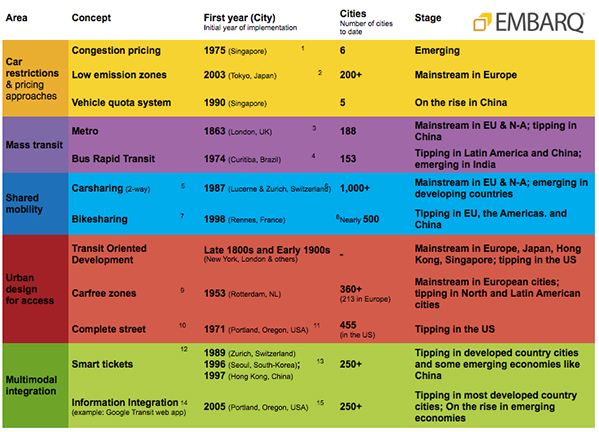 Table 1. Adoption of Avoid and Shift Strategies. Table by EMBARQ. Sources: 1. Singapore (1975), London (2003), Stockholm (2007), Milan (2012), Valetta (2012) and Gothenburg (2013) 2. European Low Emission Zone 3. World Metro Database 4. BRTdata.org 5. Shaheen, S., D. Sperling, and C. Wagner. Carsharing in Europe and North America: Past, Present and Future. Transportation Quarterly, Vol. 52, 1998, No. 3, pp. 35-52. 6. The World Carshare Consortium 7. Shaheen, Susan A., Stacey Guzman, and Hua Zhang. “Bikesharing in Europe, the Americas, and Asia.” Transportation Research Record: Journal of the Transportation Research Board 2143.1 (2010): 159-167. 8. Meddin, Russell., and Paul DeMaio. The Bikesharing World Map. Metrobike LLC. 9. Wikepedia List of Carfree places 10-11. National Complete Street Coalition 12-13. Wikipedia List of Smartcards 14-15. Google Maps[/caption]
Many emerging concepts in sustainable transport that show potential to be adopted by a larger number of cities in the near future are on the rise, including congestion pricing and vehicle quota systems. Some concepts are undergoing tipping growth toward becoming mainstream, like bikesharing, bus rapid transit (BRT), and smart tickets. Still others that are already mainstream in industrialized economies are now emerging or tipping in developing regions, such as low emission zones, carsharing, and metro.
A “new normal” is underway. Most of the concepts we’ll review have or are in a process of crossing the proverbial “tipping point”. Whether this paradigm shift will maintain its momentum is uncertain, since it will require generous enabling policies and finance, as well as developments in the private sector. Keep an eye on this series to find out the latest information and discussion on sustainable urban mobility.
Tweet
Modelling the effects of pro bicycle infrastructure and policies: towards sustainable urban mobility
This paper aims to determine the potential of the bicycle as a sustainable mode of transport in a medium-sized Spanish city (Santander, in northern Spain) with strong inclines and relatively inclement weather. For this purpose, a general methodology has been designed that could serve as an example for other areas. First, potential bicycle users in […]
Bus Rapid Transit Workshop: Experiences and Challenges
 Julio Briones*, Chilean transport engineer, discusses his recent participation in the BRT workshop at Oxford. He highlights the very comprehensive approachs presented for designing, building, and operating Bus Rapid Transit projects. He also stresses the central importance of understanding the personal motivations of metropolitan political authorities in order to successfully achieve more support for pushing bus reforms.
In September, I participated along with twenty-four other professionals from South Africa, Australia, the UK and Germany, in the Bus Rapid Transit workshop that the BRT Centre of Excellence conducted at St Anne’s College, University of Oxford, immediately following the 13th International Conference on Competition and Ownership in Land Passenger Transport. Seven experts from internationally recognized universities and public transport organizations gave a very comprehensive view of BRT projects, showing not only technical and economic aspects, but also political and managerial issues.
This is a very brief summary of the presentations, highlighting the topics that were particularly interesting for me. Darío Hidalgo, from EMBARQ, presented the historical development of BRT in various cities of Colombia, Brazil, India, and China, revealing interesting insights and lessons for adapting BRT to the unique conditions such as the availability of road surface for building this kind of projects. Nigel Wilson, an MIT professor, focused on customer experience and automated data collection, showing a very innovative methodology which he developed for Transport for London using data from electronic cards to generate matrices of trips in public transport. Juan Carlos Muñoz, from Catholic University of Chile, analyzed the problems of near-capacity operations, presenting a very practical toolkit of measures that can be employed to prioritize bus traffic and improve the level of bus services under differing conditions. Also, he presented his research on regularity in bus headways, showing through a simulation the difficulty of keeping homogeneous headways between buses and how to deal with this problem using advanced fleet management techniques.
 Rosário Macário, from the Technical University of Lisbon, presented the regulatory and institutional framework required for successful public transport reforms, paying particular attention to the primary pitfalls of competitive tendering processes such as, over-specification of services, and the setting of very rigid contracts. David Hensher and Corinne Mulley, from The University of Sydney, presented their recent research on perceived barriers that militate against BRT projects, posing questions regarding the opportunities to gain support for BRT from users, non-users, and political authorities. Finally, Chris Zegras, from MIT, focused on the broader interaction between public transport and city form, challenging the known study by Newman and Kenworthy that high density cities work well in terms of sustainability. The problem with this view is that it assumes that people will spend less time in travelling; ignoring the fact that people will have more time to do more activities that would require more trips.
In the final phase of the workshop, there was a very interesting discussion on the political feasibility for BRT projects. Some participants and speakers argued that mayors should opt for BRT because of its rapid implementation. BRT can be created, executed, and delivered in one term if there is political will as evidenced in Bogotá, where Mayor Peñalosa was able to implement a BRT project called Transmilenio during his term. I think that this argument cannot be as easily generalized for at least three reasons. First, many cities do not have a metropolitan political authority. In the absence of a mayor, achieving cooperation for a metropolitan scale project as BRT will be difficult for borough authorities. Also, if there is no mayor and the national authority is responsible of transport policy in cities, the amount of effort that a leader would be willing or able to put into BRT projects will depend upon how salient public transport policy is compared to other programs like education, health, or housing, with which the president has to work. If public transport is less important than other policies, voters will not punish a presindent for lacking a good performance in this area. Second, BRT projects do not take just one term of 3 or 4 years to materialize. In my experience, this time significantly depends upon the time required for expropriations which could last between 8 to 12 months. To my understanding, this process took less time in Bogotá because the streets where this project was located were wide enough that a large number of expropriations could be avoided. Finally, for mayors, materializing BRT projects is not just a matter of political will of maximizing public interest, but maximizing political support to be reelected. If design and implementation of a BRT project takes longer than the term of the political authority of the city, the mayor will not be able to use BRT as a signature achievement for gaining support for reelection. Also, the populace is never happy when their lives are disrupted during the construction phase of a project. Hence, I think that a better understanding of private interests of political authorities is fundamental to successfully sell them feet-on-the-ground ideas of public transport reforms.
To sum up, this workshop was an excellent opportunity to meet, learn, and discuss with internationally recognized professors and practitioners from different countries, the real-world barriers that we have to deal with in order to promote effective public transport reforms in our cities. I sincerely recommend BRT Centre of Excellence workshops to professionals working on public transport reforms. I think that for future workshops, more time should be provided for discussion among participants. Also, metropolitan politics and governance aspects should be more thoroughly considered as they play a central role in the decision-making process for successfully designing and implementing BRT and other public transport projects.
* Julio Briones works for Ministry of Transport of Chile and teaches Transport Policy at Catholic University of Chile. MSc in Transport Economics, Catholic University of Chile, and MPA in Public and Economic Policy, London School of Economics.
Here you can find the links to all the presentations from the Bus Rapid Transit (BRT) Workshop: Experiences and Challenges:
- Workshop Introduction
- Theme 1: Technological Improvements in BRT and BHLS
- Theme 2: Automated data collection – a new foundation for analysis and management
- Theme 3: The costumer experience
- Theme 3b: Users perspective of integrated transit systems
- Theme 4: Flexible capacity operations
- Theme 5: Regulatory and contractual aspects
- Theme 6: BRT vs. LRT Moving beyond emotional bias
- Theme 7: Broader interactions, public transportation and city form
Saving Lives with Sustainable Transport
The relationship between safety, capacity and operating speed on bus rapid transit