Evaluation of the traffic control system of open Bus Rapid Transit corridors: An application to the city of Guangzhou
Event Wrap Up: Transantiago and Metrobús – How to achieve social sustainability?
Profoundly reforming an urban transportation system is as complicated as trying to rebuild a house with the residents inside. Despite all the shortcomings accompanying the status quo of many urban transportation systems today, both the transportation operators and the users have adapted to the market conditions within which they operate, such that any change must proceed with caution. In other words, grand plans to improve public transportation in our cities must search for a balance between the technically desirable and the politically feasible. Putting all the emphasis on only one side (e.g., the technical) can derail reform, or weaken it to the point where the desired results are not realized. Although certainly not the only ones, two critical aspects to consider in the search for this balance are: the way in which reformers approach negotiations with existing operators; and the way in which they communicate with, and open up to the participation of civil society, more generally. Both aspects influence not only the feasibility of implementing reform but also the sustainability of the system once reformed.
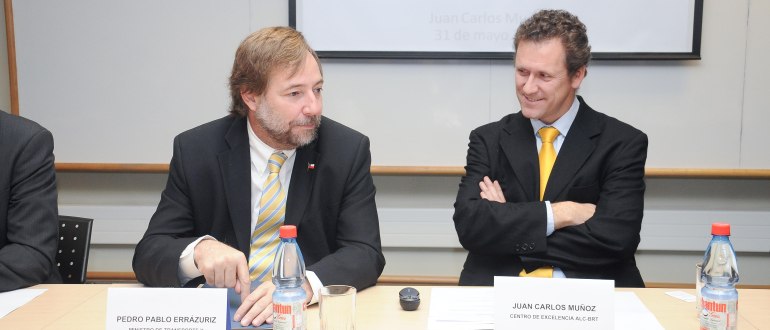
In this context, our Centre of Excellence, together with the Institute of Sociology of the Pontificia Universidad Católica de Chile and MIT’s Department of Urban Studies and Planning convened a diverse group of academics, authorities, operators, and members of civil society to discuss and share lessons from the implementation of Transantiago, in the Chilean capital, and Metrobús, in the Mexican capital. The evento took place on Thursday, 31 May at the Pontificia Universidad Católica de Chile, in Santiago, and was inaugurated by the Chilean Minster of Transportation and Telecommunications, Pedro Pablo Errázuriz.
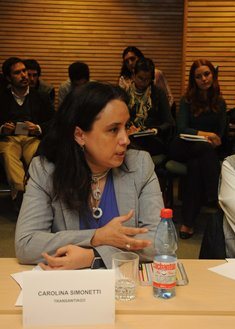
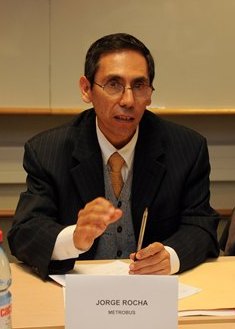
The design of the event aimed to focus on discussions rather than formal presentations. In the morning, authorities and operators from both cities spoke at a roundtable moderated by Professor Christopher Zegras, from MIT. Private sector participants included: Jesús Padilla, President of Corredor Insurgentes (the principal private operator of the Metrobús system), and Simón Dosque and Hector Moya (Managers of Transantiago’s Buses Vule y Subus Chile, respectively). Authorities included Jorge Rocha, Director of Planning and Evaluation of Metrobús, and Carolina Simonetti, from the General Coordination of Transantiago. Among the noteworthy conclusions from the discussion:
- Success apparently hinges upon moving from a scheme of confrontation (authorities versus entrepreneurs) towards one of collaboration and trust.
- The inclusion of existing operators in the BRT systems is, perhaps, necessary, but implies a complicated process (building consensus within the operators’ organizations themselves and the negotiation of contract terms) that undoubtedly increases project costs.
- These types of projects provide an opportunity to move from an association-based system (of gremios) towards a business-based system. This transition can be painful and generate losers, but it likely reduces negative externalities (accidents, congestion, pollution) and, perhaps, improves service levels for the user.
- The agreements generated with operators for the initial stages of the project should be flexible enough to be adjusted to the changing conditions during implementation.
- It is crucial to strengthen the parties involved (authorities and the private sector) that are committed to successful reform. Within both groups there are heterogeneous interests which the opposition can take advantage of to sabotage the process. In the case of authorities, it is important to avoid, as much as possible, an institutional design within which decision-making remains subdivided among multiple sub-units, as such a scheme fragments vision and responsibilities.
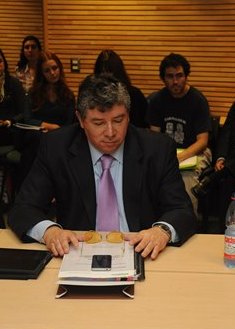
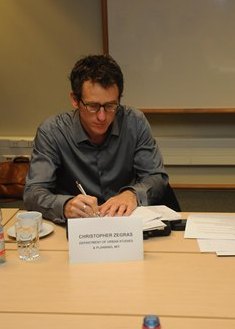
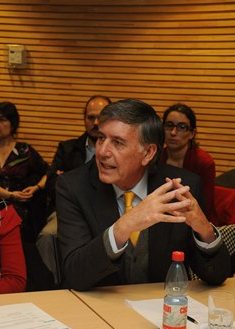
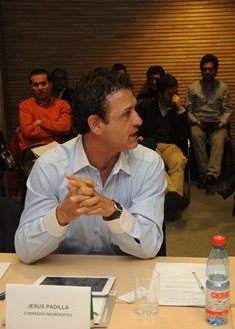
Photos: Andrés Salata
In the afternoon, Professor Manuel Tironi (Instituto de Sociología, PUC) moderated a dialogue titled “How to increase and improve citizen participation in the design and implementation of integrated BRT systems?” Marco Priego (EMBARQ, Mexico) and Sofia Lopez (Ciudad Viva, Santiago) participated as members of NGOs that have emphasized the need to modify certain aspects of the transportation systems in their respective cities. To provide the perspective of the authorities on these topics, the participants included Jorge Rocha on behalf of Metrobús and Germán Correa, ex-General Coordinator of the project that eventually became Transantiago. Among the conclusions from the roundtable:
- Citizen participation should be included, in a sustained manner, in all project stages.
- To speak of “citizen participation” in the abstract is not useful. We should specify the types of participation being considered and desired and clearly distinguish citizen participation (as an interactive political process) from simple marketing and information provision.
- There is a lack of specialists with experience in organizing citizen participation that can strengthen urban transportation system projects and improve prospects for success.
- Knowing citizens’ actual preferences is necessary to better approximate their behavior (e.g., in models); but such knowledge is insufficient for integrating citizens into the processes of design and implementation. We should also (a) better know their daily non-discursive activities and (b) enable them to participate more directly in decision-making.
- The success of citizen participation (and systems better-aligned with users) depends on recognizing the diversity of users and user profiles.
- We should take advantage of the possibilities for real-time interaction with users/citizens enabled by new communication technologies.
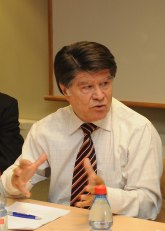
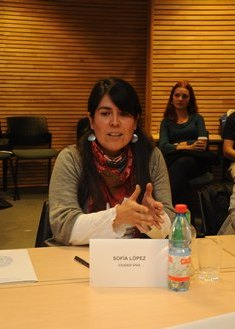
Fotos: Andrés Salata
This workshop was made possible thanks the support of the MIT International Science and Technology Initiatives (MISTI). The material discussed will be analyzed more deeply and serve to further strengthen the research of one of the research groups that participate in the Centre of Excellence ALC-BRT.
Download the full program of the Workshop (in Spanish).
Presentations (in Spanish) by:
Arturo Ardila-Gómez: Transporte y sustentabilidad política.
Christopher Zegras: Metrobús: BRT en Ciudad de México.
Manuel Tironi: Transantiago: Objetivos, Características y Desafíos.

Photo: Andrea Villena
¿Comments? ¿Opinions? ¿Similar News? Send them to us!
Tweet
Event Wrap Up: Transantiago and Metrobús – How to achieve social sustainability? (in Spanish)
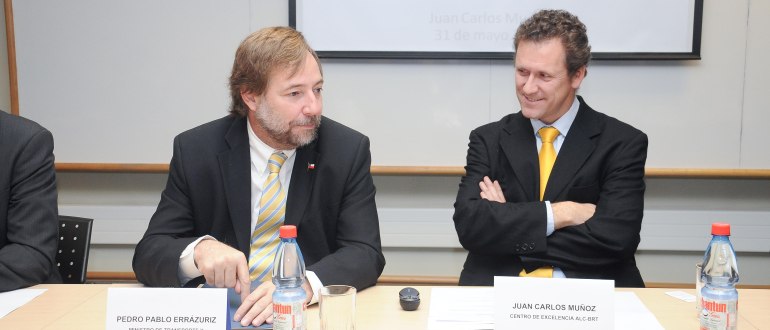
Reformar profundamente un sistema de transporte urbano es tan complicado como construir una casa con los habitantes dentro. A pesar de todas las fallas que puedan atribuirse al status quo, lo cierto es que tanto los operadores transportistas como los usuarios se adaptan a las condiciones del mercado en el que operan, por lo que cualquier modificación debe realizarse con sumo cuidado. En otras palabras, los grandes planes para mejorar el transporte urbano en nuestras ciudades deben buscar un equilibrio entre lo técnicamente deseable y lo políticamente posible. Cargar la balanza de un solo lado puede descarrilar la implementación de la reforma, o debilitarla de tal manera que no genere los resultados esperados. Aunque no son los únicos, hay dos temas críticos a considerar en la búsqueda de este equilibrio: La forma en que los implementadores abordan la negociación o incluso el conflicto con los operadores pre-existentes, y la manera en que comunican y abren el proyecto a la participación de la sociedad en general. Ambos temas inciden no solamente en la factibilidad de implementar la reforma, sino además en la sostenibilidad del sistema una vez que está en marcha.
Con esto en mente, el nuestro Centro de Excelencia, junto al Instituto de Sociología de la Pontificia Universidad Católica de Chile y el Department of Urban Studies and Planning de MIT, convocó a un grupo diverso de especialistas, funcionarios, empresarios y representantes de la sociedad civil para dialogar y compartir las lecciones resultantes de la implementación del Transantiago en la capital chilena, y del Metrobús en la Ciudad de México. El evento se realizó el pasado Jueves 31 de Mayo en las instalaciones de la Pontificia Universidad Católica de Chile, y fue inaugurado por el Ministro de Transportes y Telecomunicaciones de Chile, Pedro Pablo Errázuriz.
El diseño del evento pretendió privilegiar las conversaciones sobre las ponencias oficiales. Por la mañana tanto autoridades como operadores de ambos sistemas dialogaron en una mesa moderada el Profesor Christopher Zegras, de MIT. Participó Jesús Padilla, Presidente de Corredor Insurgentes (principal operador privado del Sistema Metrobús), así como Simón Dosque y Hector Moya (Gerentes de Buses Vule y Subus Chile, respectivamente). Por parte de las autoridades, nos acompañó el Director de Planeación y Evaluación del Metrobús, Jorge Rocha, así como Carolina Simonetti, de la Coordinación General de Transantiago. Entre las conclusiones que podemos destacar están las siguientes:
- Los sistemas más exitosos son los que logran transitar de un esquema de confrontación (autoridades vs empresarios) a un esquema de colaboración y confianza.
- La incorporación de transportistas tradicionales como operadores de BRT es quizás necesario, pero implica un proceso complicado (de construcción de consenso hacia el interior de las organizaciones y de negociación de los términos del contrato) que sin duda incrementa los costos del proyecto.
- Este tipo de proyectos ofrece una oportunidad para transitar de un sistema de organización basado en gremios a un sistema basado en empresas. Esta transición puede ser dolorosa para algunos actores y genera perdedores, pero promete menos externalidades negativas (accidentes, congestión, contaminación) y quizá un mejor servicio para el usuario.
- Los acuerdos generados con operadores para la etapa inicial del proyecto deben ser lo suficientemente flexibles como para ser adecuados a condiciones que pueden cambiar tras la implementación.
- Es vital fortalecer a las contrapartes (autoridades y empresarios) que están más comprometidos con el éxito de la reforma. En ambos grupos hay intereses heterogéneos y en ocasiones encontrados, lo que pueden aprovechar los opositores para sabotear el proceso. En el caso de las autoridades, es importante evitar en la medida de lo posible un diseño institucional en el que la toma de decisiones queda subdividida en múltiples sub-unidades, pues dicho esquema fragmentaliza la visión y el ámbito de responsabilidad de cada una.
Fotos: Andrés Salata
Por la tarde, el Profesor Manuel Tironi (Instituto de Sociología PUC) coordinó un diálogo titulado «Cómo hacer más y mejor participación ciudadana en el diseño e implementación de sistemas integrados y BRT?». Participaron Marco Priego (Embarq, Mexico) y Sofía Lopez (Ciudad Viva, Santiago), miembros de ONGs que han planteado la necesidad de modificar ciertos aspectos de los sistemas de transporte en sus respectivas ciudades. Para dar la visión de las autoridades sobre estos temas, estuvo nuevamente Jorge Rocha por parte de Metrobús y Germán Correa, ex-Coordinador General del proyecto que eventualmente se convirtió en Transantiago. Entre las conclusiones de la mesa destacan las siguientes:
- La participación ciudadana debe darse, de manera sostenida, en todas las etapas del proyecto.
- Hablar de «participación ciudadana» en abstracto no ayuda de mucho. Debemos concretizar de qué tipo de participación ciudadana estamos hablando y para qué la queremos, así como distinguir claramente entre participación ciudadana (como proceso político e interactivo) y simple marketing y entrega de información.
- Existe una carencia de especialistas que apoyen el desarrollo de modernizaciones de sistemas de transporte público, con una participación ciudadana que fortalezca y factibilice la implementación del proyecto.
- Conocer las preferencias declaradas es necesario para aproximarse más y mejor a la naturaleza de los usuarios, pero no es suficiente para integrarlos al proceso de diseño/implementación. Se debe también (a) conocer sus practicas cotidianas no-discursivas, y sobre todo (b) hacerlos partícipes directamente en toma de decisiones.
- El éxito de la participación ciudadana (y de sistemas sintonizados con los usuarios) depende de reconocer que existe una diversidad de usuarios/perfiles y no un usuario único.
- Debemos aprovechar las posibilidades de interaccion en tiempo real otorgadas por las nuevas tecnologías.
Fotos: Andrés Salata
Este seminario fue posible gracias al financiamiento del programa MIT International Science and Technology Initiatives, MISTI. El material discutido será analizado a mayor profundidad y servirá para nutrir a uno de los equipos de investigación que participan en el Centro de Excelencia ALC-BRT.
Baja el programa completo de la actividad.
Presentación de Arturo Ardila-Gómez: Transporte y sustentabilidad política.
Presentación de Christopher Zegras: Metrobús: BRT en Ciudad de México.
Presentación de Manuel Tironi: Transantiago: Objetivos, Características y Desafíos.
Foto: Andrea Villena
¿Comments? ¿Opinions? ¿Similar News? Send them to us!
Tweet
Bus Rapid Transit wanted in ACT
Source: Australasian Bus and Coach
A survey has shown more than 65 percent of Canberra residents want a rapid transit corridor between Gungahlin and Civic, according to government.
Environment and Sustainable Development Minister Simon Corbell says the survey, which sampled 1000 residents, shows about two thirds of the population want Bus Rapid Transit (BRT) or Light Rail Transit (LRT).
«While Light Rail Transit was chosen over Bus Rapid Transit by 68.5 percent of people surveyed before knowing the cost of each project, this figure fell to just under half (45.8 percent) with the preference for Bus Rapid Transit rising to about the same level (46.5 percent) once the likely costs were revealed,” Corbell says.
Corbell says the survey shows about 12.5 percent of respondents believe current public transport is acceptable.
Corbell says 32.3 percent of respondents cite environmental benefits as the main reason for prefering LRT, while 26.8 percent of people largely prefer BRT because of familiarity with bus transport.
Corbell says 14.9 percent of respondents believe BRT will be cheaper to build and maintain, 14.3 percent think it will be quicker to build and implement, and 10.3 percent believe it will be compatible with existing systems.
He says 9.7 percent also think buses could move around obstructions more easily, and 8.5 percent believe a BRT will be less intrusive.
«The survey also found that public transport improvements in the City to Gungahlin corridor were supported across the whole city – Inner South (60.6 percent), Woden-Weston (61.2 percent), Tuggeranong (61.9 percent), Inner North (65 percent), Gungahlin (70.0 percent), and Belconnen (70.3 percent),” Corbell says.
Corbell says more than 750 people attended information sessions about the project during the past three weekends at Dickson, Civic and Gungahlin and a further 560 people had completed an online survey.
Corbell says the survey was conducted by an independent consultant.
¿Comments? ¿Opinions? ¿Similar News? Send them to us!
Tweet
Video: Jaime Lerner talks about Public Transport in Latinamerica (in Spanish)
Source: SIBRT
El Presidente Honorario de SIBRT, Jaime Lerner, propuso en su mensaje seguir trabajando por la mejora sustancial de los sistemas de movilidad en buses en las ciudades latinoamericanas. Destacó la importancia de tener sistemas de alta calidad que responda a las necesidades de la gente para no depender del carro privado.
¿Comments? ¿Opinions? ¿Similar News? Send them to us!
Tweet
Event wrap up: XIX Conference of Urban and Suburban Transport in Mexico
Matías Fernández, member of our Centre of Excellence and researcher at the Institute of Sociology, Pontificia Universidad Católica de Chile, was invited to speak at the XIX Convención de Transporte Urbano y Suburbano (Conference of Urban and Suburban Transport), which took place at Puerto Vallarta, Mexico, on June 6, 7 and 8, 2012. In a Panel with representatives from Embarq-Mexico, Matías Fernández talked about «Political processes in the transition to BRT systems: the cases of Transantiago (Santiago, Chile) and Metrobús (Mexico City)». Between the audience there were transport leaders from all cities and states of Mexico, who nowadays are either participants or interested parties in several transport reforms in different cities of the country. For this reason, the presentation emphasized the weaknesses and strengths of the Transantiago experience: a system designed from a purely technical standpoint, excluding proper information, negotiation and participation processes –with dramatic consequences– but achieving a fully integrated transport system for the entire city of Santiago in a very short period of time.
Arisen from the contrasts between Metrobús and Transantiago experiences, the researcher proposed to seriously discuss the following questions: Is it possible to reconcile graduality with integrity in public transportation systems’ reforms? Which are the costs and benefits of the lack of participation and information processes in Mexico and Chile? Which consequences have had the negotiation processes in both cities?
The numerous differences between Metrobús and Transantiago, the researcher hypothesizes, would come from different ways of doing politics in both countries, and he draw attention to agents involved in design and implementation of BRT systems to properly consider the political dimension as a constitutive aspect of the possibilities and limitations of reforms to public transport systems in Latin American cities.
Download the full conference program (in Spanish).
¿Comments? ¿Opinions? ¿Similar News? Send them to us!
Tweet
Press Release by EMBARQ: New Traffic Safety Guidelines Can Save Lives on Bus Corridors Worldwide
Source: EMBARQ
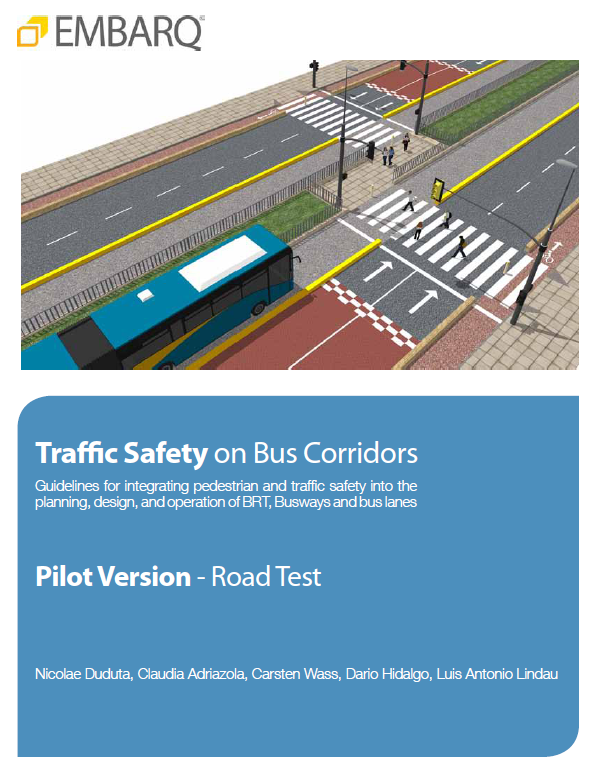
WASHINGTON (May 30, 2012) – Each year, 1.2 million people die in traffic crashes, according to the World Health Organization, and traffic fatalities are projected to become the fifth leading cause of premature death worldwide by 2030, ahead of HIV/AIDS, violence, tuberculosis, or any type of cancer. One way to prevent many of these deaths and injuries is to improve traffic safety, especially on major bus corridors in cities. EMBARQ, the World Resources Institute’s center for sustainable transport, today released the draft “Traffic Safety on Bus Corridors” guidelines to improve traffic safety on bus corridors worldwide. Based on more than two years of research, the guidelines are part of the Road Safety in 10 Countries (RS10) project, funded by Bloomberg Philanthropies.
“This guidebook is part of a broader effort by EMBARQ to illustrate how sustainable transport projects can greatly improve traffic safety, and ultimately, save lives and improve quality of life for people around the world,” said Holger Dalkmann, director of EMBARQ.
The guidelines are based on findings from a two-year research project, led by EMBARQ, which evaluated safety, operations and accessibility on major bus corridors and bus rapid transit (BRT) systems in 18 cities around the world. Key findings show:
- Pedestrians account for the majority of fatalities across all bus corridors;
- Safety on BRT and bus corridors depends on the overall design of the street and not just the bus infrastructure;
- Center-lane BRT corridors with closed stations are the safest design option;
- Counterflow, when buses drive in the opposite direction of mixed traffic, is the most dangerous type of configuration for a bus corridor; and
- The most common types of vehicle collisions in BRT systems occur when cars make illegal left turns across bus lanes and collide with oncoming buses.
“BRT and bus routes are often located on major urban roads, which have the highest concentration of traffic crashes in cities,” said Claudia Adriazola, director of EMBARQ’s Health and Road Safety program. “A new BRT system can attract a lot of pedestrians to these areas, so it is crucial to help cities understand how to maximize safety for everyone on the road.”
The purpose of the draft planning and design guidelines is to provide bus agencies, local jurisdictions, and regional and international organizations with a set of suggested design, planning, and operational criteria for bus systems, including BRT corridors. The guidelines include recommendations for street design, intersections, stations, and station access, as well as transfers and terminals.
“Data has shown that after the implementation of some BRT systems, such as TransMilenio in Bogota or Macrobus in Guadalajara, crashes and fatalities on these corridors dropped by as much as 50 percent,” said Dario Hidalgo, director of EMBARQ’s Research and Practice, member of our Centre of Excellence and an author of the guidelines. “Not all bus systems have had a positive impact on safety, and in some cases, there is still considerable room for improvement, which is why EMBARQ developed these guidelines to improve traffic safety.”
The research included iconic BRT systems in places like Curitiba and Bogota, Colombia, megacities Mexico City and Rio de Janeiro, as well as examples from New Delhi and Ahmedabad, India, and Brisbane, Australia.
“Our research shows that the design of a bus corridor can have a significant influence on the frequency of crashes on the street,” said Luis Antonio Lindau, president of EMBARQ Brazil and member of our Centre of Excellence, who contributed to the research.
During the next six months, experts are invited to provide feedback on the content, methodology, feasibility, and usefulness of the safety recommendations. The feedback will be incorporated into the final version of the guidelines, to be released in 2013.
To participate in the “road test,” please contact EMBARQ Transportation Research Analyst Nicolae Duduta at nduduta@wri.org.
Download full report:
English
Español
Português
¿Comments? ¿Opinions? ¿Similar News? Send them to us!
Tweet
Video: interview to our Director, Juan Carlos Muñoz (in Spanish)
Check out the video, where Juan Carlos Muñoz analyzes the following situations currently happening in Santiago:
- Metro de Santiago demand during peak hours
- Changes in Transantiago’s operators contracts
- Costanera Center opening
¿Comments? ¿Opinions? ¿Similar News? Send them to us!
Tweet
Opinion Pieces: The number of people using train services in the peak suggests that BRT should (must) have a real future
Opinion Pieces: since 2007, Prof. David Hensher has written an opinion column in the Australasian Bus and Coach magazine, where he monthly discusses a lot of different transport-related hot topics. In this section we are revisiting these columns.
August 2011
One of the main arguments used to support rail investment over bus systems is the carrying capacity of trains per hour. We are told that bus rapid transit (BRT) could never provide the service capacity required to offer an alternative to heavy rail investment. What is the evidence? We look at the recent figures provided by CityRail in Sydney.
The one hour morning peak to the city as measured at various stations for the nine metropolitan lines (excluding the Blue Mountains and the Central Coast) shows a maximum of 17,280 passengers on the Western line passing through Redfern Station (a station next to Central). The next highest patronage is 16,905 on the Illawarra line at Sydenham, followed by 16,680 on the North Shore line passing through St Leonards Station. The patronage drops off very fast, down to 11,735 per morning peak hour on the Airport and East Hill lines, with the remaining lines having patronage levels at surveyed locations between 9,615 and 3,810. The best in the afternoon peak from the city is 15,240 passengers counted at Redfern on the Western line.
With this factual evidence, let us note that many of the BRT systems (including Brisbane busway system) already have up to 10,000 passengers per hour (see graph below), which covers peak patronage levels for all but four of the nine lines in Sydney, with growing evidence that BRT can accommodate all patronage levels currently observed on the entire CityRail network.
Food for thought
¿Comments? ¿Opinions? ¿Similar News? Send them to us!
BRT basic concepts – video
Developed by EMBARQ Brasil
¿Comments? ¿Opinions? ¿Similar News? Send them to us!
Tweet
Cities in focus | Mexico City Metrobús
Source: EMBARQ
In 2002, EMBARQ founded CTS-México—a Mexican nongovernmental organization staffed with transport engineers, urban planners, and policy experts—and partnered with the Mexico City government to develop a bus rapid transit (BRT) corridor on a high-profile avenue running through the heart of the Mexican capital. The system has reduced emissions, improved mobility, and reduced travel times.
Producer: EMBARQ
Director: Dave K. Cooper
Executive Producer: Ethan Arpi, Rhys Thom
Editor: Emily Calderone
Music: Avenarius
¿Comments? ¿Opinions? ¿Similar News? Send them to us!
Tweet
Transmetro recovered 7.462 m2 of public space (in Spanish)
Esto fue posible gracias al trabajo coordinado entre la Alcaldía Distrital y el Sistema de Transporte Masivo, que invirtió 2 millones de dólares y apoyó la gestión de los acuerdos para lograr el traslado de los comerciantes del sector.
Source: SIBRT
Con la puesta en marcha de Transmetro en la ciudad de Barranquilla, Colombia, se inició un proceso que no sólo tenía como objetivo ofrecer a los ciudadanos una opción de transporte con comodidad, seguridad y calidad, sino también, la recuperación de espacios vitales para la convivencia de la comunidad.
Así fue como, desde la construcción del Sistema de Transporte Masivo en sus inicios, se pensó en devolverle a la ciudad vías y espacios que estaban invadidos por vendedores y particulares que incumplían las normas determinadas por las autoridades.
El pasado mes de abril, los habitantes de Barranquilla vieron con mucha complacencia cómo en un reconocido centro comercial del sur de la ciudad se recuperaron 7.462 metros cuadrados de andenes que habían sido invadidos desde hace más de 15 años. Esto fue posible gracias al trabajo coordinado entre la Alcaldía Distrital y el Sistema de Transporte Masivo, que invirtió 2 millones de dólares y apoyó la gestión de los acuerdos para lograr el traslado de los comerciantes del sector.
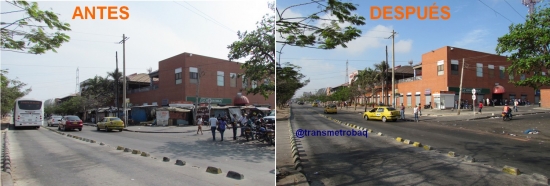 La nueva imagen despejada del centro comercial y la reubicación de 193 vendedores hacia un nuevo lugar con todos los servicios públicos y la infraestructura necesaria, fue el resultado de un proceso de más de 6 años. Durante este tiempo, fueron escuchadas las sugerencias de los vendedores quienes, además, recibieron formación en temas como atención al cliente y manejo adecuado de sus productos, gracias al convenio con una institución de educación nacional – Sena-.
La noticia tuvo gran impacto en toda Colombia como se pudo constatar en las redes sociales, toda vez que en Twitter la palabra Metrocentro –nombre del centro comercial- fue “trending topics” el día de la reubicación de los vendedores y en Facebook la foto con el área despejada tuvo más de 2.500 “me gusta” y fue “compartida” más de 500 veces. Esto demuestra que los ciudadanos cada vez son más conscientes de la importancia que tienen estos procesos para el desarrollo de las ciudades, a partir de la implementación de los Sistemas Masivos de Transnporte.
¿Comments? ¿Opinions? ¿Similar News? Send them to us!
Tweet
Modelos de Demanda de Transporte
Partiendo de experiencias anteriores, de fracasos y aciertos, propone una serie de modelos para satisfacer la demanda de transporte urbano de personas, considerando a la vez los objetivos que las personas tienen y realizan a diferentes horas del día y en diversos medios; Un libro que muestra cómo formular, seleccionar, adaptar y aplicar modelos de […]
Methodological developments in activity-travel behaviour analysis
Opinion Pieces: Tunnel Vision
Opinion Pieces: since 2007, Prof. David Hensher has written an opinion column in the Australasian Bus and Coach magazine, where he monthly discusses a lot of different transport-related hot topics. In this section we are revisiting these columns.
July 2011
A hot topic in Sydney is tunnels. Not tunnels, for cars but finding the many unused or improperly used tunnels under Sydney’s Central Business District. In a recent article I wrote of opportunities to ‘solve’ some of Sydney’s surface chaos in York Street where buses from the northern side of Sydney all converge after crossing the Harbour Bridge. In addition to buses that are actually in service, we have a number of buses ‘not in service’ due to the need to be repositioned under the contract arrangements in place. Indeed one strong message from the chaos is the restrictions that the current contract arrangements have in limiting the fuller use of the service capacity entering and leaving the CBD.
Why can we not put the bus station underground, with access soon after coming across the Bridge and just before entering the York Street precinct? Especially since we believe that there is a tunnel system in place that was designed for the railway in the Bradfield era but never used for that purpose, which recently has become a long car park. It makes very good sense, since we simply have run out of surface ideas to solve this problem.
The suggestion that we can rid of the buses by introducing light rail into the CBD is simply not tenable, unless light rail goes across the harbor bridge and extends well into suburbia. What people hate is a transfer, especially between two public transport modes, and that will be required if light rail is built and used to remove many of the bus services in the CBD.
So let us encourage a consideration of a substantial underground bus terminal with efficient lifts to and from the surface in an environment in which the air is protected from emissions and which will enable the CBD to do some nice pedestrian and bike solutions on the surface. There appears to be a growing interest in this from some stakeholders and I encourage all stakeholders with influence to promote this idea.
Food for thought
¿Comments? ¿Opinions? ¿Similar News? Send them to us!
Tweet
Eclipse Bus Rapid Transit Network launched
Source: Eurotransport Magazine
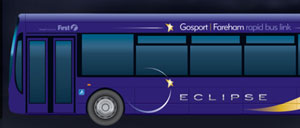
Phase one of the new Eclipse Bus Rapid Transit (BRT) busway, which connects Fareham and Gosport (England), was officially launched on 25 April.
Serving both residential and business areas in Fareham, Gosport and the Gosport peninsula, the development of the BRT scheme has been designed to ensure that bus journeys are more punctual and reliable, avoiding the problems that can be created by traffic congestion.
The dedicated Eclipse BRT busway has been constructed between Redlands Lane and Tichborne Way using what was a former railway line. Its purpose is to enable buses to bypass normal traffic, travelling quickly and easily through a very congested part of the county.
A fleet of 14 brand new, high specification buses, has been specially commissioned and will be operated by local transport provider First. This fleet will provide a dedicated, fast and frequent service on the Eclipse bus rapid transit network. Services E1 and E2 connect Fareham and Gosport providing regular travel opportunities for those wishing to get to and from the thriving shopping areas in each town, while also connecting with rail and ferry services and other bus services in the area, making it easy for people to interchange with other forms of transport. In addition Service 88, an existing bus route connecting the two towns, will also use the busway at peak times, avoiding the traffic congestion that can build up on the A32 approaching Fareham and helping to reduce journey times for peak time commuters.
Where Services E1 and E2 buses leave the dedicated busway and travel on-road, meeting normal traffic, the array of bus priority measures that have been put in place along the routes means that Eclipse buses can easily sail past other vehicles caught in traffic jams. This is particularly notable at the junctions between the A27 and Redlands Lane and the junction between the A32 and Tichborne Way.
Councillor Mel Kendal, Executive Member for Environment and Transport, at Hampshire County Council says: “We are committed to bus rapid transit in south east Hampshire and understand what it needs to offer in order to change perceptions of its value and benefits. Completion of the scheme demonstrates the significant investment that we, with the Government’s help, are making in transport infrastructure to enable improved public transport alternatives and reduce reliance on the car. Although I appreciate that, for some, it will be a big step to leave the car and travel by bus, the combination of reliable journey times and top quality buses with Wi-Fi as well as on-board, real-time travel information, are persuasive and convincing reasons to do so.”
Marc Reddy, Regional Commercial and Business Growth Director for First in the South West and Wales, says: “This is an exciting day for bus users in Hampshire. The launch of the Eclipse network delivers significant benefits for local people. The new routes, the improved infrastructure that supports them and the brand new, state of the art buses operating on them, offer people in Gosport and Fareham a real alternative to other forms of transport, making it much easier for them to travel around the area for work or pleasure. We are thrilled to have been able to work with Hampshire County Council to deliver this project and look forward to carrying many thousands of people in the months and years to come.”
The majority of funding for the busway came from a £20 million Government grant. The first Eclipse Bus Rapid Transit passengers travelled on Sunday 22 April when vehicles started running along the dedicated route.
This first phase of the Eclipse BRT network brings numerous immediate benefits to the area. Bus users in Gosport and Fareham now have access to:
- 14 brand new, specially designed buses, all complete with individual leather seats, wood effect flooring, free Wi-Fi, on-board infotainment screens providing real time bus information, local train and ferry departures, and both audible and visual “next stop” bus announcements.
- More frequent services: buses will run up to every seven minutes along the busway.
- 14 brand new bus stops on the busway, with enhanced facilities for customers. They include large shelters, comfortable seating, plenty of lighting, real time information screens, CCTV for added security and additional measures to improve accessibility for disabled users for example blind and partially sighted bus users in possession of special key fobs (being provided by Hampshire County Council) will be able to access audio announcements at key bus stops on demand.
- A number of other upgraded bus stops at key locations in the region, for instance at Fareham and Gosport bus stations, Fareham rail station and Creek Road in Gosport. The stops will offer customers similar facilities as the stops along the busway itself, while elsewhere a number of other stops have been refurbished, incorporating QR codes within the stop that users will be able to scan with their mobile phones to access real time bus information.
- Secure 24/7 real-time CCTV monitored cycle parking is provided on the busway near the junctions of Redlands Lane, Palmerston Drive, Wych Lane and Tichborne Way, giving customers the option of cycling to and from BRT stops before using the Eclipse buses to complete their journeys. Notably cyclists can also use the busway themselves.
For more information about First in Hampshire and Dorset, or to view, download or personalise timetables for those routes using the new BRT busway, log onto: www.firstgroup.com/hampshire.
A dedicated website has also been created to support the Eclipse BRT. This contains real time bus information for the services operating on the busway. It can be found at: www.eclispebus.co.uk
¿Comments? ¿Opinions? ¿Similar News? Send them to us!
Tweet
Sistemas de Transporte Público Urbano: análise comparativa entre modais de alta capacidade
The New Kid on the Block: Metrobus Opens Line 4 in Mexico City
Source: The City Fix by Dario Hidalgo*
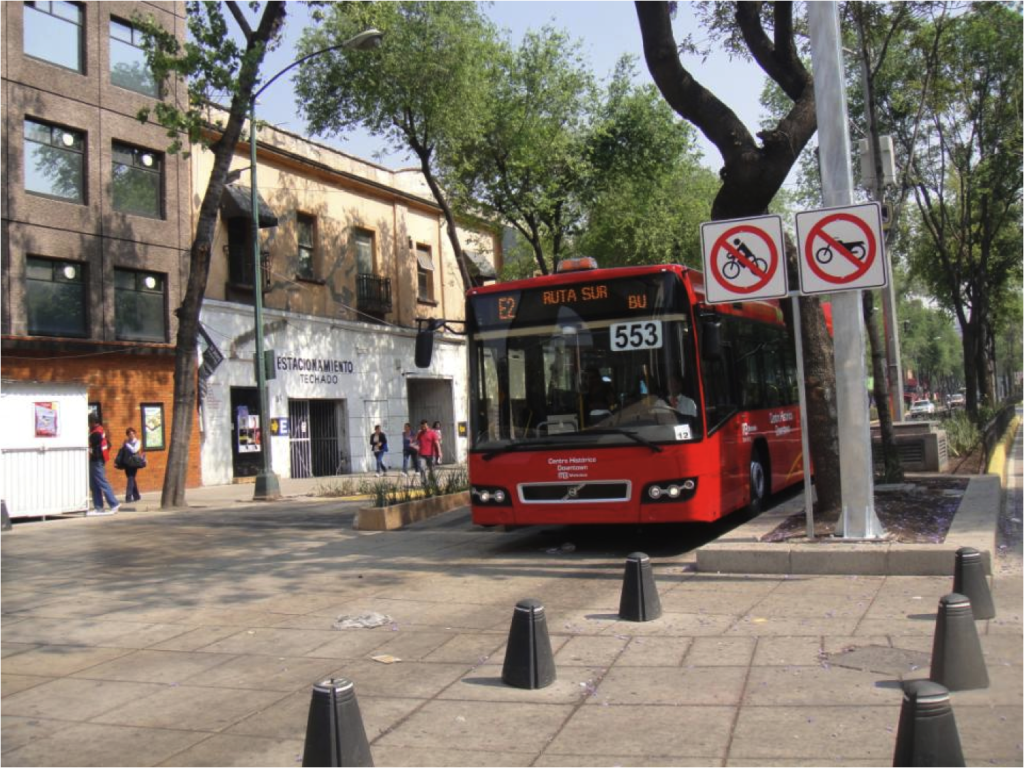
Downtown streets in Mexico City’s Historic District were totally rebuilt to provide safe transit for the new buses and help recover the urban environment. Photo by EMBARQ Mexico.
Mexico City now has a new bus service running through the heart of the Historic District, with service to the international airport. Metrobus Line 4, which opened on April 1, shows ingenuity and exemplifies the core characteristic of bus-based transit systems: being flexible.
When the city started planning for the corridor criss-crossing through downtown, EMBARQ Mexico helped them in two ways: suggesting adequate designs for narrow streets and considering pedestrian safety as a top concern. The technical team provided information about narrow corridors in the historic centers of Quito and Guayaquil, Ecuador, and Bogota, Colombia, where bus rapid transit (BRT) had already been implemented. When the designs were advanced, EMBARQ conducted a road safety audit, reviewing the designs and locations of the planned BRT corridor and making recommendations on how to make the transport systems safer for users. The audit was led by consultant Carsten Waas and EMBARQ Transportation Research Analyst Nicolae Duduta. Many of the recommendations were adopted, thereby improving several intersections. During the implementation phase, EMBARQ Mexico also provided designs for signage.
The circular line uses low-floor, 12-meter buses, an innovation from the high-floor, articulated 18-meter buses used in Lines 1, 2 and 3. Its air conditioned fleet of 46 Diesel Euro V buses and eight hybrid buses are considered to be the most advanced in the region. Fare collection is on board, for a change, using smart cards and integrated with the rest of the bus and metro network. The addition of air conditioning, advanced engines and on-board ticketing shows that it is always possible to innovate and stay ahead with technology.
But the nicest part of the system is not the buses. It is the immense care in designing bus infrastructure in a challenging environment. Downtown Mexico City is a jewel of colonial architecture, with narrow streets and beautiful buildings. It also has some areas that have deteriorated over the years. The implementation of the new bus line helped recover some of the most dreadful streets in the Historic District, with wall-to-wall interventions, adapting its design to changing conditions along the route.
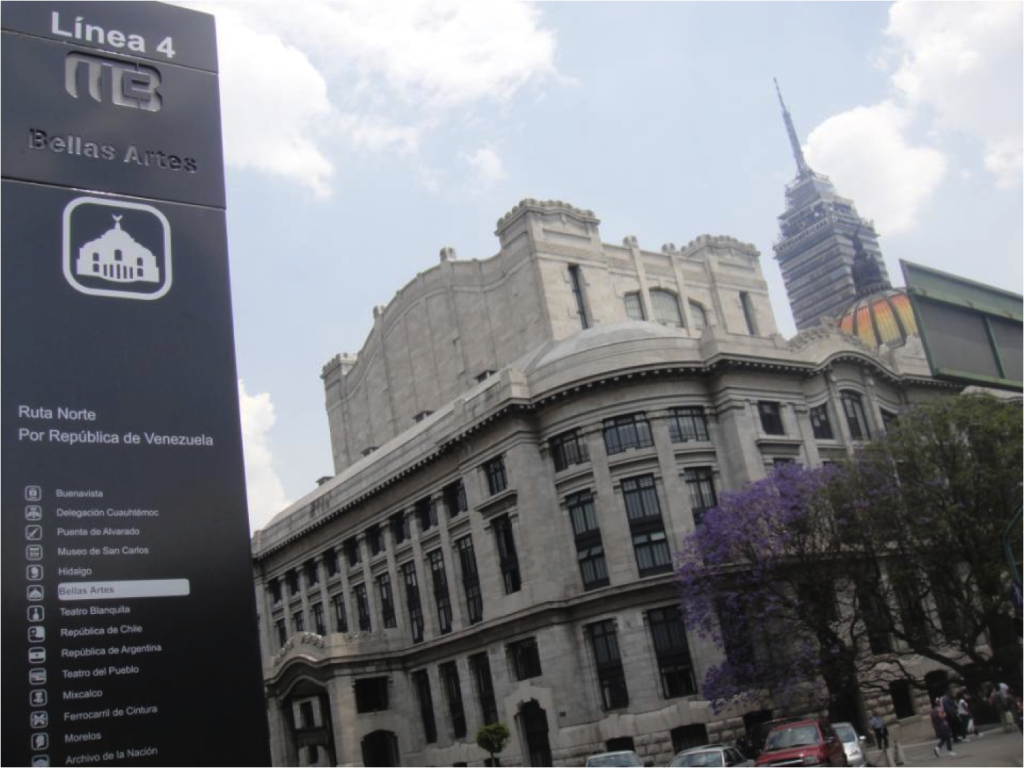
A totem at Bellas Artes Station, showing three Mexico City icons together: the Fine Arts Theater, the Latin American Tower, and Metrobus. Photo by EMBARQ Mexico.
Metrobus joins Quito and Guayaquil, Ecuador; and Pereira and Bogota, Colombia, in using downtown narrow streets exclusively for buses and pedestrians—not an easy task due to the worries of local merchants and parking operators. The design also needed to pass the tough requirements of the Historic Center Authority, which has been working over decades to recover the heart of Mexico City.
One interesting feature of the new line is the extended service to the international airport, providing passengers and workers access to an attractive and cheaper alternative to connect. It is amazing to see the buses “flying” through the dedicated bus lanes to the airport, while the cars and taxis are stuck in the gridlock of Mexico City, which has been ranked worst for car-commuter “pain” in the latest survey by IBM that ranks 20 world cities for the best and worst commutes.
REMARKABLE HISTORY
With the launch of Metrobus in 2005, Mexico showed, against all odds, that it was possible to dedicate lanes to buses on the longest avenue in Latin America, Avenida Insurgentes. In just a few short years, it grew its bus system from 20 kilometers in 2005 to 95 kilometers in 2012. Now it shows us that BRT concepts are flexible enough to cater to the challenging environment of the Historic District in the third largest megacity in the world. The new addition of Line 4 places Mexico City ahead of other cities in Latin America when it comes to the total length of bus corridors, exceeding the 84-kilometer system of Bogota and the 75-kilometer system of Curitiba—a city known for being the birthplace of BRT.
Mexico’s mass transit systems combined now boast 309 kilometers and cater to 5.8 million passengers every day. In Mexico City, alone, there are 214 kilometers of metro and light rail lines, built between 1968 and 2000. In addition, the neighboring State of Mexico has two BRT corridors (Mexibus), and there is a 27-kilometer suburban rail line, which opened in 2008.

Line 4 operates in a challenging environment of narrow historic streets. Photo by EMBARQ Mexico.
CHALLENGES AHEAD
The toughest challenge of Metrobus Line 4 was to implement bus services in a 10-meter wide right-of-way, including the sidewalks. Another challenge was dealing with the high pedestrian activity in this commercial, institutional, cultural and touristic hub. The design is full of elements to protect and provide clear guidance to pedestrians, but there is still a lot to improve, especially since jaywalking is a way of life in this part of the city.
Other features that need improvement are the programming of traffic lights and communications to potential users. Since the corridor does not have traffic signal priority, passengers are losing a lot of time at intersections. On the other hand, many potential users are not aware of the new service, including those arriving on the suburban rail line at Buenavista at the western edge of downtown.
EMBARQ Mexico, under the leadership of transport systems expert Marco Priego and other members of the technical team, provided continued support to the local government in the design and implementation of the new line. This was critical for the initial approval of the project, as there was skepticism about the possibility of running a BRT on such narrow streets. Several design elements in the stations, including the iconography of signage, were the result of EMBARQ Mexico’s recommendations. EMBARQ also provided a road safety audit, and about half of the recommendations were included in the final design.
Now that the system is in operation, EMBARQ Mexico has provided a review, highlighting additional aspects of the system to improve. Road safety, especially, can be enhanced through design, driver training and user education.
Congratulations to Mexico on this new achievement!
*With input from Marco Priego.
¿Comments? ¿Opinions? ¿Similar News? Send them to us!
Tweet
SIBRT: "High Quality Urban Public Transportation for All"
Second annual conference promotes development of urban public transport in Latin America.
The Second Annual SIBRT Congress of Best Practices in Latin America was held on April 25-26 in the city of Leon, Mexico.
The event brought together more than 350 transport experts from 15 countries, convened by the Latin American Association of Integrated Transport Systems and BRT (SIBRT) and EMBARQ.
The Congress was sponsored by 21 companies from a range of related industries, many of which expressed their interest in expanding their relationship with SIBRT and the EMBARQ Network; as a start, becoming strategic allies of SIBRT. There were 6 Gold sponsors: DINA, Pagobus, ACS, Andina Technology, Empresa1, Inteligensa; three Silver Plus: Volvo, GMV, Servyre; and twelve Silver sponsors: Caliper, Doppelmayr, Hersan, Trapeze, BEA, Transconsult, InterBerica, Grupsa, Nettropolis, Hyundai, Régie T, Bioplast. Three of these sponsors have decided to become strategic allies of SIBRT (Doppelmayr, Hersan, MAN) and many others are evaluating the possibility.
During the two-day conference, 28 lectures focused on four central themes: Public Policies for Sustainable Transportation, Modernization and Financing of Public Transport, Road Safety, and Quality of Service and User Satisfaction.
Participants included directors and technical staff from 19 agencies that manage integrated transport and BRT systems in countries like Brazil, Colombia, Chile, Ecuador, Paraguay, Peru and Mexico. Transportation managers and decision makers from Argentina, Bolivia, Botswana, Canada, the United States, Spain and Guatemala also had the opportunity to learn best practices of Latin America transit systems. Representatives of bus systems operators also attended, including Otavio Cunha, president of the NTU, which is the national association of Brazilian bus system operators.
Here are some key takeaways from the main speakers:
Luis Aparicio Gutiérrez, EMBARQ’s Latin America Strategic Director and Executive Secretary of SIBRT, stressed the need to integrate policies for mobility and urban development, and to prioritize high-quality «door to door» transport solutions for all.
«We need to prioritize the recovery of public spaces for people and for non-motorized transport,” he said. “We must prioritize the use of technology and clean fuel, and reduce inequality.”
Fernando Paez, former president of SIBRT and former director of the Transmilenio in Bogota, Colombia, stressed the importance of developing the institutional capacity, including financial mechanisms, to put policies into practice.
Claudio Varano, an expert in pre-paid fare systems, said “the quality of service on integrated systems and BRT should be subject to constant monitoring.”
Salvador Herrera, deputy director of EMBARQ Mexico, said resource management should begin from a solid institutional structure and planning.
Jorge Jara, director of EMBARQ Andino, focused on the need to save lives. «We can improve in many ways, especially in regards to standardizing and updating traffic crash records, developing auditing committees to improve road safety, and improving the design of infrastructure, with a focus on safety and conducting traffic education programs.”
Monica Vanegas, former director of Megabus, the entity that manages the transportation system of the city of Pereira, Colombia, presented on branding and marketing, saying that the focus of transportation projects should be on people.
«Marketing, media relations, and user education are three aspects that are relevant to the planning, implementation and operation of integrated transport and BRT,» she said. «It is necessary to understand the feedback from dissatisfied users to seek real, deep and appropriate solutions,» she said. «Communication in transportation projects must be grounded in transparency and honesty. And never promise something that cannot be fulfilled.”
¿Comments? ¿Opinions? ¿Similar News? Send them to us!
Tweet
Accidents on Ahmedabad 'killer road' go down: Study
Source: Daily News & Analysis India
Photo: Wikipedia by Amcanada
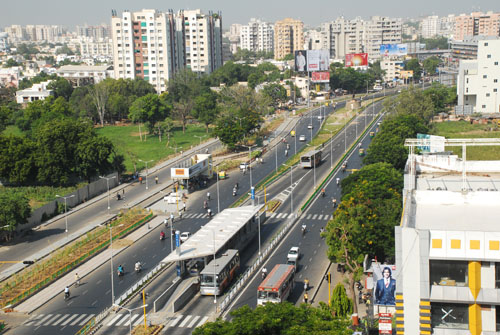 It seems the Bus Rapid Transit System (BRTS) has not only introduced a faster mass transport system with improved infrastructure but also systemized road traffic in Ahmedabad. If statistics of road accidents released in a Centre for Environmental Planning and Technology (CEPT) University study are to be believed, the number of accidents has gone down in stretches like Narol-Naroda in eastern Ahmedabad, earlier known as ‘killer road’.
According to statistics sourced from the Ahmedabad Traffic Department by Cept, at least 4 persons lost their lives in road accidents on the Narol-Naroda stretch every month – a total of 47, in 2006. The BRTS was introduced in the Narol-Naroda route towards the end of 2010, when two people were killed every month on the stretch. For the year, 24 people were reported dead in road accidents.
The study says the number of fatal accidents in 2011 has come down by 50%, as 12 people died in road accidents in 2011.
The number of serious accidents in the Narol- Naroda stretch in 2006 was 18, 9 in 2010 and 11 in 2011. The total number of accidents on the stretch has thus come down from 183 in 2006 to 151 in 2010 (when BRTS was launched) and 147 in 2011.
HM Shivanand Swamy, associate director at CEPT, said that the reduction in accidents is significant because the number of trucks plying on the Narol-Naroda stretch has not gone down.
«Around 30% of accidents on the stretch happen because of trucks. Despite the number of trucks remaining the same, accidents have gone down,» he said.
The reasons for fewer accidents could be improved road infrastructure on the BRTS route. Authorities say broad roads and barricades along the BRTS corridor have restricted citizens’ habit of driving on the wrong side and switching sides while driving.
«Now they have, perforce, to take a turn and use traffic junctions. Also, the junctions are well managed by the traffic police deputed there,» said Utpal Padia, executive director of the Special Purpose Vehicle, Ahmedabad Janmarg Limited (AJL).
SM Khatri, Deputy Commissioner of Police (DCP), Traffic, Ahmedabad, said that one of the reasons could also be that because of wide roads along the BRTS route, response time for emergency services has also gone down and so it is possible to provide medical help to accidents victim faster than before.
¿Comments? ¿Opinions? ¿Similar News? Send them to us!
Tweet
New Secretary-General-elect of the International Transport Forum: José Manuel Viegas
Source: International Transport Forum
Photo: International Transport Forum
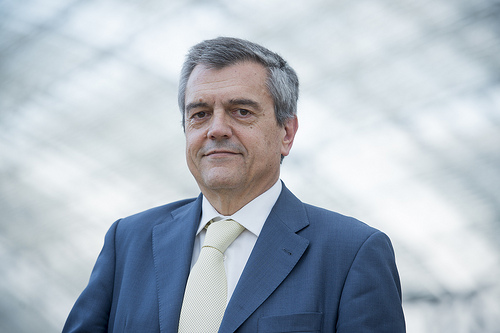 Paris/Leipzig, 3 May 2012 – Professor José Manuel Viegas, one of our members, has been chosen as Secretary-General-elect of the International Transport Forum, an intergovernmental organisation within the OECD family that acts as a global transport policy think tank.
At their Annual Summit in Leipzig (Germany), Ministers from the 53 member countries of the Forum chose Viegas as the next chief executive of the organisation. Viegas is expected to take up office this summer, taking over from Michael Kloth of Germany, who led the Forum as Acting Secretary-General since November of last year.
Secretary-General-elect Viegas said: “I am grateful to the Ministers for electing me as the new Secretary-General of the International Transport Forum. I look forward to make it a prime example of ‘network governance’, to foster innovative transport policies based on solid knowledge.”
Professor Viegas comes to his new leadership position at the International Transport Forum from an internationally recognized career as an academic and consultant. He is a professor of civil engineering at the University of Lisbon and the chairman of Transport, Innovation and Systems s.a. (TIS.pt) a transport consultancy firm. Viegas has worked in all transport modes and with numerous international organisations. In his career, he has frequently launched and managed collaborative networks across different countries as well as across different economic sectors engaged in transport issues. Viegas has also been responsible for technical, organisational and financial innovations in his projects. He also has a long and distinguished history of collaboration with the International Transport Forum and its precursor, the European Conference of Ministers of Transport.
¿Comments? ¿Opinions? ¿Similar News? Send them to us!
Tweet
Transportation and the New Generation: Why Young People are Driving Less and What it Means for Transportation Policy
Source: Center for Transportation Research News – The University of Texas at Austin
A new report released by the U.S. Public Interest Research Group Education Fund and the Frontier Group demonstrates that Americans have been driving less since the middle of last decade. The report, Transportation and the New Generation: Why Young People are Driving Less and What it Means for Transportation Policy, shows that young people in particular are decreasing the amount they drive and increasing their use of transportation alternatives.
Transportation and the New Generation reveals that for the first time since World War II, Americans are driving less. The report shows that by 2011, the average American was driving 6 percent fewer miles per year than in 2004.
This trend away from driving is even more pronounced among young people. The average young person (age 16-34) drove 23 percent fewer miles in 2009 than the average young person in 2001. The report also notes that a growing number of young Americans do not have driver’s licenses; from 2000 to 2010, the share of 14 to 34-year-olds without a license increased from 21 percent to 26 percent.
The full report can be accessed here.
¿Comments? ¿Opinions? ¿Similar News? Send them to us!
Tweet
Analyzing route choice decisions in Metro networks: A comparison between Santiago and London
Route choice modelling on metro networks
Route choice modelling on metro networks: A comparison between Santiago and London
Practical and empirical identifiability of hybrid discrete choice models
The formulation of hybrid discrete choice (HDC) models including both observable alternative attributes and latent variables associated with attitudes and perceptions has become a renewed topic of discussion in recent years. Even though there have been developments related to HDC model estimation and theoretical parameter identification, many practical and empirical issues related with HDC modelling […]
Opinion Pieces: The Challenge for the Infrastructure New South Wales Chief
Opinion Pieces: since 2007, Prof. David Hensher has written an opinion column in the Australasian Bus and Coach magazine, where he monthly discusses a lot of different transport-related hot topics. In this section we are revisiting these columns.
June 2011
The New South Wales (NSW) Government recently announced the appointment of Nick Greiner as the Chair of Infrastructure NSW. This is a critical appointment to direct the turnaround of NSW’s reputation in infrastructure provision, especially in the transport sector. The biggest challenge that will be faced in Sydney is how to move forward to deliver good transport coverage and service frequency in the face of a government commitment to announced major rail passenger projects. If one were able to start with a clean slate and be mindful of getting started sooner than later, and getting some real political mileage that is value adding to the electorate, there is no doubt that this is best achieved by a focus on upgrading the road network and using this opportunity to start assigning a substantial part of the road network as dedicated roads to buses (similar to what we are seeing with the Brisbane busway system) (with the possibility in off peak periods of giving access to taxis and hire cars), in contrast to painted bus lanes which appear and disappear throughout the network, forcing buses into mixed traffic just when they are getting a time benefit. Crucially, however, one must ensure that such a network lines up with meeting the growing accessibility needs of commuters in particular, where the test is in terms of door-to-door connectivity on high frequency, high service capacity (so one can sit) public transport. One will have to deliver some of this in tunnels (which buses can use) given the loss of transport corridors over the years. If the Chair is already constrained by two expensive rail projects (the NW and SW railways), then the network approach should still be proceeded with to ensure that these large projects do not hinder the needs to provide coverage and connectivity for all of Sydney where it can make a difference. Overlaying all of this physical network development must surely be a rethink about the low cost of using cars, which is the nemesis for public transport, and in many ways the efficient and fair pricing of the car use can be a significant part of the public transport solution. I recently calculated that if we were not the build the NW and SW railways, we could purchase 28,500 new buses for the equivalent projected capital cost, increasing bus service capacity 7.5 times (and even allowing for the operating cost differences, this number could be as high as 4 times, still impressive). That would surely deliver massive accessibility benefits to all of Sydney! For the rest of NSW, the focus must be on completing the Pacific and Hume Highways as dual carriage throughout.
Food for thought
¿Comments? ¿Opinions? ¿Similar News? Send them to us!
Tweet
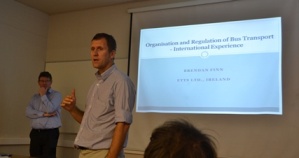
Brendan Finn visit to Pontificia Universidad Catolica de Chile
The PUC team received the visit of Brendan Finn the last week of March. Brendan Finn is a Civil Engineer with M.Sc. In Transport Engineering and Operations. He has worked for more than 30 years in the public transport sector, first with the public bus company in Dublin, Ireland, and since 1993 as an independent transport consultant. He specializes in public transport organization and operations, with particular interest in institutional and regulatory frameworks, operations management, BRT and ITS. He is currently working on BRT projects in Ghana and Philippines, and was co-editor of the EU COST Action Report on Buses with High Level Service (BHLS).
During his visit, he worked with the members of our Centre of Excellence, and also had the chance to present two seminars:
BHLS– Bus with High Level of Service: results on a study of BHLS in Europe.
Download presentation here
Organization and Regulation of Bus Transport – International Experience: comparative international study about:
– Roles and functions of passenger transport authorities
– Forms of regulation and market access
– Options for passenger transport institutions
Download presentation here
¿Comments? ¿Opinions? ¿Similar News? Send them to us!
Tweet
Analyzing route choice decisions in Metro networks
The Road Not Taken – Amman Bus Rapid Transit system
Source: Jordan Business by Hazem Zureiqat*
In three years of political turmoil and economic drift, Jordan has seen plenty of error. The decision to kill the Amman Bus Rapid Transit system is one such mistake. Hazem Zureiqat looks at the project’s inception. What went wrong and where do we go from here?
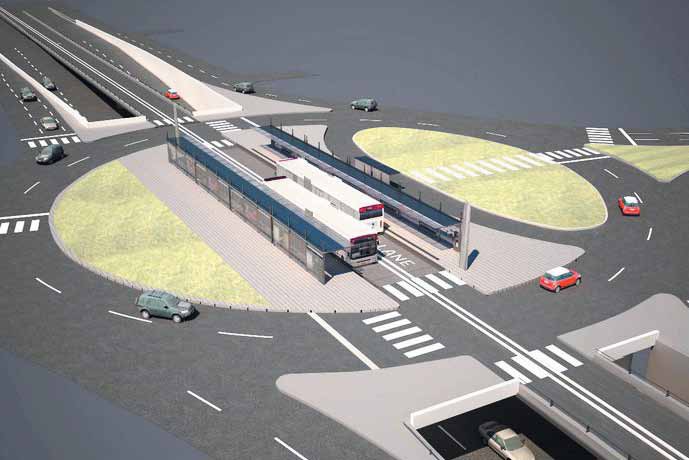
Rendering of GAM’s solution for the Press Tunnel. The BRT lanes will run on a raised structure above the tunnel and will then pass the intersection at street level. A BRT station will be located at the intersection.
Most of us have seen the abandoned two kilometers of bus lanes along Queen Rania Street. They are part of an ambitious 32-kilometer network of bus rapid transit (BRT). The Amman BRT project, known in Arabic as Al-Baas Al-Saree, has been a hot topic in the media and among the residents of Amman. Much has been said on the project and where it stands today, but truly understanding this particular issue requires taking a step back and looking at the bigger picture.
From Roundabouts To Rapid Transit
Urban transport planning, in its comprehensive and multi-modal context, has never really been part of the public discourse and policymaking in our part of the world. Some would even argue that this is the case for other forms of planning, be they physical or otherwise, but the absence of proper transport planning has been especially palpable in our oilrich region.
It is not hard to make out how this longstanding approach to doing things (or not doing them) has manifested itself in Amman. The city today is marred by countless bridges and tunnels. Sidewalks are, for the most part, ineffective, and pedestrian crossings are virtually non-existent. Public transport is in disarray, with over 70% of the fleet comprising of small service taxis or Coaster buses, many of which are individually owned and operated. With the rapid population growth the city has experienced, the size of our fleet of large buses remained constant between 2000 and 2010, after which an additional 116 buses were introduced. Meanwhile, car ownership levels in the city are increasing by an alarming 10% to 15% per year, even among households
with fairly low levels of income. At the same time, more than half of the city’s population is under the age of 25; add to that the increasing rate of female participation in the labor force, and what you get is nothing short of an explosion in future transport demand that no road widening, bridge or tunnel would be able to accommodate.
So, how did we get here? Firstly, we have been relying for too long on cheap oil from our neighbors, so building roads and importing more cars was the way to go, not just in Amman, but at the national level as well. Secondly, the institutional set-up was not designed to give the right incentives for policymakers at the municipal and national levels to think more systemically.
In Amman, traffic engineering and operations tasks, in addition to spatial and land-use planning, fell under the responsibilities of the Greater Amman Municipality (GAM), while public transport planning and regulation was under a different entity working at the national level, the Land Transport Regulatory Commission. Coordinating both functions was not easy across different bureaucracies.
Today, things have changed. We no longer have access to cheap oil – or at least not to the same extent as we did prior to the 2003 US-led invasion of Iraq. Prime Minister Awn Khasawneh recently reiterated this point in an interview on Jordan Television’s 60 Minutes. The premier cited the large number of cars that enter the Kingdom each year, adding that meeting the energy bill has become Jordan’s primary economic challenge.
The weak institutional set-up – the second reason listed above – has been addressed and we now have the right framework to think and plan in a more integrated fashion. In 2007, planning and regulation of public transportation within Amman became part of GAM’s responsibilities, and today GAM has one integrated Transportation Planning Department that deals with all modes of transport, from private cars to public transportation and pedestrians. More and more, decision makers and staff at GAM are becoming well aware that the problem in Amman is about moving people and goods, not just cars, and that our transport system needs to be more balanced and multi-modal and should be planned accordingly – all while taking into consideration changes in land use and zoning.
The question becomes then: what has happened since the institutional changes of 2007? GAM developed a Transport and Mobility Master Plan (TMMP) that outlined the city’s mobility needs for the period leading up to 2025. The study involved conducting a survey of around 10,000 households to assess their transport behavior. That survey, along with extensive traffic and public transport data collection across the city, created a rich database that formed the basis of the Amman transport model, a powerful planning tool that integrates transport, land use and socio-economic data.
As the outcomes of the TMMP began to emerge, it became clear that the city needed a higher order, namely a more rapid public transport mode. Several options were analyzed, and BRT emerged as the preferred option for Amman due to its low cost, effectiveness and relative ease of implementation given the city’s hilly terrain. BRT is a term used to describe public transport systems in which buses run on a segregated right-of-way, essentially offering a service similar to that of trains (but, clearly, at a fraction of the cost). A BRT lane in Amman can accommodate more than three times the number of people in a regular traffic lane. BRT was first implemented in Curitiba, Brazil in 1974, and has since been successfully constructed in over 120 cities worldwide. Often cited as one of the most successful examples, the BRT system in Bogotá, Colombia, has a current capacity of 45,000 passengers per hour in each direction, which is higher than the capacity of most metro systems worldwide.
Amman BRT And The Perfect Storm
In early 2009, GAM commissioned a comprehensive study to develop the BRT scheme for the city. The study aimed to first validate the BRT network developed under the TMMP and then to develop the complete service and operations plan for the system (in terms of number of buses required, frequencies of service, etc.). This would be followed by estimating the demand and revenue forecasts and operating costs; preparing an economic feasibility study and an environmental impact assessment; and finally, developing the detailed engineering designs for the infrastructure, from bus lanes to stations and terminals. Focus groups were held to obtain a better understanding of the problems people face when using different modes of transport. An additional survey was carried out at the University of Jordan, one of the key nodes along the BRT network, to ascertain what students felt they needed in a new public transport system.
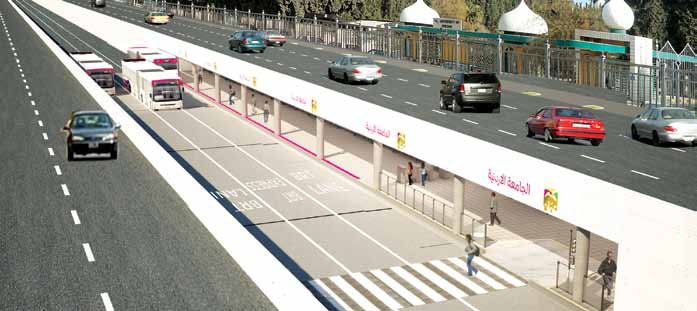
Rendering of the BRT station by the University of Jordan. This is the only underground station along the 32-km network.
As the economic and financial appraisal of the BRT began, work on developing the infrastructure design was undertaken in parallel. It was clear at the outset that the engineering design of a 32-kilometer network of exclusive bus lanes would be a challenge given the large number of grade-separated intersections (i.e. intersections with multiple levels) in Amman. Starting that process early on was, therefore, essential. As is the case with such complex projects, an iterative approach was adopted, so designs were constantly discussed and revised as work on other streams progressed.
Contrary to what many seem to believe, intersections such as the Press Tunnel and Sports City were tackled early on. Alternative solutions were analyzed based on various criteria, such as the level of BRT priority, accessibility to passengers, construction costs and impact on traffic during both construction and operations.
Throughout this entire process, the French Development Agency (AFD) was heavily involved in the appraisal of the project to ensure its feasibility, both economically and financially. After conducting a thorough financial audit for the municipality, the AFD and GAM signed a credit facility agreement under which the AFD would provide a $166 million loan to GAM to fund the construction of infrastructure for the Amman BRT. This was a soft loan that was offered directly to GAM with no sovereign guarantee from the Government of Jordan. It demonstrated AFD’s faith in the project and in GAM’s ability to pay off the loan in due course.
After detailed designs were completed for some sections along the BRT network, GAM began tendering out construction works. Construction of the first two kilometers along Queen Rania Street began in July 2010, and was completed the following year.
As the first package of BRT was being constructed, there was an unexpected turn of events. In May 2011, some members of parliament called for the BRT to be suspended. Some said it was a “failure” while others deemed it “unsuitable for Amman”. At the end of following month, then prime minister Marouf Bakhit formed a ministerial committee to reassess the project. During the same period, a number of media outlets, including a prominent daily newspaper, attacked the project as a corrupt and failed endeavor. The Audit Bureau, which had previously offered its seal of approval along various stages of the project, issued a report saying the BRT was “not feasible”. Not surprisingly, since the report was issued by an entity whose responsibilities never included preparing feasibility studies, the report lacked the basic elements of such studies and was erroneous in many respects, according to technical staff at GAM.
Meanwhile, the ministerial committee conducted a comprehensive review over the course of two months, looking at technical, financial and environmental aspects of the project. It issued a very positive assessment of the scheme and clearly stated that there was no evidence of corruption. This assessment was sent to the Cabinet of Ministers, which issued a very brief, weasel-worded decision on September 10, 2011, to temporarily suspend all construction works on the project pending further independent review. As of the date of this writing, this review has yet to take place.
It is difficult to frame such a bizarre turn of events within a rational context. Developments across the region took policymakers in Jordan by surprise. The decision-making process, already distorted at the time due to the lack of political reforms, became even more crippled. A haphazard fight against corruption put everyone and everything under question, creating an environment in which decision makers opted for stalling or adopting a more populist approach rather than performing their managerial duties as public officials.
The Amman BRT and perhaps GAM as an institution were easy targets. The biggest losers in all of this, however, are the people of Amman. Our ability to move around the city is at stake, and we should not remain silent.
* Hazem Zureiqat is a transport consultant working for Engicon, a multidisciplinary engineering consulting firm based in Amman. Prior to joining Engicon, he was part of GAM’s core transport planning team.
¿Comments? ¿Opinions? ¿Similar News? Send them to us!
Tweet