
Comparing operator and users costs of light rail, heavy rail and bus rapid transit over a radial public transport network
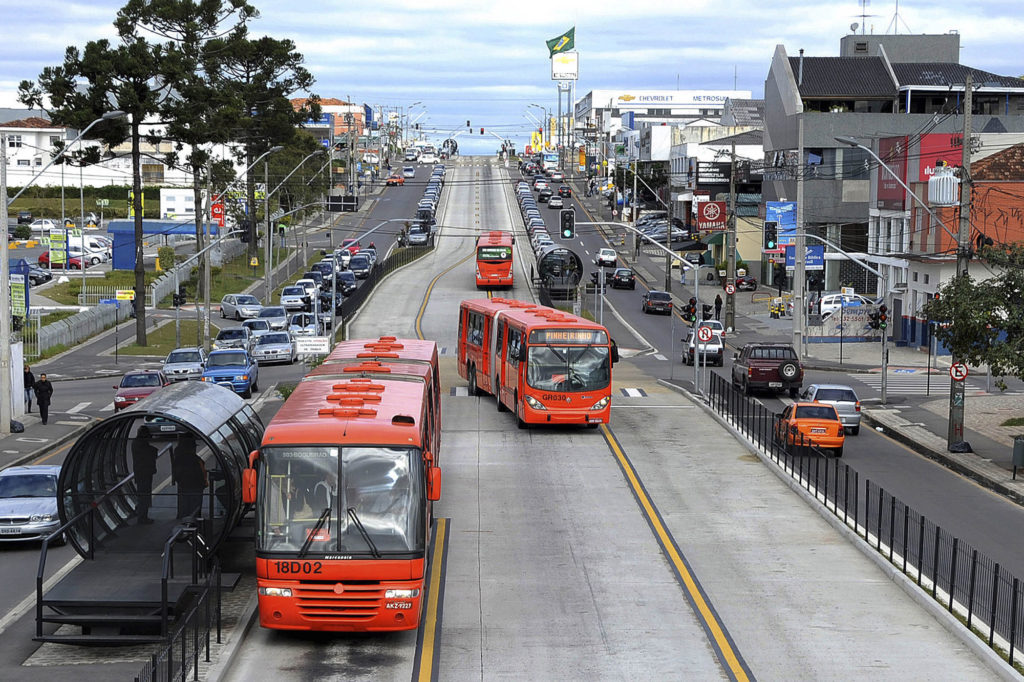
A model to compare three alternative forms of public transport – light rail, heavy rail and bus rapid transit – is developed for an urban network with radial lines emanating from the borders to the city centre. The theoretical framework assumes an operation aimed at minimising the total cost associated with public transport service provision, which encompasses both operator and users costs. The decision variables are the number of lines (networkdensity) and the frequency per period for each mode. This approach has no prejudices a priori in respect of whether a specified delivery scenario is aligned with existing modal reputation. Rather, we establish the conditions under which a specific transit mode should be preferred to another in terms of the operator (supply) and user (demand) side offerings. The model is applied using data from Australian cities, suggesting that in most of the scenarios analysed a high standard bus service is the most cost-effective mode, because it provides lower operator costs (infrastructure, rolling stock and operating cost), access time costs (due to a larger number of lines) and waiting time cost (due to larger frequencies of operation). A railmode, such as light rail or heavy rail, may have a lower total cost only if it is able to run faster than bus rapid transit, and the difference in speed is enough to outweigh the bus advantage on operator cost and access and waiting times.
Restating modal investment priority with an improved model for public transport analysis
We compare analytically and numerically the optimised performance of different urban public transport modes for three objectives: total cost minimisation, profit maximisation, and welfare maximisation. We find that under optimal operation, buses provide lower waiting time and operator costs, therefore the only possible advantage for rail is providing a lower in-vehicle time cost if trains are faster. Using Australian data, we found that bus rapid transit provides a lower total cost, higher profit and welfare, up to their capacity. Introducing passengers dislike of crowding and train-specific attraction elements might make Heavy Rail the most cost effective mode for high levels of demand.
Service reliability measurement using automated fare card data – Application to the London Underground
This paper explores the potential of using automated fare card data to quantify the reliability of service as experienced by passengers of rail transit systems. The distribution of individual passenger journey times can be accurately estimated for those systems requiring both entry and exit fare card validation. With the use of this information, a set of service reliability measures is developed that can be used to routinely monitor performance, gain insights into the causes of unreliability, and serve as an input into the evaluation of transit service. An estimation methodology is proposed that classifies performance into typical and nonrecurring conditions, which allows analysts to estimate the level of unreliability attributable to incidents. The proposed measures are used to characterize the reliability of one line in the London Underground under typical and incident-affected conditions with the use of data from the Oyster smartcard system for the morning peak period. A validation of the methodology with the use of incident-log data confirms that a large proportion of the unreliability experienced by passengers can be attributed to incidentrelated disruptions. In addition, the study revealed that the perceived reliability component of the typical Underground trip exceeds its platform wait time component and equals about half of its on-train travel time as well as its station access and egress time components, suggesting that sizable improvements in overall service quality can be attained through reliability improvements.
Reliability improvement in short headway transit services – schedule- and headway-based holding strategies
Improving service reliability is becoming a key focus for most public transport operators. One common operational strategy is holding. Holding vehicles can improve reliability, resulting in shorter travel times and less crowding. In this paper both schedule-based and headway-based holding strategies in short headway services are analyzed. Despite significant attention to holding in the current literature, some important aspects were not previously researched. The main new variables are maximum holding time, reliability buffer time, and, in the case of schedule-based holding, percentile value used to design the schedule. A real line in the Hague (Tram Line 9), Netherlands, and hypothetical lines are analyzed with various levels of running time variability. Headway-based and schedule-based holding have the largest effect if deviations are high. When schedule-based holding is applied with a maximum of 60-s holding time, the optimal value of the percentile value becomes about 65% for all lines analyzed. When no maximum holding time is applied, schedule-based holding is more effective; there is no difference when the maximum holding time is set to 60 s. This research also shows the effect of holding on crowding: an average level of irregularity of 20% could decrease to 15%, enabling either smaller capacity slack or less crowding.
Questioning the need for full amortization in PPP contracts for transport infrastructure
PPP contracts most often have durations of between 20 and 35 years, but in some cases even longer. The main reason for this is the wish of the Public side to minimize its financial contribution, by including in the contract many years of revenue generation by the project to help cover the investment contribution of the private partner. Implicit however is the need to fully amortize the initial investment, which in many countries is even included in the relevant legislation.
PPP contracts are normally framed around the delivery of a range of services during the lifetime of the contract, those services requiring the initial construction or recovery of an expensive infrastructure. The specification of the financial clauses of the contract requires the estimation of demand for those services over the period of the contract and this is usually taken as the major incidence of uncertainty in the contract. Indeed, experience shows that demand forecasts often fail substantially, in many cases by more than 20%, mostly by excess, as State side project promoters (and the bidding private partners) tend to be excessively optimistic about the development of such demand.
But when we consider the nature of these contracts we should recognize the existence of at least two other very important types of uncertainty: first, the socially desirable scope and specification of the services to be offered as technology and social preferences evolve; and second, the policy guidelines relative to the total quantity and the social distribution of those services, as that quantity may be causing congestion in other parts of the system, or it may become important to (positively or negatively) discriminate some user segments.
In both cases, it is almost impossible to foresee at the time of writing the initial contract if, when and in what direction such types of socially beneficial changes in the provision of the services would intervene, but this rigidness may bear a great loss of social welfare in relation to a more adjustable framework. This criticism affects not only PPPs but all kinds of concession contracts with long duration, so it is not the “partnership” element that must be questioned but rather the duration of the contract.
An alternative way is relatively straightforward: abandon the assumption that these contracts must provide full amortization of the infrastructure, which allows adoption of contracts with a shorter life, and the use of multiple such contracts over the lifecycle of the infrastructure.
The first generation contract would still have to face the full cost of the construction, but the private partner would receive the unamortized part at the end of that contract, to be paid by the State, directly from the public budget if no more private participation is wanted, or indirectly through the acquisition fee for the contract to be paid by the partner to the second life segment. But, crucially, the State recovers the right to re-specify the terms of the service to be provided without the need for any indemnity, and also the uncertainty associated with the evolution of demand in that period will be much smaller, as this will be my then a mature system in operation.
This may seem to increase the transaction costs for the State as more contracts (although of a similar type, especially from the second onwards) may have to be negotiated and signed. But if we take into consideration the difficulties of the frequently needed renegotiations of long duration contracts and the conditions of asymmetry of information in which the State normally finds itself in such cases, we will conclude that, besides avoiding the loss of welfare due to the poor fit of the contract after 20 years or so, this solution after all may also reduce the transaction costs associated with negotiations over the duration of the traditional contracts.